Post provided by Pasquale Raia (he/him), Alessandro Mondanaro (he/him) and Silvia Castiglione (she/her)
Quo Vadis? Latin for Where Are You Going? was a huge 1951 box office hit produced by Metro Goldwyn Mayer. The film (which is based on an 1896 book wrote by the Polish novelist Henryk Sienkiewicz) was set in ancient Rome during Nero’s reign and is credited for saving MGM from bankruptcy at the cost of a huge, neck-risking initial budget. The movie’s title refers to the apocryphal New Testament story telling about the encounter between Saint Peter and Jesus, where the former asks the Domine (the Lord) where he is going to. In biogeography, Quo Vadis? is a truly common question, mostly referring to ecologists and conservationists trying to figure out where species will go, or could go, stirred by the impending effects of the global change. The New York Times movie critic Bosley Crowther wrote about the MGM film that it brings a staggering combination of cinema brilliance and sheer banality. In biogeography’s shoes we see the same brilliancy, and yet very little triviality. Understanding how and where species will track their habitats is a critically important difficult question, if nothing else for the excruciatingly vital issue of understanding how high a price biodiversity will pay because of anthropogenic climate change and other human activities. The upended version of Quo Vadis, or where do you come from? (which translates in Latin as Unde Venis?) is much less awe-inspiring perhaps, but still hugely important. Understanding where species originated is key to appreciate which factors promote speciation, where are the sources of standing biodiversity, and why some groups of species sharing a common ancestor are incredibly diverse whereas others look cut down to the bone. And yet, for the vast majority of the species out there responding to such a simple question as Unde Venis? shrouds in mystery. Current methods sought to address the issue leverage phylogenetic relationships to reconstruct ancestral geographic ranges and identify the area of origin for species. These approaches typically discretize species current geographic distributions into distinct areas and then employ ancestral character estimation to infer the location at the time of speciation. While powerful and capable of accommodating diverse speciation modes, these methods inherently assume that present-day species ranges accurately reflects their historical and climatic associations. Thes assumptions can be problematic, as they often overlook complex metapopulation dynamics and histories, and the very fact that a species’ current range may be the relic of a broader, possibly fragmented, past distribution. Furthermore, the majority of these methods struggle to incorporate fossil data, a crucial source of information about species past distributions and their inner potential in terms of climatic adaptation, and cannot readily handle phylogenies that include extinct species. This reliance on extant distributions and the difficulty of incorporating fossil evidence create a persistent challenge in accurately reconstructing the evolutionary history of species ranges. We propose a new method written in R, named RRphylogeography, which addresses these shortcomings. Unlike traditional phylogenetic approaches that rely solely on current distributions, RRphylogeography integrates bioclimatic modeling to locate the potential habitat patches occupied by species throughout their evolutionary histories, known as species distribution modelling. This approach allows for a more dynamic understanding of range evolution, moving beyond the limitations of assuming current ranges are static reflections of past conditions. RRphylogeography identifies potential habitat patches at the time of speciation and then determines the patches most likely representing the true area of origin or zones of interspecies contact. Rigorous testing using virtual species simulations demonstrates RRphylogeography‘s better performance compared to commonly used historical biogeography tools. These simulations highlight the power of integrating bioclimatic modeling into ancestral range reconstruction, particularly in capturing the influence of past environmental changes on species distributions.

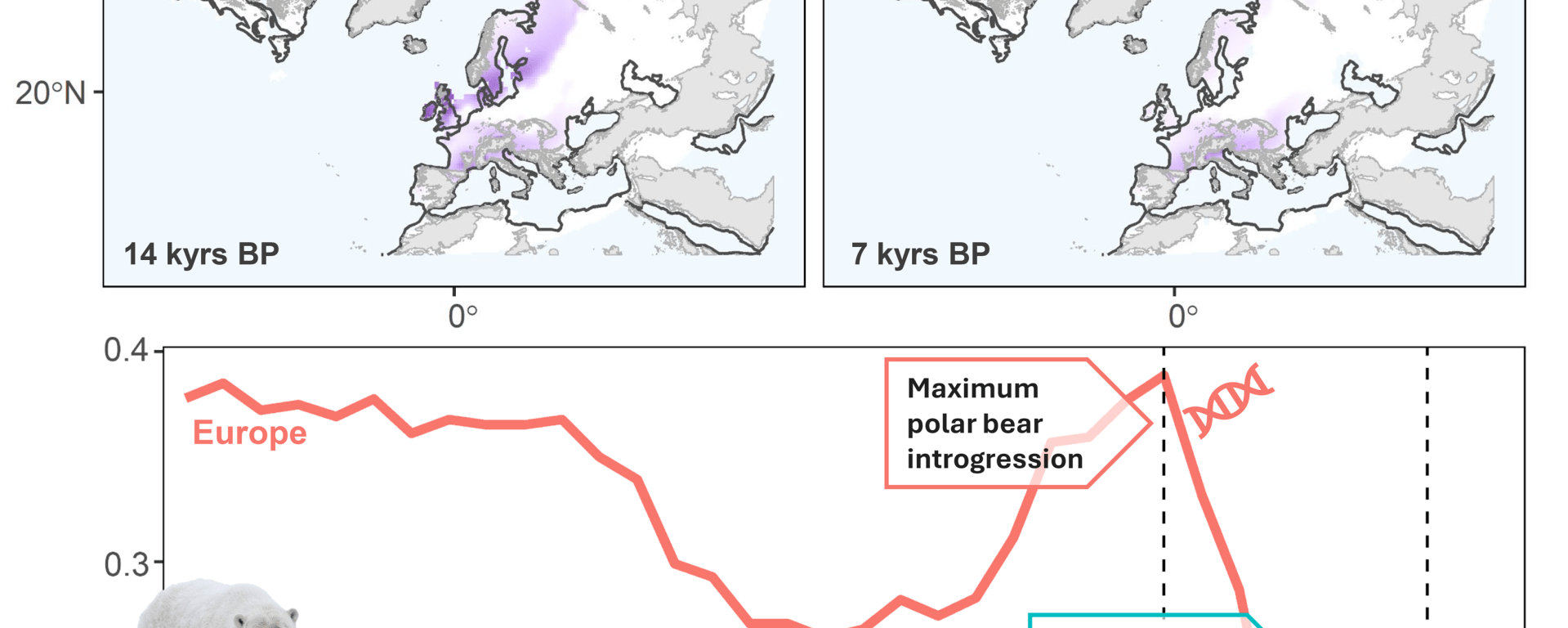
Craving to move from virtual species to more mundane examples, we decided to illustrate RRphylogeography proficiency in addressing a long-standing, intricate biogeographical question, that is the origin of polar bear (Ursus maritimus) and its history of past gene exchange with brown bear (Ursus arctos). We picked the polar bear case for no coincidence. The majestic apex predator of the Arctic ice carries within its genes a tale of evolutionary mystery. Several studies revealed gene flow with brown bears unconfined to the expected regions where their ranges overlap today. Remarkably, evidence suggests that this interbreeding occurred in unexpected locations such as Emerald Isle of Ireland and the remote Alexander Archipelago islands in Alaska. These instances of gene exchange paint a picture of a dynamic past, where polar and brown bears, despite their distinct ecological niches, occasionally crossed paths and shared their genetic heritage, adding another layer of complexity to the polar bear’s evolutionary story. In our study, RRphylogeography unsurprisingly pinpointed Northern Beringia as the most probable are origin of the polar bear. Intriguingly, RRphylogeography further revealed potential contact zones between polar bears and brown bears in northwestern Europe during the late Pleistocene and in Beringia during the Pleistocene-Holocene transition. These findings are remarkably consistent with the documented hybridization history between these two species, providing independent support for RRphylogeography’s ability to accurately reconstruct past interactions and range overlaps. This ability to recover known contact zones, alongside its superior performance in simulations, strongly suggests that RRphylogeography offers a substantial advance in the field of historical biogeography. If you are interested in historical biogeography at any level, and any Unde Venis? roams though your mind, we suspect you might want to give RRphylogeography a chance.
Read the full article here.
 Methods Blog