Addressing observational biases in data-driven approaches of zoonotic hazard prediction

Post provided by Andrea Tonelli Over the past five decades, more than half of emerging infectious diseases in humans originated from animals, with zoonotic pathogens posing a growing threat to global health. Shifts in land use, climate change, direct use of wildlife and biodiversity loss all influence human exposure to pathogens of wild animals, shaping the likelihood of zoonotic spillover events. In the wake of … Continue reading Addressing observational biases in data-driven approaches of zoonotic hazard prediction

Unde Venis Species? RRphylogeography, a new accurate method finds the area of origin of species

Post provided by Pasquale Raia (he/him), Alessandro Mondanaro (he/him) and Silvia Castiglione (she/her) Quo Vadis? Latin for Where Are You Going? was a huge 1951 box office hit produced by Metro Goldwyn Mayer. The film (which is based on an 1896 book wrote by the Polish novelist Henryk Sienkiewicz) was set in ancient Rome during Nero’s reign and is credited for saving MGM from bankruptcy … Continue reading Unde Venis Species? RRphylogeography, a new accurate method finds the area of origin of species

Into the Swarm-Verse: quantifying collective motion across species and contexts

Post provided by Marina Papadopoulou Authors We are three researchers interested in collective animal behaviour. Marina Papadopoulou is a postdoctoral researcher at Tuscia University in Italy, Simon Garnier is a Professor at the New Jersey Institute of Technology (USA), and Andrew King is an Associate Professor at Swansea University (UK). As a Greek-French-Welsh team with empirical, mathematical, and computational backgrounds in different study systems, we … Continue reading Into the Swarm-Verse: quantifying collective motion across species and contexts

It is only by understanding what causes sampling bias that we can correct it

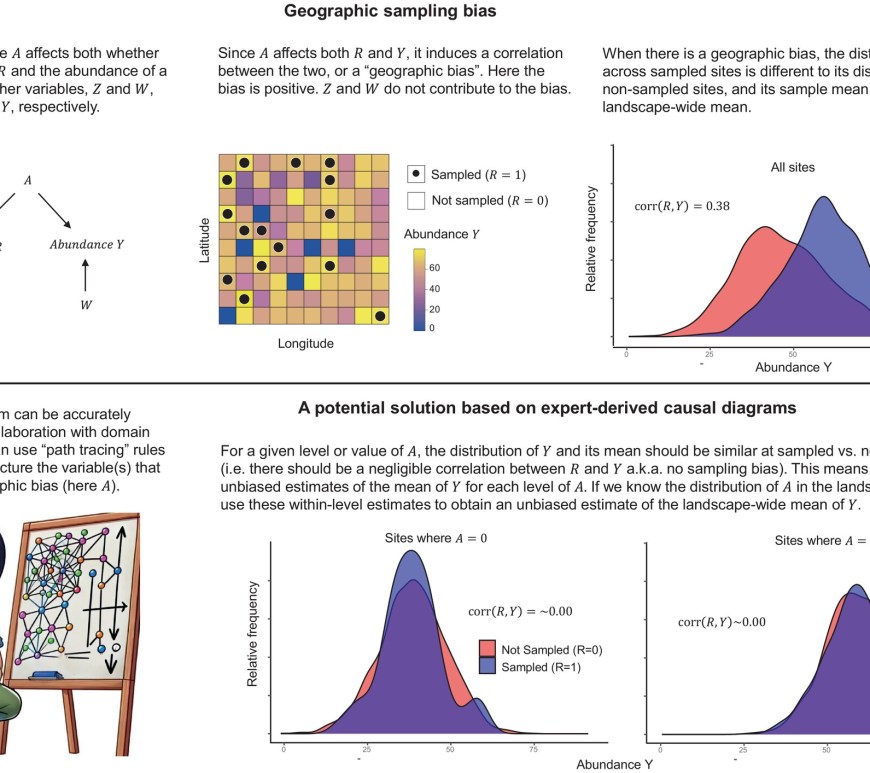
Post provided by Rob J. Boyd Colleagues and I recently published a paper in MEE, and its title might induce a bit of head scratching: “Using causal diagrams … to correct geographic sampling biases in biodiversity monitoring data” (Boyd et al., 2025). If you’re familiar with causal inference, you might be wondering, “What have causal diagrams got to do with sampling biases?” And if you’re … Continue reading It is only by understanding what causes sampling bias that we can correct it