What method has transformed your field the most, during your career?

In the 4th and final installment of Barb Anderson’s INTECOL 2013 podcasts, she asks a number of delegates: What method has transformed your field the most, during your career?

The answers in this podcast are given by the following people:

  1. Steve Hubbell, University of California, Los Angeles, USA (00.21)
  2. Georgina Mace, University College London, UK (00.44)
  3. Carsten Dormann, University of Freiburg, Germany (01.07)
  4. Continue reading “What method has transformed your field the most, during your career?”

If you could invent a method, what would it be?

At INTECOL 2013, Methods’ Associate Editor, Barb Anderson, interviewed a number of delegates and asked them: If you could invent a method, what would it be?

The answers in this podcast are given by the following people:

  1. Carsten Dormann, University of Freiburg, Germany (00.17)
  2. Helen Roy, Centre for Ecology and Hydrology, UK (00.36)
  3. Georgina Mace, University College London, UK (01.01) Continue reading “If you could invent a method, what would it be?”

What are the newest methods being used?

At INTECOL 2013, Methods’ Associate Editor, Barb Anderson, interviewed a number of delegates and asked them: What is the newest method that you currently use?

The answers in this podcast are given by the following people:

  1. Bill Sutherland, University of Cambridge, UK (00.18)
  2. Georgina Mace, University College London, UK (01.04)
  3. Simon Leather, Harper Adams University, UK (01.12) Continue reading “What are the newest methods being used?”

Issue 4.12

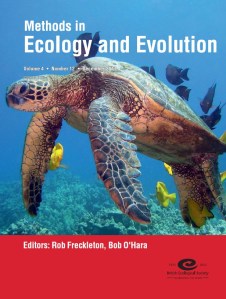
mee-4-12-coverlargeThe final issue of the year is now available online!

One of this month’s articles, ‘Calculating the ecological impacts of animal-borne instruments on aquatic organisms’ by Todd Jones et al., was picked up by the press after the University of British Columbia published the press release ‘Tagging aquatic animals can disrupt natural behaviour‘. Todd also summarises his study in an accompanying video which can be viewed on the Methods YouTube channel.

There are 2 freely available application articles included in this issue: ‘Animal social Continue reading “Issue 4.12”

An interview with the Tea Bag Index team

The Tea Bag Index is an innovative, cost-effective, well-standardised method recently covered in MEE, used to gather data on decomposition rate and litter stabilisation using commercially available tea bags as standardised test kits. In this video, David Warton interviews 2 of the authors, Joost Keuskamp and Mariet Hefting from Utrecht University, who explain how it works and what they plan to do with it in … Continue reading An interview with the Tea Bag Index team

Tagging aquatic animals can disrupt natural behavior

In this video Todd Jones gives a summary of his recent study, which aims to increase our understanding of the impact that carrying electronic tags can have on aquatic animals. Does the increased drag have power implications? Do the tags themselves affect the behavior of the animals? To answer these questions Todd and his colleagues made cast models of sea turtles and put them in … Continue reading Tagging aquatic animals can disrupt natural behavior

What are the oldest methods still being used?

At INTECOL 2013, Methods’ Associate Editor, Barb Anderson, asked a number of delegates: “What is the oldest method that you still use today?” This podcast includes the answers given by the list of people below.

Barb also produced podcasts about the newest methods currently being used, potentially useful methods that have not yet been invented, and the most transformational methods in various fields of research.

  1. Chris Thomas, University of York, UK (00.40)
  2. Sue Hartley, University of York, UK (00.46)
  3. Ken Wilson, Lancaster University, UK (00.53) Continue reading “What are the oldest methods still being used?”

An interview with Noel Cressie

In this video, David Warton interviews Distinguished Professor Noel Cressie of the University of Wollongong. Noel is a big name in spatial statistics, an advocate of hierarchical modeling in ecology, and the author of a key reference text in spatial statistics, and more recently “Statistics for Spatio-temporal data” with Chris Wikle; David and Noel discuss all of these topics in this interview. Continue reading An interview with Noel Cressie

An interview with Trevor Hastie

In this video, Methods‘ Associate Editor, David Warton, interviews Trevor Hastie, Professor of Statistics at Stanford University. Trevor is a leading figure in the discipline who has been instrumental in the development and uptake of a range of modern analysis methods, including generalised additive models, the LASSO, and boosting. Trevor talks about his recent paper “Inference from presence-only data; the ongoing controversy” with Will Fithian … Continue reading An interview with Trevor Hastie