
We’re excited to announce Willem Bonnaffé as the winner of the 2023 Robert May Prize, celebrating the best article in the journal by an author at the start of their career.
Winner: Willem Bonnaffé
About the Research
In previous work, Willem Bonnaffé and Tim Coulson showed how neural networks could be used in mathematical models to fill in the gaps in our understanding of the mechanisms that give rise to dynamical patterns we see in nature.
In this paper, they designed an algorithm that reduces fitting times from 15 minutes to 5 seconds (on the hare-lynx time series), by using neural networks to bypass numerical simulations. This makes it possible to tackle larger systems, which they demonstrate by estimating ecological interactions from time series in a 15-species aquatic community.
Beyond speed, their method deals automatically with uncertainty and model complexity through Bayesian sampling and regularisation. This makes it a powerful tool for population management, as the user can focus on monitoring and forecasting dynamics, leaving the difficult task of identifying mechanisms to the neural networks.
About the Winner
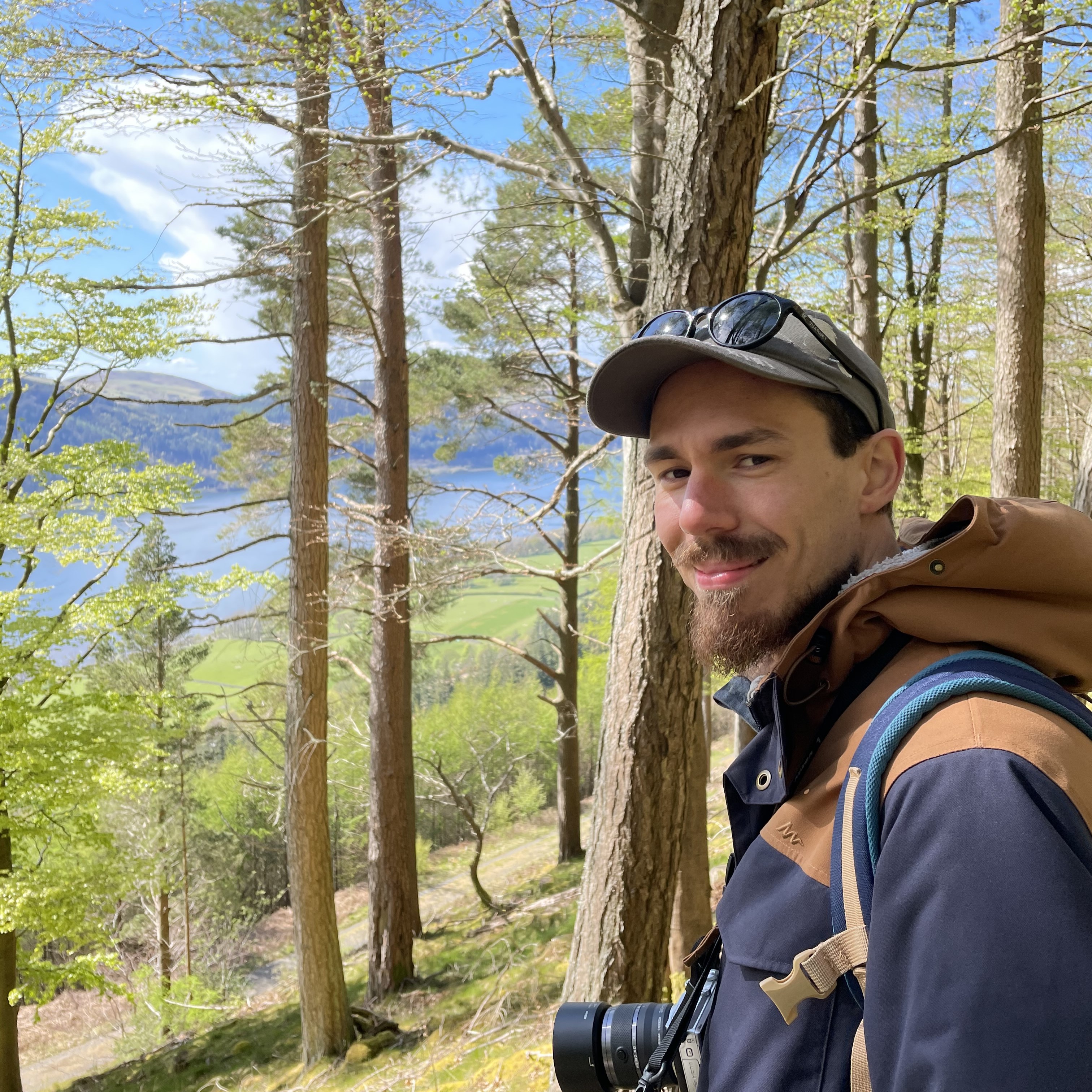
Willem obtained a BSc in Life Sciences at Université Pierre et Marie Curie, an MSc in Biology at Ecole normale supérieure, Ulm, and a DPhil in Zoology from the University of Oxford, where he is currently doing a postdoc. His research focuses on integrating mathematical models of natural systems with real-world data through Bayesian statistics and machine learning. His primary focus has been in embedding neural networks in dynamical system models to identify the drivers of spatial, ecological, and evolutionary dynamics. In addition to natural systems, he has recently started integrating these methods with deep learning models to study cancer evolution in digital pathology.
We asked Willem some questions about his research and career:
Could you give us a bit of background about yourself and how you got into ecology?
I spent a good part of my childhood exploring forests and rivers in rural France. I wanted a career that would allow me to maintain this connection with nature throughout my life, which led me to study Biology at university. During my bachelors, I was initially intimidated by the breadth and complexity of ecology as a research field. This changed during a lecture on ecological modelling which showed how the V-shaped flight formation of migratory birds could be explained by 3 basic rules. Since then, modelling natural systems to uncover their core functioning has been my obsession.
What did you enjoy most about conducting this research?
I am fascinated by the flexibility of neural networks and the promise of being able to analyse and forecast natural system dynamics without any prior understanding of what those might be. There will always be components of models which we do not have information on. Neural networks can fill in the gaps for us until we identify a suitable mechanistic theory, in a way that is analogous to random effects in linear models.

Were there any funny experiences or surprising discoveries from this research?
I accidentally came across this framework by trying to model the flight patterns of moths around street lights. I was not satisfied with the dynamics I obtained with simple parametric models and instead tried to plug a small brain (i.e. the neural networks) in the equations in order to train the moths to fly in a realistic way. I quickly realised that the power of the approach, as instead of the position of moths in space, we could model any ecological/evolutionary quantity, such as population densities, phenotype distributions… and that this all remains to be (re-)explored!
Have you continued this research and if so, where are you at now with it?
In my DPhil, I applied this methodology to estimate feedback effects between ecological and evolutionary change. Building on this work, I am currently integrating the framework with the Price equation, where the neural networks approximate fitness landscapes from time series data, and thereby fitness gradients, enabling us to assess how well phenotypic change tracks local fitness optima in nature.
Going forward, this work also makes it computationally feasible to develop more complex models to non-parametrically infer dynamics of structured populations. This would generate invaluable insights into population spatial dynamics and phenotypic evolution.
I am also exploring ways to combine this methodology with deep learning models and digital pathology to study cancer evolution. This would allow us to leverage the colossal databases with genetic and phenotypic information on multiple cancers, which may provide new insights into evolution and help improve patient care.
Find the winning article: ‘Fast fitting of neural ordinary differential equations by Bayesian neural gradient matching to infer ecological interactions from time-series data‘, as well as the shortlisted papers for the 2023 Robert May Prize in this Virtual Issue.
 Methods Blog