Post provided by Chris Barratt
Chris is a Researcher in the Animal Breeding and Genomics group (Centre for Genetic Resources Netherlands) at Wageningen University and Research, and a guest researcher at Naturalis Biodiversity Center in Leiden. Caught somewhere between being a quantitative geneticist, a spatial modeller and a conservationist, he is committed to finding new and interesting ways to integrate genomic data and predictive modelling to predict and reduce biodiversity loss.
Our recently published toolbox in MEE called ‘Life on the edge’ (LotE) can be used to predict population vulnerability by integrating genomic, spatial and environmental data. LotE is a pretty big and powerful beast, but don’t be scared – it’s a very flexible tool that is suitable for many different biological systems. We’ve created a pretty dense tutorial here, but we also wanted to introduce it more generally in this short blog to give some background to the work, outline why we think it’s an important step forward for the fields of ecology and evolution, and to get you inspired and thinking how you might be able to apply it your own datasets.
Before we dive in though, an acknowledgment… we did not completely reinvent the wheel with this work. I’m not just being British and overly-modest here, the ‘Life on the edge’ toolbox was a colossal amount of work, but despite not reinventing anything per se, we did spend a lot of time thinking of ways to connect many disparate analyses and methods, and how we can quantify and report this in a consistent, transparent and repeatable way. As such, we went to great lengths to create a framework that connects ecological and evolutionary research in a (hopefully) useful tool for the population genomics/climate change/conservation communities.
What is it and what does it do?
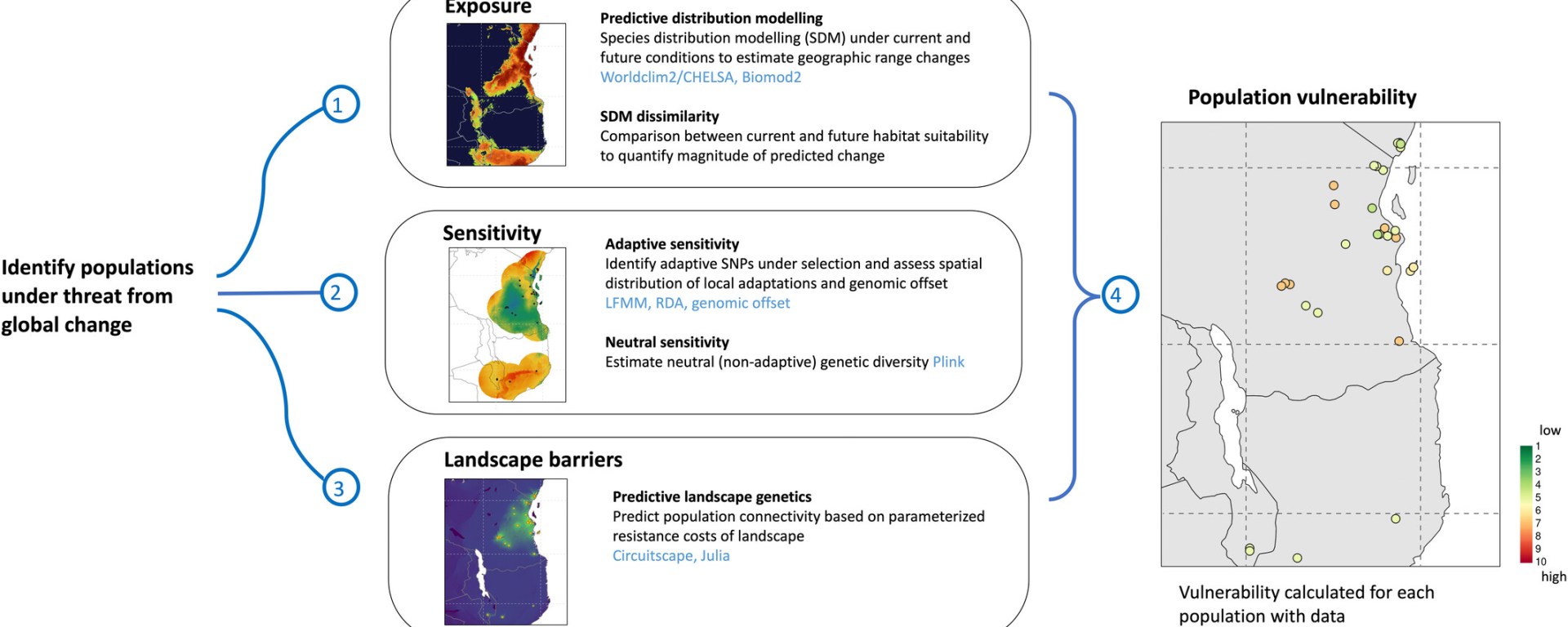
Life on the edge is a toolbox of interconnected R, bash and Julia functions and scripts which can be used to perform a number of tasks to evaluate how different populations within species might be affected by future global change. It runs from a parameter text file, where you can control up to almost 70 different parameters suitable for your study species (you can analyse many species with a set of parameters on a different line for each). With it, you can evaluate the spatial, environmental and evolutionary aspects of predicted changes between current and future environmental conditions using complementary data types, in line with the terms adopted by the Intergovernmental Panel on Climate Change (IPCC) in 2007. For example, you can evaluate how changing environmental conditions and habitat suitability (using Species Distribution Models) may affect populations (‘Exposure’), and you can model how future changes to the landscape and environmental conditions may impede gene flow between those populations (‘Landscape barriers’). At the molecular level, you can quantify neutral genetic diversity (‘Neutral sensitivity’) across populations as well as assessing local adaptations to their environment and how these genotype-environment associations may be affected by future environmental changes (‘Adaptive sensitivity’) in populations. LotE quantifies all of these metrics in a consistent way, and you can use them all together to create an index of ‘Population vulnerability’ and map this across your study region (see Fig. 1). Alternatively, you can use the individual metrics themselves to provide information on which conservation actions may be necessary for specific populations. For example, an isolated population with low gene flow to others and high climatic exposure might benefit from assisted migration. A population with higher gene flow to others and high adaptive sensitivity, on the other hand, might be suitable for protected area implementation or habitat restoration along connectivity corridors.

Why is this important – what’s new?
Given that you’re reading a British Ecological Society blog I probably don’t need to explain to you that there’s an ongoing biodiversity crisis – every day we lose some aspect of our biodiversity, and in most cases that lost biodiversity will never come back. Because biodiversity is crucial for the general health and sustainability of earth’s ecological systems, protecting it is critical for our own survival and to the legacy we leave for our children and future generations.
Climate change vulnerability assessments became popular in recent years to prioritise species for conservation actions, however there has been a growing recognition that populations are the first to be affected before we see wider scale species declines. The widespread adoption of high throughput sequencing data, which enable us to look into species’ populations, has been a major step forward in this respect. Despite new tools and frameworks being developed to enable assessment of population-level vulnerability, it’s always been tricky to fit code and scripts developed for one specific study system to a new one. This is where Life on the edge comes into its own – it’s completely standardised and takes in very simple data which can be easily generated for many species (as long as you have some good population genomic data!). In fact one of the main motivating factors for the project was that we saw how many wonderful datasets are being generated (our own included) to address a question (e.g. someone’s PhD thesis, or a short conservation genetics project), and then those data are published, archived and often never looked at again, and we wanted to find a way to be able to repurpose some of these data.
How can this be applied to your datasets?
To use it yourself the only things that are needed for you to run LotE on a species of interest are:
- Population genomic data [ PLINK .ped/.map format] – typically from RAD-seq/ddRAD/GBS style datasets
- Spatial coordinates of the genomic samples [decimal lat/long in .csv format]
- Environmental predictor data [e.g. Worldclim2 or CHELSA data in .asc raster format] that is ecologically relevant to your species
You’ll also need to provide a completed parameter file to run your species of interest, see the manuscript for a detailed breakdown.
This work has been an all-consuming labour of love for the past 3 years, so we’re very happy to now be able to share it – we hope that it can help and inspire your research and kickstart some new and interesting developments. The full article is here, the tutorial here for those of you who wish to go further down the rabbit hole. Please contact me if you have questions or you’re interested in developing additional tools that may support it!
Post edited by Lydia Morley
 Methods Blog
One thought on “Introducing ‘Life on the edge’, a new toolbox for predicting population responses to global change”