Post provided by Jonas Lembrechts.
Blogpost adapted from: www.the3dlab.org: Ten practical guidelines | The 3D lab
Ecologists and biogeographers are increasingly recognizing the critical role of microclimate in addressing a wide range of research questions. Consequently, many researchers are incorporating microclimate sensors into their studies. While deploying these sensors might seem straightforward—simply plugging them in and collecting data—there are numerous important factors to consider. Until now, however, a comprehensive guide to navigating these challenges has been lacking. Today, we are excited to share a major step toward achieving that goal: our new paper, “Ten practical guidelines for microclimate research in terrestrial ecosystems“, is now published in Methods in Ecology and Evolution.
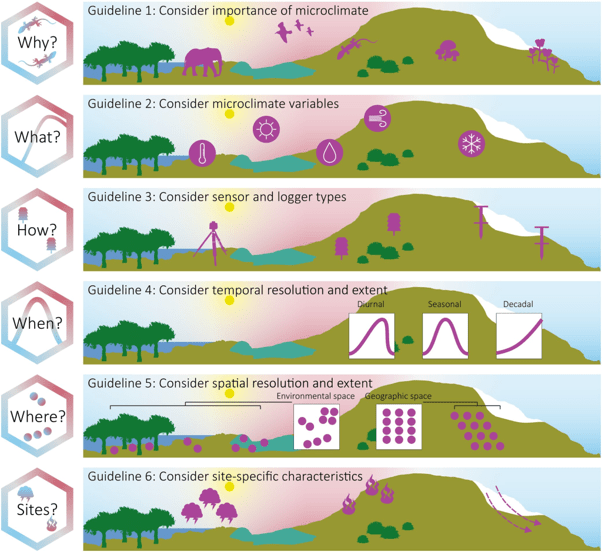
This paper provides exactly what every graduate student and researcher in ecology and biogeography has been waiting for: a comprehensive guide on everything you need to consider when integrating microclimate monitoring into your research. From defining why you need microclimate data, to determining what and where to measure, and deciding on how and when to collect your data, this paper has it all. It doesn’t stop there either: it also walks you through compiling, analyzing, and publishing your microclimate data in ways that maximize impact and accessibility.

It’s quite the giant of a paper as well, trying to go sufficiently in depth with all these aspects of the question to have practical relevance, and to really put you on the road to a successful microclimate project.

Where to measure?
One of our favourite parts of the paper – to name just one – focuses on where to measure microclimate. This section emphasizes the importance of matching spatial resolution and extent to the scale at which your study organisms experience their environment. It highlights the nested, hierarchical nature of microclimates: locally measured conditions (e.g., temperature, moisture, wind) are shaped by a combination of local, regional, and global climatic signals.

That chapter explores the concept of proximal microclimate, which refers to how closely microclimate measurements represent the actual conditions experienced by organisms. Proximal microclimate goes beyond simply placing sensors: it considers both the spatial and temporal alignment of measurements with biological processes. By addressing this, researchers can better connect microclimate data to ecological responses.
Additionally, we introduce practical approaches like stratified random sampling to select logger locations. This technique helps ensure that you capture as much environmental variation as possible, maximizing the value and representativeness of your dataset
No ‘one-size-fits-all’ solution—and that’s okay!
Importantly, the paper doesn’t promise a single ‘golden rule’ to every microclimate monitoring challenge. There’s no universal sensor, setup, or methodology that works for all studies—and that’s because each research question is unique and the microclimate of each study object and area is unique. What the paper does offer is a clear framework to help you identify the best strategy for your specific case, taking into account the unique characteristics of your study system.
Building on the latest advances in microclimate research
In addition to its practical advice, the paper builds on the latest advances and literature in microclimate science, making it an invaluable resource for both beginners and experts. It not only provides you with step-by-step guidance but also connects you to a carefully curated list of must-read references in the field that dive for instance, into the importance of microclimates and the different remote sensing and field techniques.
As you can expect, we are incredibly excited about this paper finally seeing the light of day, and hope it will inspire and support researchers around the world in designing successful studies involving microclimate data.
The authors are the steering committee of the SoilTemp-network (www.soiltempproject.com) and invited experts in terrestrial microclimate ecology. One of the biggest dreams when we started the SoilTemp project was not only to bring together all available microclimate data into a single, unified database, but also to align how we think about and measure microclimate. This paper is a major milestone of the latter ambition.
The majority of the 27 authors of this review represent different disciplines within ecology, and they chiefly study microclimates and plants of the forest, grassland, and tundra biomes. The authors represent different institutes, career stages, and genders. We summarize the key demographics of our authorship in the supplementary material, to be open about where our insights come from.
 Methods Blog