This issue contains the latest methods in ecology and evolution. Read to find out about this month’s featured articles and the article behind our cover!
Featured
Ten practical guidelines for microclimate research in terrestrial ecosystems
This review presents 10 practical guidelines for ground-based research of terrestrial microclimates, covering methods and best practices from initial conceptualisation of the study to data analyses. The guidelines encompass the significance of microclimates; the specifics of what, where, when and how to measure them; the design of microclimate studies; and the optimal approaches for analysing and sharing data for future use and collaborations. The paper is structured as a chronological guide, leading the reader through each step necessary to conduct a comprehensive microclimate study. The authors also discuss further research avenues and development in this field.

Single‐egg comet assay: A protocol to quantify DNA damage in natural bioarchives
The comet assay (CA), originally developed as toxicity test, quantifies DNA integrity from DNA distribution across an electric field. However, the CA has never been applied to dormant eggs of aquatic taxa archived in lake sediments. Salimraj et al. aimed to adapt and optimise a CA protocol for such dormant stages using Daphnia eggs as a model. Their protocol provides a cost-effective method of assessing DNA damage in sedimentary propagules. More generally, it is applicable to testing DNA integrity in individual propagules prior to genome sequencing or to quantify environmental impacts on natural sedimentary biobanks.

ChirpArray: A low‐cost, easy‐to‐construct microphone array for long‐term ecoacoustic monitoring
This study introduces ChirpArray, a cost-effective and easily assembled microphone array for long-term ecoacoustic monitoring of outdoor ecosystems. The ChirpArray system features a four-channel microphone array that estimates sound source directions, aids in identifying individual animals and provides a detailed behavioural analysis. ChirpArray features low power consumption, low cost, and high customizability, making it ideal for long-term, multipoint ecoacoustic monitoring with the advantages of multichannel recordings.

Using causal diagrams and superpopulation models to correct geographic biases in biodiversity monitoring data
This study combines causal diagrams with ‘superpopulation models’ to correct time-varying geographic biases in biodiversity monitoring data. Boyd et al. assume that a time trend in the mean of Y across all sites in the relevant landscape is the target quantity, and it is estimated by fitting separate superpopulation models for each of several time-periods. They test the approach using simulated data then apply it to real data from the UK Butterfly Monitoring Scheme (UKBMS).

The Wayqecha Amazon Cloud Curtain Ecosystem Experiment: A new experimental method to manipulate fog water inputs in terrestrial systems
The amount and frequency of fog immersion are affected by rapid ongoing anthropogenic changes, but the impacts of these changes remain relatively poorly understood compared with changes in rainfall. Here, authors present the design and performance of a novel experiment to actively manipulate low lying fog abundance in an old-growth tropical montane cloud forest in Peru. They present the results of 2–7 years of monitoring of a range of climatic variables within the fog exclusion treatment plot and an adjacent unmodified control plot. Discussing the opportunities and challenges of adapting the approach to other environments and experimental designs.

Cover Image

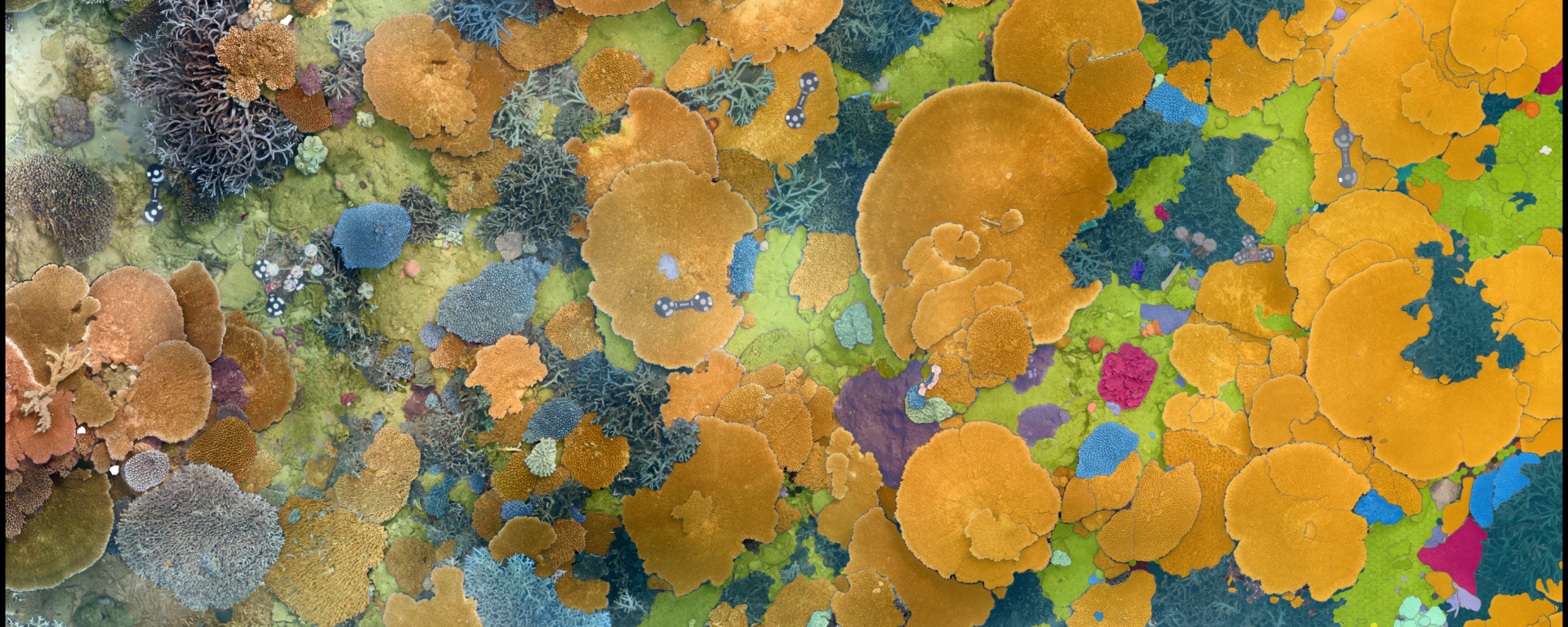
This month’s cover image features a 72 square meter orthomosaic of a coral reef automatically segmented and classified using RapidBenthos. Developed by Remmers et al., this innovative workflow uses machine learning for feature extraction and analyses of photogrammetric data from underwater orthomosaics of coral reefs. The automated workflow integrates the Segment Anything Model (SAM) and ReefCloud point annotation in a two-stage process: (1) employing a pre-trained, open-source machine learning segmentation model, which removes the need for users to manually generate fine-scale segmented training data, and (2) classifying the resulting segments using the underlying survey images from multiple viewpoints, achieving classification at higher taxonomic levels. This study demonstrates that artificial intelligence tools can automatically and reliably extract data from orthomosaics with an unprecedented level of taxonomic detail and accuracy. While the approach has been developed and tested on images from a shallow coral reef, it has the potential to be applied to any ecosystem monitored via photogrammetry and is scalable for large-area applications. Such advancements enable the sustainable scaling of photogrammetric monitoring techniques, offering a more comprehensive understanding of coral reefs community composition and habitat. In turn, this will inspire new research questions, enhance ecosystem models, and support improved ecosystem management.
 Methods Blog