Post provided by Brendan Carswell.

Brendan (he/him/his) is currently a PhD student in Biology at the University of Calgary in the Weaving Wildlife and Land Based Knowledges lab. This paper, however, came from Brendan’s Masters work at the Memorial University of Newfoundland and Labrador in the Wildlife Evolutionary Ecology Lab.
Motivation
Our research team is interested in facilitating inclusive and accessible wildlife management across Canada. Understanding how many animals are in an area, that is, density or abundance estimates, is perhaps the most critical aspect of making wildlife management decisions. For large-bodied ungulate species in Canada, such as moose or elk, density estimates are generally achieved through aerial flight surveys. Aerial flight surveys have a high logistical and financial constraint, and as a result, are generally only conducted by colonial governments in Canada. Such logistical and financial barriers prevent other rights-space or interest-space holders, such an Indigenous Nations, non-profit organisations, or wildlife advocates from collecting knowledge or participating in wildlife management decisions.https://www.menzieslab.ca/
Wildlife density estimation using camera traps
Using remote camera traps (aka game cameras) to estimate wildlife species density is a relatively novel set of methods that could potentially alleviate some of the logistical and financial constraints imposed by aerial flight surveys. For example, camera traps can be purchased by anyone, are easy to set up and use, and do not require hiring a trained pilot to capture photographs. Many different methods, which incorporate different processes and hold different assumptions, exist that can use data collected from camera traps to estimate wildlife species density. Our research group, however, was interested in two particular methods of camera trap-based density estimation—the Random Encounter Staying Time (or REST) and the Time in Front of Camera (or TIFC) models.
In essence, both the REST and TIFC models require precise calculations of the time camera traps were active and the space camera traps monitor to accurately estimate density. Calculating how long a camera trap is active is incredibly easy, and as long as no batteries failed, a camera would be active for every second that it was deployed. Determining how much space a camera monitors, however, is a different story. All camera traps will have a pre-programmed maximal area they can monitor, that is, their field of view (see photo below).

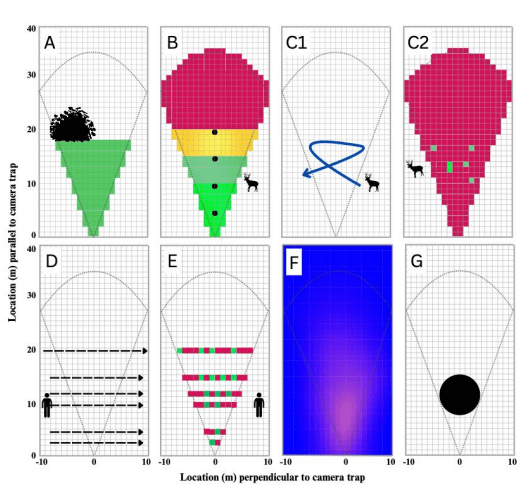
The maximal area a camera trap can monitor, however, is not reflective of the realised area a camera actually monitors when considering the influence of vegetation, topography, weather, time of day, etc. Many methods exist to estimate the space a camera trap can monitor, however, each method has its own limiting assumptions which influence their ability to be applied to different camera trap projects. No method to estimate the space cameras monitor, including our own developed here, is perfect and no method can address all underlying assumptions. Yet, each method to estimate the space cameras monitor has its own utility and unique applications. Our method specifically addresses the assumption of missed captures, that is, when an animal was present in front of a camera but no photograph was captured (e.g., see photos below).

Realised Viewshed Size
The metric we developed in this paper, the Realised Viewshed Size (RVS), is the first to intentionally account for missed captures when estimating how much space a camera can monitor. We achieved this through standardized field procedures where we jogged along fixed transects in front of dozens of camera traps.

Jogging in front of cameras was not always easy, especially considering we conducted most our trials during the winter. I fell into the snow, tripped on my snowshoes, or got caught in the shrub many times. Thankfully, all instances where we had tripped and fallen into the snow or bushes were never captured by the cameras—maybe wildlife species trip more than we think!
As we discuss in our paper, there are numerous, interacting conditions that will affect the functionality of a camera trap and thus the space it is able to monitor. Such factors might include fine-scale weather such as fog, time of year, and even how the thickness of animal fur interacts with the camera traps sensor! We hope future work on our method can refine estimates of RVS to account for such fine-scale factors and thus improve the quality and rigor of camera trap science.
Many camera trap-based studies are limited in management and processing of photographs, especially when post-hoc implementing a method to estimate the space a camera monitors. Conducting our RVS method is incredibly easy when practitioners are setting up their camera traps in the field, and in many cases, field trials would only need to occur once. Thus, our a priori field method to estimate the space a camera monitors can help alleviate photograph processing constraints as well as increase the precision and accuracy of some camera trap-based density estimation methods.
Read the full article here!
Post edited by Sthandiwe Nomthandazo Kanyile.
 Methods Blog