This issue contains the latest methods in ecology and evolution. Read to find out about this month’s featured articles and the article behind our cover!
Featured
The fallacy of single imputation for trait databases: Use multiple imputation instead
The past few years have seen the publication of many new trait databases. However, trait databases usually have many missing data. Biologists have developed several methods to impute missing values, allowing ordinary statistical procedures to be used in analyses and the use of only complete cases, with a concomitant loss of power and accuracy, can be avoided. Often, biologists use simulation to test new methods by deleting values from a dataset and recording how well the imputed values match the known, removed values. Here Blomberg and Todorov argue that this is a poor measure of the strength of an imputation method. They also describe the importance and logic of the statistical procedure of multiple imputation, which requires that the imputations need not be precise or accurate estimates of the missing data.
mtGrasp: Streamlined reference‐grade mitochondrial genome assembly and standardization to enhance metazoan mitogenome resources
High-quality, accessible mitogenome sequences are crucial for comparative genomics, phylogenetic constructions and environmental DNA (eDNA) applications. In their paper, Lopez et al. present the Mitochondrial Genome Reference-grade Assembly and Standardization Pipeline (mtGrasp), a streamlined and high-throughput mitogenome assembly utility. mtGrasp enables streamlined processing from de novo assembly of the short reads to mitogenome circularization and standardization. Its standardization feature can also be used as a standalone tool to process existing mitogenomes, including those deposited in public archives. As open-source software for complete and standardized mitogenome assembly, mtGrasp is an effective tool to facilitate eDNA studies among other applications.

Innovative chips for coral cultivation: Enhanced flexibility and experimental applications
Since the report of the coral-on-a-chip platform in 2016 by Shapiro et al., modifications of coral microfluidic chips have been reported for various experimental purposes. Here, Chuang et al. present two new coral chips that enable long-term (over a month), stable coral cultivation in the laboratory without laborious maintenance. Authors conducted experiments on coral responses to environmental stresses, exemplified using several physical, chemical and biological factors. Results from this study offer strong support for the applicability of their millifluidic system as an alternative platform for coral research. The miniaturized system presented here considerably extends the applicability of existing coral cultivation chips and provides a convenient, cost-effective and environmentally friendly platform for future coral studies.

The rarity of mutations and the inflation of bacterial effective population sizes
Mutations are common in mathematical models of population genetics, and ways to model them vary depending on assumptions of their frequency and timescale over which they take place. By examining mutation rates and effective population sizes across the Tree of Life, Borges demonstrates that the boundary mutation (BM) model remains valid for most species but significantly deviates in bacteria. Analyses further reveals that the BM model tends to overestimate the effective population size, particularly in bacteria. They address these biases by proposing a Bayesian estimator for population size that accounts for recurrent mutations. They further present a case study showing that the BM model exaggerates the intensity of selective constraints acting on the three codon positions of the bacterium Pseudomonas fluorescens. This study emphasizes the importance of considering recurrent mutations in highly diverse species for accurate population genetics inference.
Benchmarking tree species classification from proximally sensed laser scanning data: Introducing the FOR‐species20K dataset
This study, addressing the need for benchmarked individual tree species classifiers, is part of a broader effort to automate forest ecosystems characterization using proximal laser scanning data. Puliti et al. compiled the FOR-species20K benchmark dataset, consisting of individual tree point clouds captured using proximally sensed laser scanning data from terrestrial (TLS), mobile (MLS) and drone laser scanning (ULS). They also establish a baseline by benchmarking current state-of-the-art DL models, underlining the importance of moving towards platform- and sensor-agnostic models. The FOR-species20K dataset serves as a crucial foundation for future efforts to classify accurately and map tree species at various scales using laser scanning technology.

Linking relative suitability to probability of occurrence in presence‐only species distribution models: Implications for global change projections
Here, authors test how the function used to convert relative suitability to probability of occurrence in presence-only species distributions models can affect predictions of both the magnitude and location of biodiversity change. They use a back-casting analysis to compare how well different functional forms for translating relative suitability to probability of occurrence recapture observed changes in probability of occurrence for 354 North American bird species between 2019 and 1981. They then explore how the choice of these different functional response curves may bias our expectations of biodiversity responses to climate change, and then finally, they explore what steps we can take to minimize these biases.
Cover Image

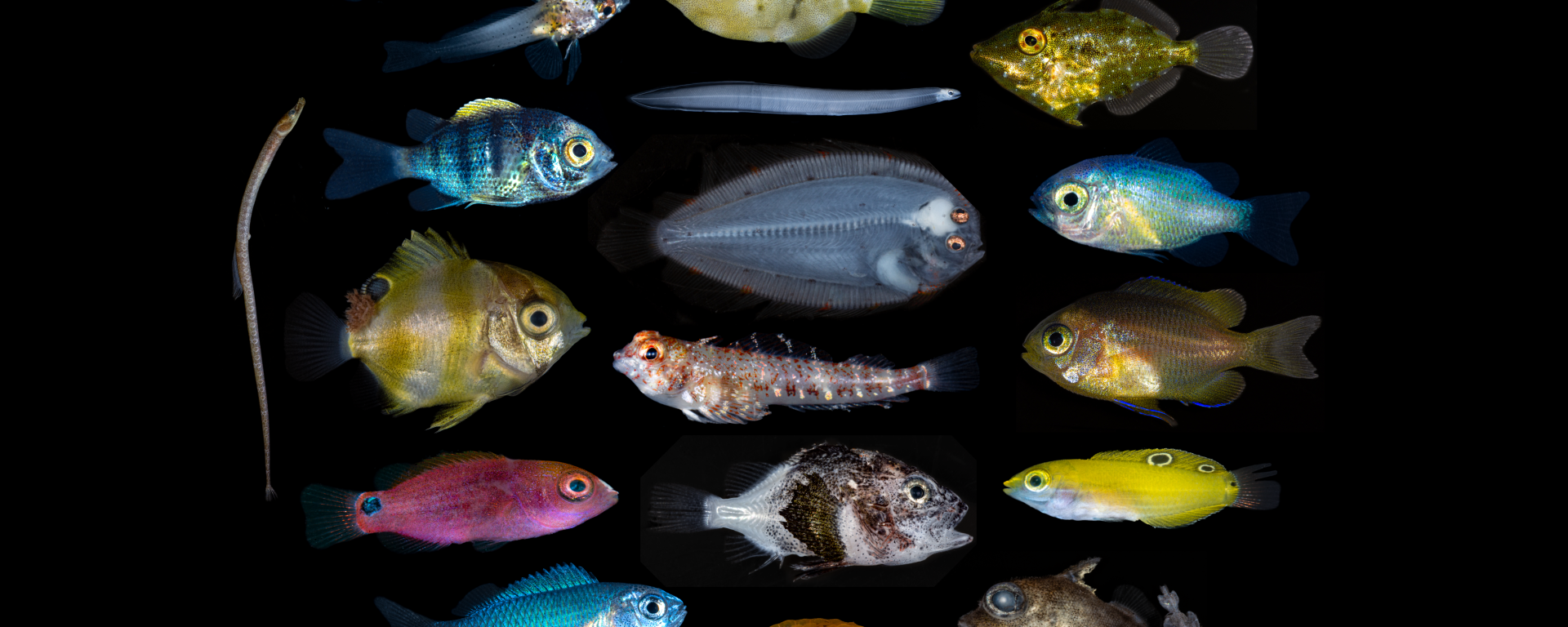
The early life stages of most coastal marine fishes indeed take place in the open ocean before larvae or juveniles start orienting toward the coast to settle after an average of 30 days (min-max: 4 to 467 days). This highly dispersive stage (up to thousands of kilometers) compared to the small-scale movements by adults (generally less than ten meters) ensures the crucial role of maintaining gene flow between distant populations which notably drastically shaped current biogeographical patterns. The dispersal potential conferred by ocean currents is further enhanced by amazing orientation abilities associated with exceptional swimming skills as demonstrated by Ruiz et al. with their new system to precisely quantify these behaviors in the wild. This mandala provides a brief overview of the great taxonomical (22 out of >300 species) and morphological diversity of fishes during or shortly after metamorphosis sampled in two different oceans. Soon after capture, Ruiz et al. released settlement-stage individuals from some of these species to track them while diving equipped with a high-frequency logger and a flowmeter for 3D position recording. Here are names from species represented, belonging to 15 different families, by columns (top to bottom from left to right): Bryx dunckeri (Guadeloupe), Petroscirtes mitratus (Maldives), Parapercis hexophtalma (Maldives), Abudefduf vaigiensis (Maldives), Chaetodon striatus (Guadeloupe), Cirrhilabrus exquisitus (Maldives), Pomacentrus pavo (Maldives), Scarus rubroviolaceus (Maldives), Halichoeres hortulanus (Maldives), Paraluteres prionurus (Maldives), Conger conger (Mediterranean Sea), Bothus ocellatus (Guadeloupe), Enneapterygius abeli (Maldives), Scorpaena plumieri (Guadeloupe), Acanthostracion quadricornis (Guadeloupe), Ophichthus cylindroideus (Guadeloupe), Macropharyngodon bipartitus (Maldives), Monacanthus ciliatus (Guadeloupe), Chromis viridis (Maldives), Stegastes bipartitus (Guadeloupe), Halichoeres leucoxanthus (Maldives), Canthidermis maculata (Guadeloupe). Some fish also come with their parasites such as cnidarian polyps (Larsonia/Hydrichthys sp.) on Chaetodon striatus or blood-sucking crustaceans (Caligus sp.) on Canthidermis maculata
Read the article here.
 Methods Blog