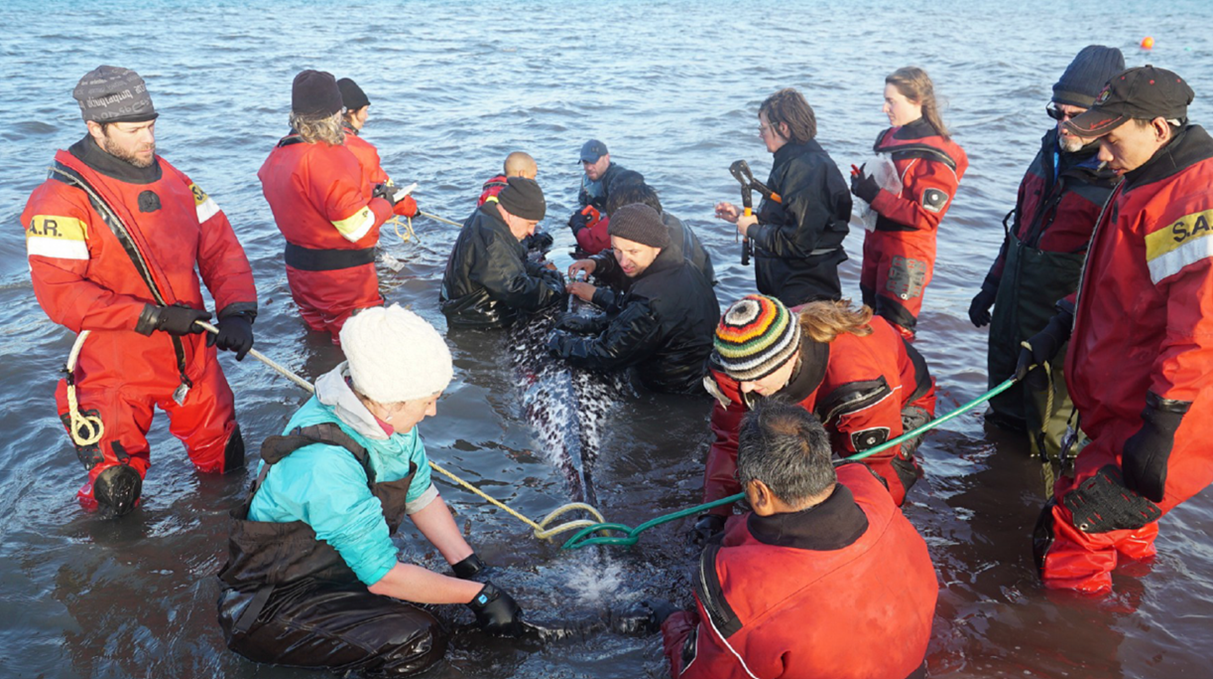
Post provided by Fanny Dupont.
About the first author
My PhD focuses on animal movement and the impact of vessels on Arctic marine mammals (lab website). Specifically, I develop statistical tools to analyse narwhal (Monodon monoceros) behaviour and assess the effects of increased shipping on marine ecosystems. I am co-supervised by Dr. Marie Auger-Méthé (University of British Columbia) and Dr. Marianne Marcoux (Fisheries and Oceans Canada).


Narwhals hold deep cultural significance for Inuit communities, who rely on them for subsistence, cultural practices, and traditional knowledge. Narwhals are facing many threats due to declining sea ice, which has led to increased predator presence and ship traffic in their habitats. Our joint work with Dr. Nigel Hussey focuses on uncovering how these changes are affecting narwhal behaviour and distribution, providing critical insights to support their conservation.
Observing the Unseen: the challenge of studying marine mammals.
“Understanding animal behaviour is an essential step in assessing how human-induced changes, like climate change, are affecting animals” says Dr. Marie-Auger Méthé. However, marine mammals live in aquatic and remote habitats, making direct observations very difficult and leaving ecologists with one problem: how to understand the behaviour of animals we can hardly observe? Researchers rely on advanced tracking technologies, such as satellite tags, to collect data (e.g., time-series of location, depth) from afar. As tagging efforts have increased, the volume of data collected has grown significantly, providing unprecedented opportunities to analyse animal movement and behaviour. But with the growing volume of complex data, the question becomes: how do we analyse them effectively?

Hidden Markov Models: a powerful but complex tool to analyse movement data.
Hidden Markov Models (HMMs) are powerful tools for analyzing time series data, especially in ecology, where they help infer animal behaviour from movement patterns. By identifying distinct behavioural “states”—such as foraging, resting, or traveling—HMMs allow researchers to interpret complex movement data.
But there’s a challenge: how many states should we include? “Figuring out how many states to include in an HMM is always tricky—too few and we oversimplify, too many and we lose ecological meaning”, says Dr. Marie Auger-Méthé.

To tackle this challenge, we developed a double penalised maximum likelihood estimate (DPMLE) method, which estimates the number of states of HMMs. Unlike traditional metrics like AIC and BIC, which often struggle to balance model complexity and interpretability, DPMLE provides a more reliable way to determine the number of states.
A key advantage of our approach is its ability to incorporate spatial and temporal covariates (e.g., temperature, time of day, bathymetry), making it particularly well-suited for ecological applications. On the narwhal case study, we demonstrated that DPMLE identifies fewer, but ecologically more meaningful states compared to traditional methods.
Implications
Our method offers a general and robust framework for selecting the number of states in HMMs, overcoming the limitations of AIC and BIC while improving the ecological relevance and interpretability of animal movement analyses. To make this tool accessible to researchers and practitioners, we have developed a step-by-step tutorial that walks users through applying DPMLE to their own datasets (accessible via the QR code). Whether you’re studying narwhals, birds, or any other species, this method can help you uncover clearer, more interpretable patterns in movement data.

Read the full article here.
Post edited by Sthandiwe Nomthandazo Kanyile.
 Methods Blog