
Post provided by Marçal Pou-Rossell
Many studies of animal behaviour – especially parental care – rely on short, fragmented observations. Whether due to battery limitations, human resources, or remote field conditions, collecting continuous data throughout an entire reproductive cycle is often just not feasible. As a result, key behaviours can go undocumented, and our understanding of how animals make decisions across time remains incomplete.
We wanted to change that.
We’ve spent the last few years building and field-testing a system that could make wildlife observation in remote places a whole lot easier – and cheaper. Now that our open-access paper is out in Methods in Ecology and Evolution, we’re excited to share more about how we made it work, what we learned, and how others can use or improve what we’ve done.
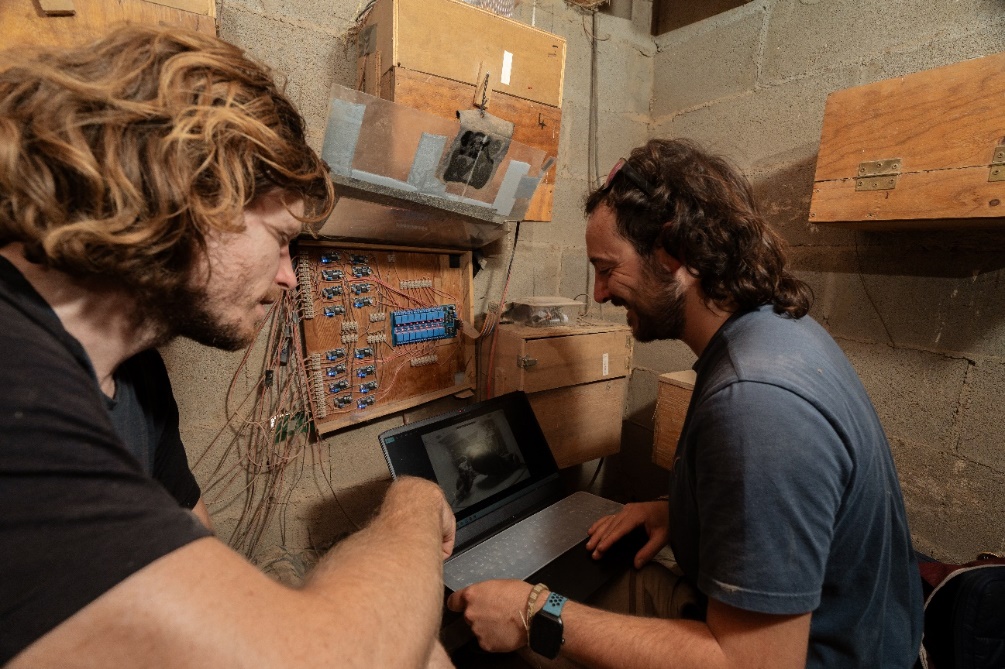
The idea: Use open-source electronics to monitor nest boxes of wild jackdaws (Corvus monedula) across the complete breeding season without needing to be physically present or constantly recharge batteries. It had to work fully automated. The result was a centralized, multi-unit, solar-powered monitoring system made from Raspberry Pi computers and cameras. We deployed a 14-unit system to monitor multiple jackdaws breeding in nest boxes for three full breading seasons in Lleida (Catalonia, Spain). The goal: get continuous, high-resolution footage of parental care at the nest, from sunrise to sunset, without gaps across the complete breeding season, with minimal manual intervention. The multiple units are designed in a “parent-child” scheme, where a single “parent” unit synchronises and manages the power input of all “child” units, allowing to capture video and temperature data around the clock – entirely off-grid.


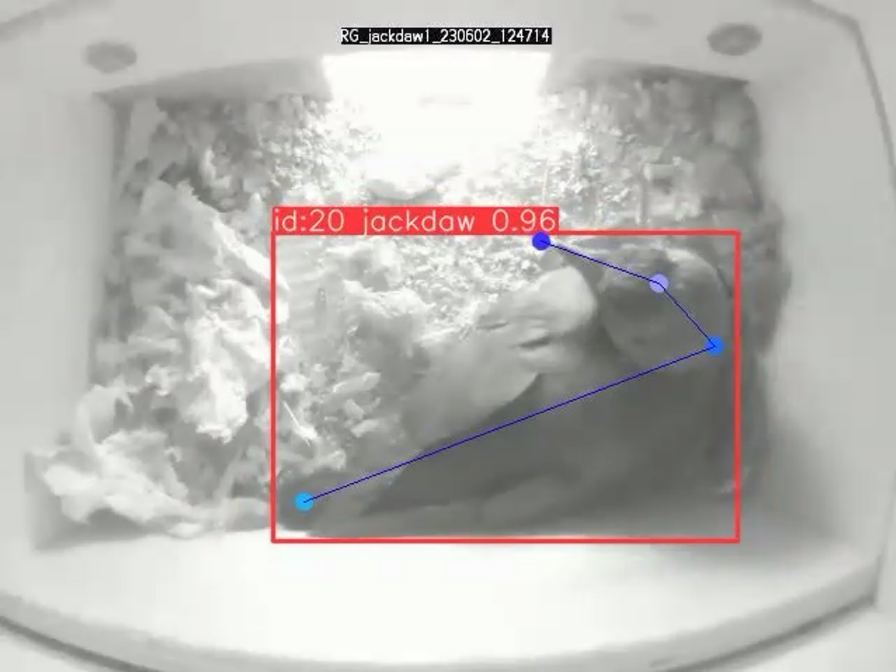
We captured millions of images from uninterrupted video data, revealing fine-scale details of parental behaviour throughout the entire breeding cycle. But this was not the only challenge. We also needed to extract behavioural information from a vast video data collection. Manually watching all the videos was obviously not an option. Hence, we thought of using modern computer vision tools to customize a model that automatically detected the jackdaws in our videos. By combining the footage with deep-learning tools, we were able to automatically quantify how much each parent invested in care – something that would have been impossible with sporadic observations.
The whole 14-unit system, including solar panels, batteries, cameras, and computers, cost just over €2,000. That’s a fraction of what commercial solutions would cost, and because it’s all built with DIY and open-source tools, we had complete flexibility to adapt everything to our needs.
But the system isn’t just for bird behaviour.
Because it’s modular and adaptable, it can be used for any research question that needs coordinated monitoring across multiple points: nest boxes, feeders, traps, plots, or even distributed environmental sensors. Whether you’re monitoring birds, mammals, pollinators, or just need reliable off-grid, multiple-unit data collection, we think this framework could be a useful starting point.
Ultimately, this project is a small example of how open science and accessible tech can push field ecology forward. We’re proud of what we’ve built – and we’re even more excited to see how others will build on it.
We hope our work can help other researchers, especially those working in remote areas or with limited budgets. Our full system is open and publicly available: all hardware designs, software, and detailed guides can be found on our GitHub repository (https://github.com/mpourossell/Centralised-Multi-RPi-Recording-System).
The paper is available Open Access at https://doi.org/10.1111/2041-210x.70129.
 Methods Blog