Post provided by Daniel Souto-Vilarós.
I’m a molecular ecologist who currently works as a postdoctoral researcher at the University of Utah, with a long-standing obsession with biodiversity. While much of my work has focused on plant-pollinator interactions, this project took me down a very different path: into the leaf litter, soil, and night sky of a tropical forest to try and find out how many arthropod species live in one place.
We carried out this survey in one of the best-studied forests in the world, Barro Colorado Island (BCI), Panama. Here, the Smithsonian Tropical Research Institute’s Arthropod Monitoring Program, has been actively surveying the abundance and distribution of focal arthropod species since 2009, greatly contributing to the monitoring of the little things that run the world.
A Collector’s Dream
Led by Dr. Yves Basset, we designed an ambitious survey: to process arthropod bulk-collections from seven different protocols with DNA metabarcoding. Once collected, all samples were processed at the Centre for Biodiversity Genomics in Canada. The COI gene, a standard barcode for animals, was sequenced from thousands of specimens, allowing us to cluster them into Barcode Index Numbers, or BINs, a proxy for species.
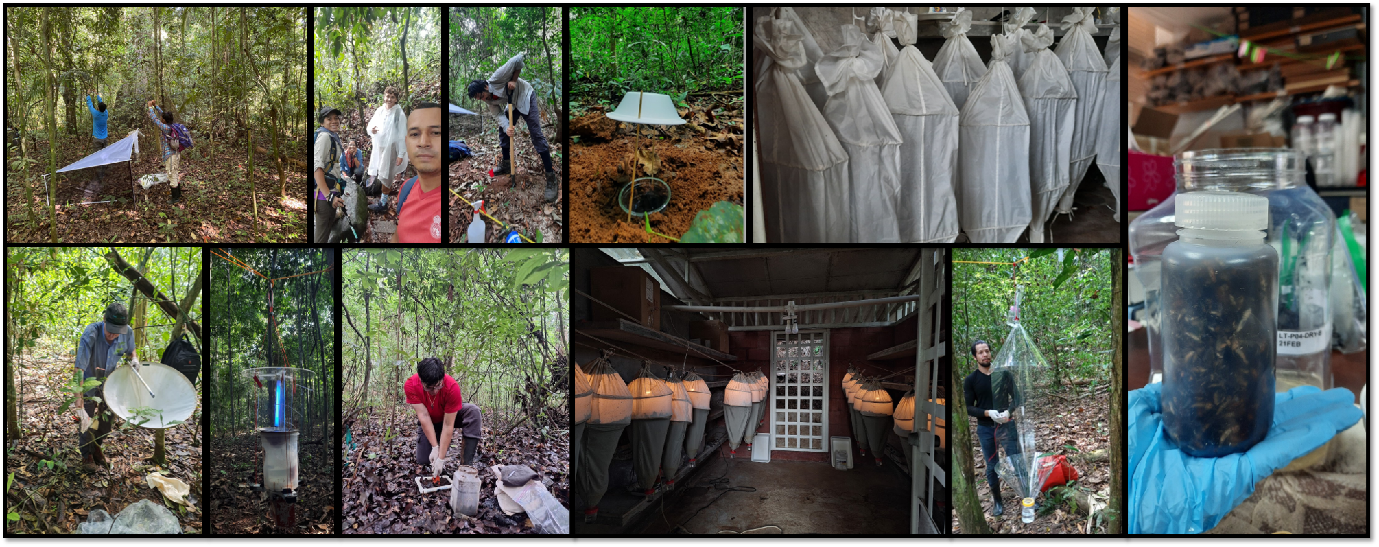
It is well known that each method targets a different slice of the arthropod community, some catch flying insects; others extract tiny creatures from the leaf-litter, or crawling through the forest floor. Despite these known differences, all trap types often catch beyond the intended groups, but time and expertise requirements often limit the identification of the catch. Using DNA metabarcoding helps face these limitations and allows us to see how each method contributes to the overall biodiversity, and how much overlap between methods can help us decide the most cost-effective trap, depending on the research question.
We tried out these seven methods across 25 rainforest plots, in both wet and dry seasons. That meant over 350 total samples, using pitfall traps, polytraps, Malaise traps, light traps, Winkler extractors, Berlese-Tullgren funnels, and beating sheets.
How Many Species?
The answer: almost 10,000 BINs.
Out of some stringent filtering, in one hectare of tropical rainforest, we recovered 9,398 genetically distinct arthropod taxa. These are just the species we could detect using seven bulk-sampling protocols over two seasons and with a couple of temporal and spatial limitations. There’s no doubt we still missed many more, with the whole of BCI ranging in the order of 25,000 to 30,000 species.
Our results highlight how incredibly rich tropical insect communities are, and how many species are likely still undescribed, but more importantly, how limited our taxonomic classification really is! Of the total 9,398 BINs detected, only 32% are identified to species level, and about half of these rely on name placeholders rather than accepted binomials. Similarly, our results also underscore a major challenge in biodiversity monitoring: no single method captures the whole picture. Each trap type collected a unique set of taxa. Some traps (like polytraps and Malaise traps) were dominated by flying insects like Diptera and Hymenoptera. Others (like Berlese or Winkler extractors) were best for soil dwellers like springtails and mites.

A Toolbox for Tropical Monitoring
Beyond recording the magnitude of species, our study helps set the stage for better monitoring. By combining traditional field ecology with cutting-edge DNA techniques, we now have a scalable, replicable way to estimate diversity in megadiverse habitats. Our analyses showed that while many traps reached high sample coverage, others (like Berlese and beating sheets) still undersample rare taxa, suggesting further refinement is needed for monitoring programs.
These results have major implications for conservation planning, tropical ecology, and even global biodiversity assessments like LIFEPLAN or the Global Malaise Program. As DNA barcoding continues to grow, studies like ours provide a benchmark for how and where to deploy these tools effectively.
A Few Favourite Moments
Fieldwork was full of surprises, from unexpected rainstorms flooding the beating canvas, to digging multiple holes to fit the pitfall traps in incredibly hard clay soil while at 30°C and high humidity. But the biggest challenge was watching hundreds of insect filled vials leave for Canada and later receiving a spreadsheet with millions of raw sequencing reads, felt like peeking into a hidden world, one we’d barely touched.
Of course, this would not have been possible without the incredible STRI field crew, volunteers, interns, and collaborators who helped set every trap, sort every vial, and carry bulky traps deep into the forest. Field ecology at this scale is exhausting, exhilarating, and deeply rewarding.
What’s Next?
We’re now using this data to better understand how communities shift across space and time, and which traps are best for different ecological questions. We’re also working to make these methods accessible for long-term monitoring, even in places without traditional taxonomic expertise, however, we keep emphasizing that without continued efforts into basic taxonomy and barcoding, metabarcoding studies like this will continue to face the challenge, we simply do not know what is out there.
Read the full article here.
Post edited by Sthandiwe Nomthandazo Kanyile.
 Methods Blog