Post provided by Lima F. P.; Pereira F. L.; Loureiro B.; Humet M.; Seabra R.
How can we tell when an animal is stressed, long before it dies? For marine invertebrates like mussels, limpets, oysters, or crabs, one of the clearest signals comes from their hearts. Heart rate can vary in response to changes in the environment (such as temperature or oxygen), offering a non-invasive way to understand how these animals respond to their surroundings.
From smartwatches to shellfish
Until recently, measuring heartbeats in shelled invertebrates was difficult and tedious. Animal physiologists have used photoplethysmography (PPG), a technique that employs infrared light to detect heart contractions through the shell, since the 1980s. However, they had to use a signal amplifier tethered to an oscilloscope and then to a computer, and had to process results manually over weeks or months. Recently, PPG became popular in smartwatches, where it is seamlessly used to track users’ heartbeats. Inspired by the simplicity of wearable systems, we knew it had to be possible to improve the lab setup.
Building a new toolkit
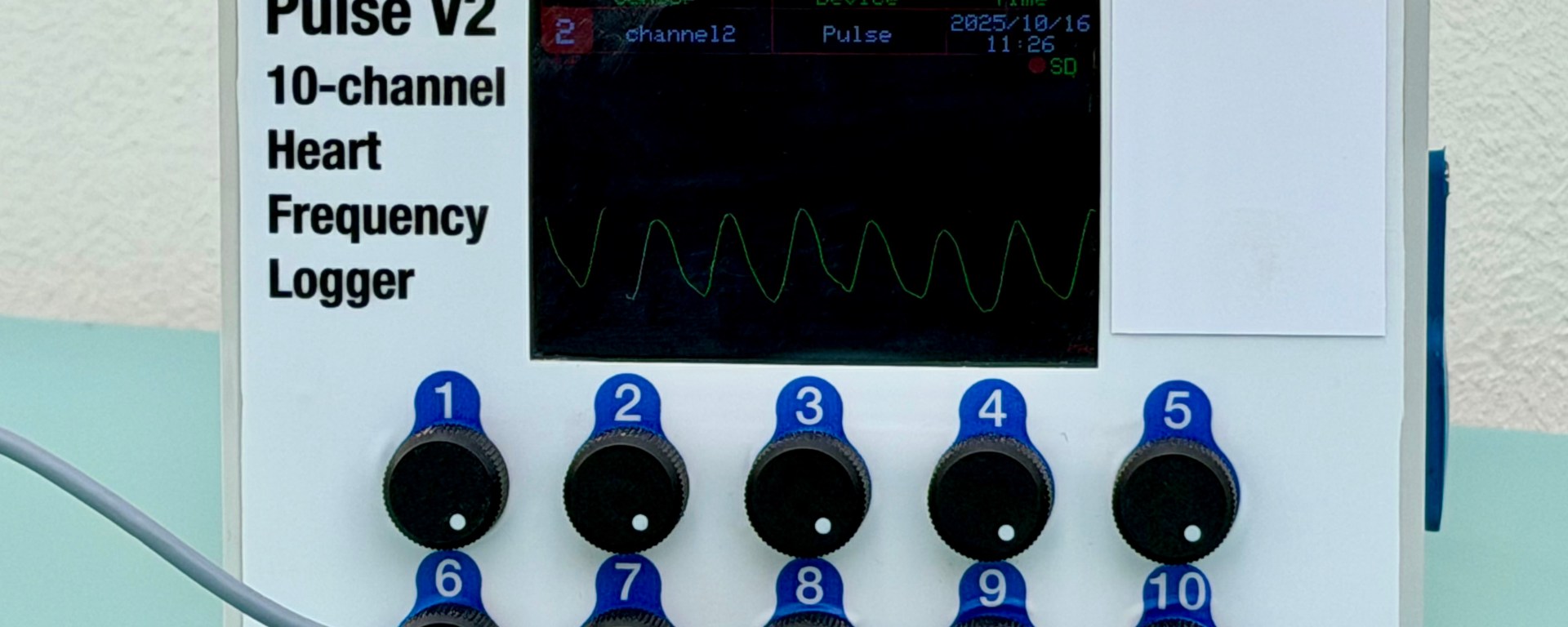
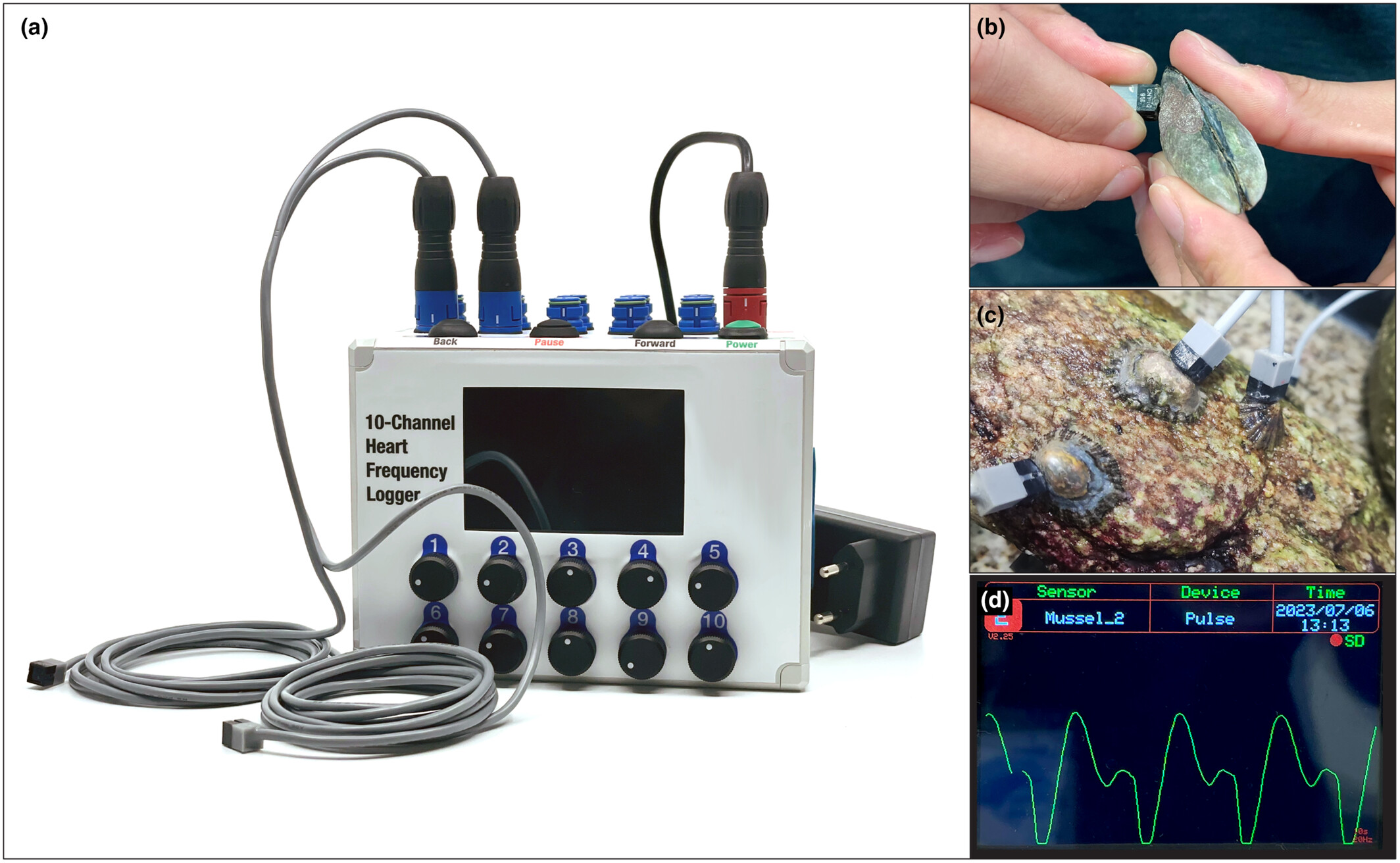
Our team developed a fully automated, open-source system that brings everything together. The device consists of a splash-proof logger that records data from up to ten animals simultaneously, with a screen for real-time feedback, adjustable amplification, Wi-Fi, and simple microSD card storage. In addition, we developed an R package (heartbeatr), which imports signals, detects peaks, corrects errors, filters out low-quality data, and automatically produces reliable heart rate estimates. Together, these features make the system fully self-contained: no oscilloscope, no laptop tether, and, crucially, no more months of manual annotation.
Putting it to the test
We experimented the system on mussels (Mytilus galloprovincialis) and limpets (Patella vulgata). For the hardware, we recorded short periods of clear heart activity across ten mussels. For the R package, we benchmarked it against nearly 79,000 manually classified heartbeats of limpets. The results showed 94% agreement between automated and human classifications. We also demonstrated that the automated pipeline can not only replace human annotation but also scale it up dramatically, from thousands to millions of heartbeats per study.
Why it matters
Heart frequency is one of the most direct measures of sublethal stress. It’s a way to see what’s happening inside the animal. By automating both recording and processing, researchers can now (i) run longer-term experiments without drowning in data, (ii) increase replication and capture natural variability, (iii) apply cardiac monitoring to a broader range of species, and (iv) study responses under realistic, fluctuating environments. As marine invertebrates face increasingly variable climates, with warming, hypoxia, and acidification events becoming more frequent, such tools will help identify their physiological tipping points and resilience limits in the lab and in nature.
Open-source
From the start, we wanted this toolkit to be something others could build, use, and improve. All hardware designs, firmware, and example datasets are openly available, and the R package heartbeatr is on CRAN, complete with tutorials and documentation. Although building a unit costs over €1000, the ability to record ten individuals simultaneously, and without extra equipment, makes it cost-effective. Being open-source also allows others to adapt the system, for instance by designing waterproof housings for field use or testing smaller, less intrusive sensors for mobile species.
Looking ahead
For us, the most exciting breakthrough is that physiological monitoring can now finally match the scale of ecological questions. We are no longer limited by bulky hardware or data-processing bottlenecks. We can finally explore not only whether animals cope with stress, but how consistently and with what individual variation. In doing so, we hope to move closer to understanding how life at the shore feels and responds to a rapidly changing ocean. By lowering technical barriers, we hope this toolkit will help turn heartbeats into insights on the resilience of marine life in a changing world.
Read the full article here.
Post edited by Sthandiwe Nomthandazo Kanyile.
 Methods Blog