Post provided by David Bolduc and Frederic Dulude-de Broin
Most people have played some form of tag during childhood – games where certain players try to catch others, who in turn may be able to take refuge in designated areas, or who must collect a flag or another item to win the game. These games are fun and engaging perhaps because they tap into some of our most fundamental instincts: gathering resources and avoiding predators. Without any knowledge of ecology or the ability to consciously evaluate trade-offs, even small children intuitively balance the rewards of acquiring resources with the risks of being caught.
What if we built a game that leveraged these risk-reward trade-off decisions for the study of predator-prey interactions?
The idea emerged as we were preparing an intensive summer school in computational ecology. It seemed to offer an original solution to our main challenge: quickly engaging participants and make them eager to explore a dataset using state-of-the-art analytical approaches.
Childhood game to player-based simulations

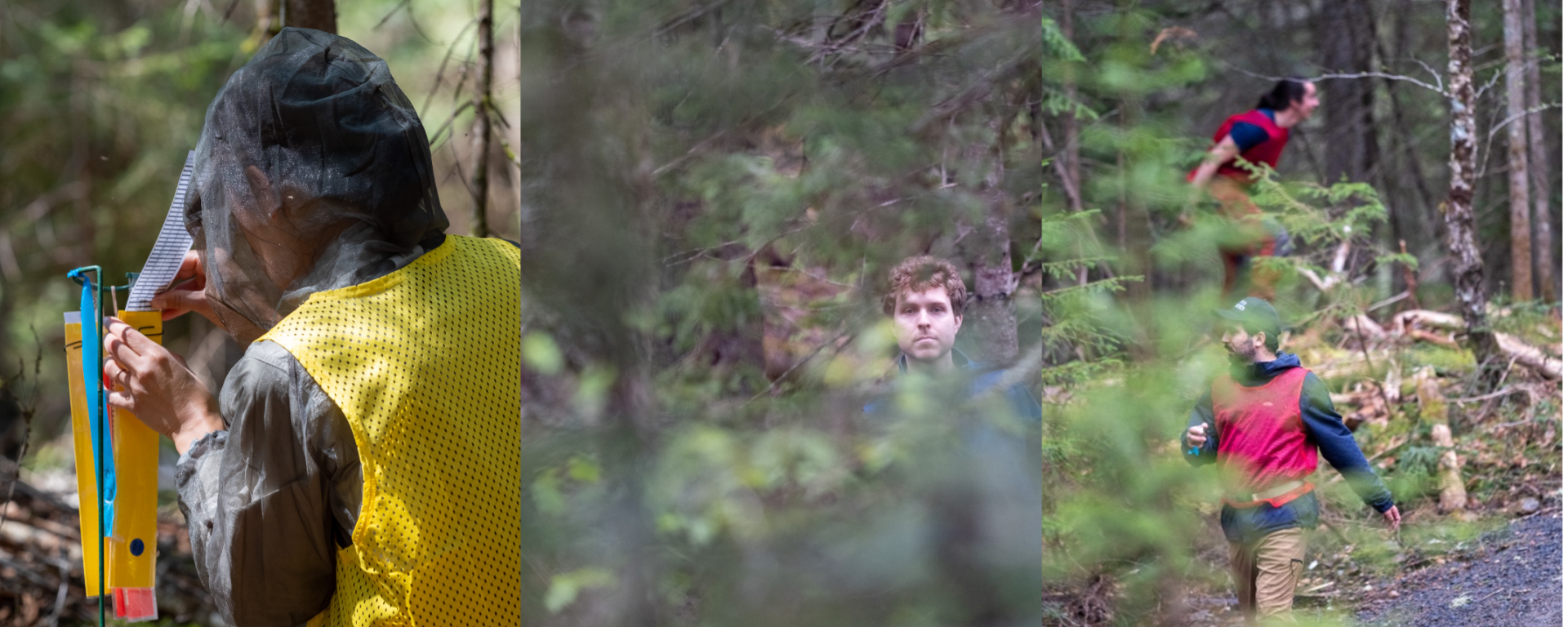
Keeping the predator-prey framework in mind, we drafted the rules from some very basic principles: Predators catch prey. Prey forage while avoiding predators. To bring the idea to life, we scattered resource tokens and refuges across the landscape. Prey were constrained to walking speed, predators could run, and players had to balance collecting tokens with avoiding capture.
Through early test-runs, we iteratively refined game mechanics by creating new game scenarios, adjusting the goals, and adding a mesopredator role to make the game more dynamic. Using cell phones as movement loggers and survey tools, we recorded every player’s movements and interactions throughout the games. The result was a comprehensive, spatialized record of who went where, and who caught or consumed what.
Upscaling the idea

After a few months of development, we welcomed 40 participants for the summer school in beautiful Val-Morin, Québec, Canada. From the very first game, group cohesion and creative energy surged. Participants eagerly foraged, sought cover, and experienced game-induced predation risk, which sparked lively discussions about predator-prey dynamics. The idea that play fosters learning and intellectual engagement is not new, but seeing it unfold so vividly was striking. Through the games and discussions, it also became clear that the approach not only had potential has an engaging educational tool, but could also be a powerful way to test ecological hypotheses. Everyone had felt the intricacies of predator-prey interactions. These real-world simulations resembled agent-based modeling approaches, yet conducting them in a real landscape with living participants offered added realism, without the need for advanced computational skills.

Comparing players to animals
By the end of the summer school, we were eager to share our experience and evaluate the potential of our game-based simulation approach. We organised four research teams to assess whether the game could reproduce ecological dynamics based on different aspect of predator-prey interactions: movement behaviour, habitat selection, foraging strategies and interaction networks. These analyses showed that players’ behaviors mirrored natural predator-prey dynamics, which emerged from simple game rules within a natural landscape augmented with resource patches and refuges. This highlighted the potential of using real-life simulations to generate rich datasets for ecological research, while also serving as an engaging and effective tool for teaching ecological concepts. Based on the fun we had conducting this project, we can’t wait to see how others make the idea their own, and how player-based simulations will keep evolving in the years ahead.
Read the full article here.
 Methods Blog