Post provided by Rosa Aghdam
I am a scientist at the Solís-Lemus Lab at the University of Wisconsin–Madison, working at the intersection of microbiome networks and computational biology. My research focuses on understanding the invisible world inside and around us. Microbial communities form intricate social systems, and my goal is to build tools that help researchers study those systems more clearly and more reliably. You can explore our research projects here.
The Invisible Cities Within Us
Our bodies and environments are home to trillions of microbes, including bacteria, fungi, and viruses. Imagine a bustling city of countless residents, each with a specific role to play. That is what a microbiome looks like. To understand how these residents interact, scientists create microbiome networks, which are maps showing how microbes connect and influence one another. Each microbe is a node, and the lines between them represent cooperation, competition, or communication. These networks reveal how microbial communities work together to keep ecosystems, including our own bodies, in balance. In these microbial communities, some species act as healers while others can cause harm. This duality reminds me of a line from one of my favorite songs, Clocks by Coldplay: “Am I part of the cure, or am I part of the disease?” Like in the song, microbes can play both roles, helping maintain health or contributing to illness when that balance is lost. Just like city workers, microbes are constantly at work. Some act as chefs who break down food, while others serve as security guards who keep harmful invaders in check. Builders repair the gut lining, ensuring it stays strong and healthy. When these microbial workers fail, it is like a city’s infrastructure collapsing, leading to illness, allergies, or anxiety.
The Problem: Different Tools, Different Answers
Many computational tools exist to construct microbiome networks from microbiome data, which capture the abundance and distribution of microbes across different samples. But there is a challenge. When scientists use different methods, they often get conflicting results. One tool might say that microbe A interacts with microbe B, while another finds no connection at all. It is like asking five people for directions and ending up with three completely different maps. This inconsistency makes it difficult to know which interactions are reliable and which are simply artifacts of the chosen method. These frustrations led to the creation of CMiNet.
The Story Behind CMiNet
CMiNet began with a simple frustration: running the same dataset through different tools and receiving completely different networks. Even small changes in data sometimes produce new results. We began to ask a simple question: What if the most stable interactions are the real ones? After many experiments and benchmarks, CMiNet emerged as a framework that captures shared signals across diverse algorithms. What looks like noise to one method can become a clear signal when several agree.
A Quick Example: Finding Reliable Microbial Links
Imagine you are studying human gut microbiomes. You run three popular tools: SparCC, SPIEC-EASI, and SPRING. SparCC finds 200 microbial links, SPIEC-EASI finds 180, and SPRING detects 150. When compared, only 90 links are shared across all three. Which network would you trust? CMiNet identifies those 90 shared links as the consensus network, a stable backbone supported by multiple methods. These shared links are more likely to represent true biological interactions rather than random noise.
Introducing CMiNet: A Consensus Approach
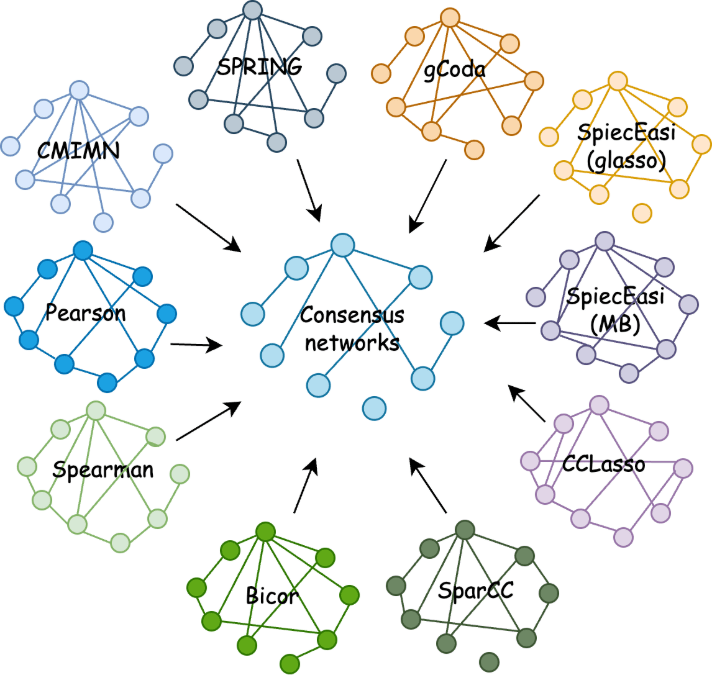
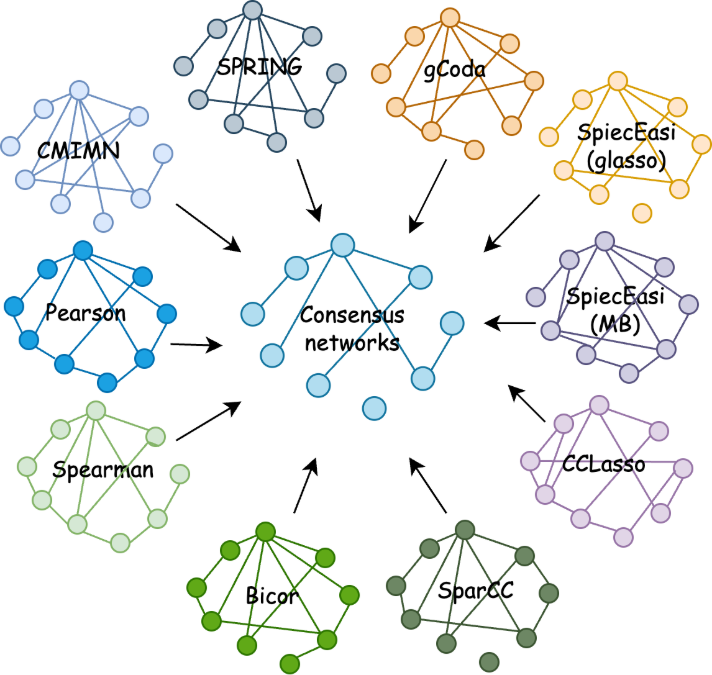
CMiNet is an R package and a user-friendly Shiny app that builds consensus microbiome networks. Instead of depending on a single method, CMiNet combines multiple algorithms and identifies microbial links that appear consistently across them.
Each method gets a “vote.” Connections supported by several methods become part of the consensus network, while less reliable; method-specific links are filtered out. The result is a network that reflects agreement across different approaches and provides a more stable view of microbial interactions (See Figure 1). You can explore CMiNet and its resources here (R package and Online Shiny App)
How CMiNet Helps the Research Community
CMiNet improves reproducibility, highlights agreement between methods, and provides an intuitive Shiny app that allows anyone, even without programming experience, to run ten different algorithms and build reliable consensus networks. CMiNet is an important step forward, but it is not the final one. We are now developing tools to:
-Quantify uncertainty for each edge
-Weight methods based on reliability
-Handle large microbiome datasets
Key Findings from the Study
When applying CMiNet to multiple datasets, we observed that:
-Consensus networks are more stable than any single-method network.
-Microbiome networks produced by CMiNet were more reproducible across noisy or resampled data.
-Using these reliable microbiome networks together with machine learning methods improved feature selection for detecting disease-related microbes.
-The Shiny app lowered the barrier to performing high-quality network analysis since it is easy to use and requires no installation.
Closing thoughts
Microbial communities are astonishing in their complexity. They shape ecosystems, influence health, and connect to nearly every aspect of life on Earth. CMiNet aims to bring clarity to this complexity by offering researchers a stable foundation for interpreting the interactions that matter most. Our hope is that CMiNet empowers the ecology and evolution community to build networks they can trust and to uncover new insights about the invisible worlds that surround us. We are now focusing on developing CMiNet version 2, which will find even more reliable and faster consensus microbiome networks, helping researchers identify stable microbial interactions with greater confidence.
You can read the full article here.
Post edited by Sthandiwe Nomthandazo Kanyile
 Methods Blog