Double anonymous peer review frequently asked questions

Like many of the other British Ecological Society journals, MEE has recently transitioned to a double anonymous peer review model. This decision was made after the results of a recent study conducted from 2019-2022 on the Journal of Functional Ecology. Below are some frequently asked questions to help with the preparation of your submission to Methods in Ecology and Evolution. Can I publish a preprint … Continue reading Double anonymous peer review frequently asked questions

Students, software, and soil flux: lessons learned from development of a package to estimate soil carbon flux at National Ecological Observatory Sites across the United States

By Naupaka Zimmerman and John Zobitz We (Naupaka and John) are faculty at primarily undergraduate institutions (PUIs) where our lives are a blend of teaching and scholarship. We’re always looking for projects that impact our teaching, mentoring, and scholarship duties simultaneously—those sweet spots where one effort advances multiple aims. Due to higher teaching loads and institutional missions that focus on undergraduate research, it can be … Continue reading Students, software, and soil flux: lessons learned from development of a package to estimate soil carbon flux at National Ecological Observatory Sites across the United States

Detecting and classifying animal calls from audio data using animal2vec

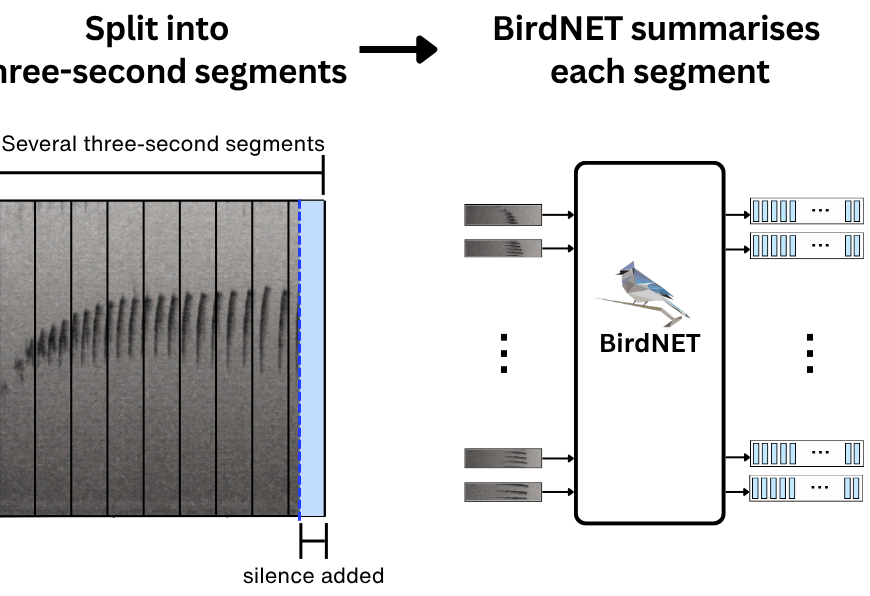
Post provided by Julian Schäfer-Zimmermann An introduction for people lacking a machine-learning background We provide a non-technical explanation of the animal2vec framework, including its capabilities and potential for usage in animal behavior, ecology, and conservation research. This summary is intended as a starting point for people lacking a technical background (e.g., field biologists) interested in understanding how the system works and what makes it unique … Continue reading Detecting and classifying animal calls from audio data using animal2vec

Seeing the Hearing: How 3D Photogrammetry Reveals Directional Hearing in Animals

Post provided by Karsten Vesterholm I’m a Postdoc in the Sound and Behaviour research group at the Department of Biology at the University of Southern Denmark, where I work in the Bat Echolocation Lab. We are particularly interested in understanding how bats use directional hearing as part of their echolocation. Direction of hearing is determined primarily by the shape and orientation of the outer ear … Continue reading Seeing the Hearing: How 3D Photogrammetry Reveals Directional Hearing in Animals

Studying social transmission using STbayes

Post provided by Michael Chimento. When studying animal culture, it’s important to establish whether novel behaviours or information have spread through social contact, or are rather innovated or personally discovered. Unfortunately, we can’t give animals a survey asking how they learned something! While many methods for studying social transmission have been proposed over the years, network-based diffusion analysis (NBDA), first introduced in Franz and Nunn … Continue reading Studying social transmission using STbayes

How to Communicate with the Public as a Scientist

Post provided by Carsten Schradin. Science is about creating knowledge. Yet knowledge only becomes meaningful once it is shared and understood by others. Publishing your research in journals reaches a few very specialised minds of your peers, but if you want your ideas to travel further, you must also communicate them to the public, reaching thousands, hundreds of thousands, or even millions of minds. You … Continue reading How to Communicate with the Public as a Scientist

Tracking animals in an underwater maze

Post provided by Edward Lavender Skating in the deep A decade ago, the Movement Ecology of Flapper Skate project was established to track flapper skate (Dipturus intermedius) in Scotland. Flapper skate are large, flattened, benthic animals, with pale undersides and mottled, grey-brown colouration above. Growing in excess of two metres long, they roam over the seabed down to depths of 1200 m. It is thought … Continue reading Tracking animals in an underwater maze

Teaching Models to Listen to Bats: The Story Behind BSG-BATS

Post provided by Katarina Meramo Bats are extraordinary animals. They fly, echolocate, and navigate in absolute darkness, and produce some of the most complex acoustic signals in the mammalian world. They pollinate, disperse seeds, control insect populations, and quietly hold ecosystems together. Yet, despite their importance, monitoring bats – particularly across large spatial and temporal scales – remains remarkably challenging. Over the past decade, bioacoustic … Continue reading Teaching Models to Listen to Bats: The Story Behind BSG-BATS

All I Want for Christmas is Data: Thoughts on Holidays in the Bush

In this series, we explore the unique experiences of field ecologists conducting research in remote field stations during the holiday season. Through personal stories and reflections, our contributors share what it’s like to conduct scientific work in remote, biodiverse environments, where the challenges of research intersect with the spirit of the holidays. From the solitude of secluded field stations to unexpected festive moments in the … Continue reading All I Want for Christmas is Data: Thoughts on Holidays in the Bush

CMiNet: Building Reliable Microbiome Networks Through Consensus. 

Post provided by Rosa Aghdam I am a scientist at the Solís-Lemus Lab at the University of Wisconsin–Madison, working at the intersection of microbiome networks and computational biology. My research focuses on understanding the invisible world inside and around us. Microbial communities form intricate social systems, and my goal is to build tools that help researchers study those systems more clearly and more reliably. You … Continue reading CMiNet: Building Reliable Microbiome Networks Through Consensus. 

Our December issue is out now!

This issue contains the latest methods in ecology and evolution. Read the last issue of the year to find out about this month’s featured articles and the article behind our cover! Featured Fast‐tracking ecological interpretation using bespoke quantitative large language models There is untapped potential to apply large language models (LLMs) to quantitative ecological and environmental datasets. Here, authors present a roadmap for designing and … Continue reading Our December issue is out now!