A Big Database and Big Models Pave the Way for Big Questions in Ecology

This post was provided by Sean McMahon.

Sean is an Associate Editor for Methods in Ecology and Evolution and is a staff scientist at the Smithsonian Institution based at the Smithsonian Environmental Research Center.  His research focuses on the ecological mechanisms that structure forest communities, with interests spanning the fields of demography, physiology, and remote sensing.

The 100th anniversary of the Ecological Society of America was celebrated in Baltimore, Maryland at their Annual Conference in August. This year a record 10,000 ecologists attended the six day event. ESA conferences now boast a staggering number of scientific presentations, ranging from numerous plenary talks, organized oral sessions and regular oral presentation sessions to lightening talks, posters, workshops and mixers. It was both exhilarating and overwhelming, but featured a truly impressive amount of science.

As the sheer magnitude of the event made attending even a fraction of the talks impossible, it feels odd to highlight any particular presentations. Two talks, however – both on the final morning of the conference – did strike me as worth mentioning; not because they featured groundbreaking science, or novel insights, but because they reflect potentially powerful new platforms from which groundbreaking science might develop. Continue reading “A Big Database and Big Models Pave the Way for Big Questions in Ecology”

Choosing Where to Submit: Is Your Manuscript Right for MEE?

You’ve spent months, or even years, working on a project. You’ve finalised your manuscript and you’re ready to submit. But which journal should you send your paper to?

@ Colin (click image to see original)

In recent years, this question has only gotten harder. As more and more journals enter the market, the decision of where to send your paper is becoming increasingly confusing. With predatory journals muddying the waters and an increasing pressure to publish, deciding where to submit can be a daunting task for even seasoned academics.

Is Methods in Ecology and Evolution the right journal for your manuscript? Is your manuscript right for Methods? Hopefully this blog post will give you a set of tools to make that decision a little easier. Most of these can be applied to other journals too (although some may need to be tweaked a little). Continue reading “Choosing Where to Submit: Is Your Manuscript Right for MEE?”

How Much Methodology Should go into Conference Talks?

The following post was written by Tim Poisot. To see the original version, please visit his blog.

Tim is an Associate Editor who works on Applications submissions for Methods in Ecology and Evolution. His research interests include spatial and temporal dynamics of species interactions at the community level, the relevance of variability in community structure on emerging ecosystem properties, and the evolutionary dynamics of multi-species assemblages.

I am back from the centennial meeting of the Ecological Society of America. I met a lot of great people, saw a lot of great talks, and had lovely discussions. One thing that has been in the back of my mind for a while though, is the question of how much methodology should go into an oral presentation?

How much methodology should be in your presentation? © Phil Whitehouse

Methods are important  —  over the last two years I have found that this has been the part of papers I criticize the most during peer review. Any result is only as robust as its least robust element and there are, in ecology, enough sources of variability that we do not want methods to add any more. As a consequence, appreciating a result and its robustness require that we be able to understand and evaluate the methods by which this result has been obtained.

There are a few elements to evaluating a method. Does it rely on a sound and tested theory? Is it properly applied? Is the method correctly implemented? All of these questions (and some more) should be asked —  and answered in the affirmative  —  before we decide to accept a result. If not, we are putting ourselves in the position to blindly accept what we are being told. Continue reading “How Much Methodology Should go into Conference Talks?”

Study Finds Black Bears in Yosemite Forage Primarily on Plants and Nuts

Below is a press release about the Methods paper ‘Measuring the realized niches of animals using stable isotopes: from rats to bears‘ taken from the University of California, San Diego:

©PLF73 (Click image to see original)
Animal proteins only make up a small part of a black bear’s diet. ©PLF73 (Click image to see original)

Black bears in Yosemite National Park that don’t seek out human foods subsist primarily on plants and nuts, according to a study conducted by biologists at UC San Diego who also found that ants and other sources of animal protein, such as mule deer, make up only a small fraction of the bears’ annual diet.

Their study, published in Methods in Ecology and Evolution, might surprise bear ecologists and conservationists who had long assumed that black bears in the Sierra Nevada rely on lots of protein from ants and other insects because their remains are frequently found in bear feces. Instead, the researchers believe that bears likely eat ants for nutrient balance. Continue reading “Study Finds Black Bears in Yosemite Forage Primarily on Plants and Nuts”

National Honey Bee Day 2015

Happy National Honey Bee Day everyone!

As you may know, tomorrow (Saturday 22 August) is National Honey Bee Day in the USA. To mark the day we will be highlighting some of the best papers that have been published on bees and pollinators in Methods in Ecology and Evolution.

You can find out more about National Honey Bee Day (and about bees in general) HERE.

Without further ado though, here are a few of the best Methods papers related to Honey Bees:

Wildebeast graze on the cover of MEE 2.5Honey Bee Risk Assessment

Our Honey Bee highlights begin with Hendriksma et al.’s article ‘Honey bee risk assessment: new approaches for in vitro larvae rearing and data analyses‘. Robust laboratory methods for assessing adverse effects on honey bee brood are required for research into the issues contributing to global bee losses. To facilitate this, the authors of this article recommend in vitro rearing of larvae and suggest some appropriate statistical tools for the related data analyses. Together these methods can help to improve the quality of environmental risk assessment studies on honey bees and secure honey bee pollination. As this article was published over two years ago, it can be accessed for free by anyone.

Continue reading “National Honey Bee Day 2015”

Issue 6.8

Issue 6.8 is now online!

The August issue of Methods is now online!

This month’s issue contains two Applications article and one Open Access article, all of which are freely available.

LEA: This R package enables users to run ecological association studies from the R command line. It can perform analyses of population structure and genome scans for adaptive alleles from large genomic data sets. The package derives advantages from R programming functionalities to adjust significance values for multiple testing issues and to visualize results.

PIPITS: An open-source stand-alone suite of software for automated processing of Illumina MiSeq sequences for fungal community analysis. PIPITS exploits a number of state of the art applications to process paired-end reads from quality filtering to producing OTU abundance tables.

Giovanni Strona and Joseph Veech provide this month’s Open Access article. Many studies have focused on nestedness, a pattern reflecting the tendency of network nodes to share interaction partners, as a method of measuring the structure of ecological networks. In ‘A new measure of ecological network structure based on node overlap and segregation‘ the authors introduce a new statistical procedure to measure both this kind of structure and the opposite one (i.e. species’ tendency against sharing interacting partners).

In addition to this, our August issue features articles on Estimating Diversity, Ecological Communities and Networks, Genetic Distances and Immunology. Continue reading “Issue 6.8”

Impact of Flooding on Wetlands Measurable via Low-Cost Approach

Below is a press release about the Methods paper ‘Testing sea-level rise impacts in tidal wetlands: a novel in situ approach‘ taken from the University of Alabama:

IMG_0175 (2)
Researchers installed adjustable enclosures near the shoreline to simulate low, medium & high flooding levels. © Dr Eric Sparks, Mississippi State University

Scientists designed a new, on-site method for studying potential impacts rising sea levels can have on vital wetlands, said a University of Alabama researcher who led a study publishing in Methods in Ecology and Evolution today describing the modifiable apparatuses.

Primarily using materials available at the local hardware store, the scientists, including UA’s Dr Julia Cherry, designed, constructed and tested low-cost enclosures, called weirs, to realistically simulate three flooding levels on coastal wetlands. Simulating impacts of sea level rise on-site and at larger scales had previously proven difficult.

“I hope this provides other researchers with a template to ask their questions and to improve upon the method we’ve documented to do bigger and better coastal wetland studies,” said Cherry, an associate professor in UA’s New College and its biological sciences department. Continue reading “Impact of Flooding on Wetlands Measurable via Low-Cost Approach”

Animal-eye view of the world revealed with new visual software

Below is a press release about the Open Access Methods paper ‘Image calibration and analysis toolbox – a free software suite for objectively measuring reflectance, colour and pattern‘ taken from the University of Exeter:

New camera technology that reveals the world through the eyes of animals has been developed by University of Exeter researchers. The details are published today in the journal Methods in Ecology and Evolution.

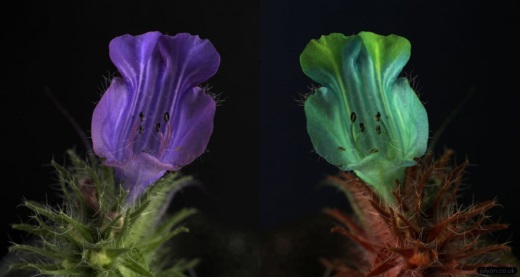
Echium angustifolium in Tenerife (Borage family). To us the flowers are a fairly uniform purple, but bees can see two UV absorbent patches at the top of the flower.

The software, which converts digital photos to animal vision, can be used to analyse colours and patterns and is particularly useful for the study of animal and plant signalling, camouflage and animal predation, but could also prove useful for anyone wanting to measure colours accurately and objectively.

The software has already been used by the Sensory Ecology group in a wide range of studies, such as colour change in green shore crabs, tracking human female face colour changes through the ovulation cycle, and determining the aspects of camouflage that protect nightjar clutches from being spotted by potential predators. Continue reading “Animal-eye view of the world revealed with new visual software”

The Value of Information: Does More Data Mean Better Decisions?

Post provided by Dr Stefano Canessa

Applied ecology can be defined as scientific knowledge that helps in making good management decisions. Scientists have a natural desire to collect information, managers want that information so that they know they are doing the right thing, and both generally act under the assumption that more information equals better decisions. This is generally correct, since information helps us make, well, informed decisions. Therefore, when our ecological knowledge is uncertain (which is practically always the case) we usually advocate further research.

On the other hand, however, information comes at a cost. It may cost money to collect it and take time to set up studies: both are usually in short supply. We can’t learn everything and often the information we can actually collect is still imperfect. So how do we determine if that additional piece of information we’d like to have is really valuable for our management?

In ‘When do we need more data? A primer on calculating the value of information for applied ecologists’ , Stefano Canessa and colleagues provide a tutorial to the calculation of value of information (VOI) for applied ecologists and managers who would like to know more about it, but are not familiar with decision-theoretic principles and notation.

What is ‘Value of Information’?

In decision analysis, the value of information is the improvement in the outcomes of our actions that we would expect if we could reduce or eliminate uncertainty before making a decision. Previously applied in engineering, economics and healthcare planning, VOI is also intuitively appealing for environmental management, where decisions must be made in the face of ubiquitous uncertainty.  Knowing the value of information can assist in designing monitoring and experimental programs, implementing adaptive management and prioritising sources of uncertainty. In other words, it can help applied ecologists and conservation managers find a focused, transparent way to address the inevitable need for “more data”.

An increasing number of studies are applying VOI to conservation management; however, in spite of its potential the technique is still underused in real-world applications, particularly beyond the small community of applied ecologists trained in decision-analytic methods.

Click Image to begin a Prezi Presentation on Value of Information

In summary, three things determine the value of information:

  1. How much we already know (the more we know, the less beneficial it is to collect more information)
  2. Whether and how we would react to that extra information by changing actions, and how much better would the updated action be
  3. How good is the information we can actually get (think about sample sizes, imperfect detection, time lags, etc)

Continue reading “The Value of Information: Does More Data Mean Better Decisions?”

Issue 6.7

Issue 6.7 is now online!

The July issue of Methods is now online!

This month’s issue contains two Applications article and one Open Access article, all of which are freely available.

fuzzySim: Binary similarity indices are widely used in ecology. This study proposes fuzzy versions of the binary similarity indices most commonly used in ecology, so that they can be directly applied to continuous (fuzzy) rather than binary occurrence values, producing more realistic similarity assessments. fuzzySim is an open source software package which is also available for R.

 Actave.net: A freely accessible, web-based analysis tool for complex activity data, actave.net provides cloud-based and automatic computation of daily aggregates of various activity parameters based on recorded immersion data. It provides maps and graphs for data exploration, download of processed data for modelling and statistical analysis, and tools for sharing results with other users.

Anna Sturrock et al. provide this month’s Open Access article. In ‘Quantifying physiological influences on otolith microchemistry‘ the authors test relationships between otolith chemistry and environmental and physiological variables. The influence of physiological factors on otolith composition was particularly evident in Sr/Ca ratios, the most widely used elemental marker in applied otolith microchemistry studies. This paper was reported on in the media recently. You can read more about it here.

Our July issue also features articles on Monitoring, Remote Sensing, Conservation, Genetics and three papers on Statistics. Continue reading “Issue 6.7”