Criminal profiling technique targets killer diseases

Here’s a press release about a recent Methods paper, Spatial targeting of infectious disease control: identifying multiple, unknown sources, taken from the Queen Mary University of London press page:

A mathematical tool used by the Metropolitan Police and FBI has been adapted by researchers at Queen Mary University of London to help control outbreaks of malaria, and has the potential to target other infectious diseases.

In cases of serial crime such as murder or rape, police typically have too many suspects to consider, for example, the Yorkshire Ripper investigation in the UK generated a total of 268,000 names. To help prioritise these investigations, police forces around the world use a technique called geographic profiling, which uses the spatial locations of the crimes to make inferences about the criminal’s likely anchor point – usually a home or workplace.

Writing in the journal Methods in Ecology and Evolution, the team has shown how the maths that underpins geographic profiling can be adapted to target the control of infectious diseases, including malaria. Using data from an outbreak in Cairo, the scientists show how the new model could use the addresses of patients with malaria to locate the breeding sites of the mosquitoes that transmit the disease.

“The experts working in the field had to search almost 300 square km to find seven breeding sites, but our model found the same sites after searching just two thirds of this area,” said Dr Steve Le Comber, a senior lecturer at QMUL’s School of Biological and Chemical Sciences.

“In fact our model found five of the seven sites after searching just 10.7 square km. This is potentially important since there is a lot of evidence suggesting that the best way to control outbreaks of malaria is to attack the mosquito breeding sites – but it is incredibly difficult to do in practice.”

The mathematical approach takes just minutes on a computer, meaning that the method could be used in the early stages of epidemics, when control efforts are most likely to be effective – potentially stopping outbreaks before they spread.

This contour map shows the number of cases in Cairo, Egypt. The observed data points are shown as red circles, while the empirically identified sources are shown as blue dots.

Dr Le Comber added: “The model has potential to identify the source of other infectious diseases as well, and we’re now working with public health bodies to develop it further for use with TB, cholera and Legionnaires’ disease.” Continue reading “Criminal profiling technique targets killer diseases”

UV-radiation data to help ecological research

Here’s a press release on a recent Methods paper, glUV: a global UV-B radiation data set for macroecological studies, taken from Helmholz – Centre for Environmental Research – UFZ:

Researchers at the Helmholtz Centre for Environmental Research (UFZ) have processed existing data on global UV-B radiation in such a way that scientists can use them to find answers to many ecological questions. According to the paper published in Methods in Ecology and Evolution, an online journal of the British Ecological Society, this data set allows drawing new conclusions about the global distribution of animal and plant species.

fig 2
Average intensity of global UV-B radiation – mean UV-B of highest month. (Tomáš Václavík/UFZ)
fig 1
Average intensity of global UV-B radiation – mean UV-B of lowest month. (Tomáš Václavík/UFZ)

Many research projects study the effects of temperature and precipitation on the global distribution of plant and animal species. However, an important component of climate research, the UV-B radiation, is often neglected. The landscape ecologists from UFZ in collaboration with their colleagues from the Universities in Olomouc (Czechia), Halle and Lüneburg have processed UV-B data from the U.S. NASA space agency in such a way that they can be used to study the influence of UV-B radiation on organisms.

The basic input data were provided by a NASA satellite that regularly, since 2004, orbits the Earth at an altitude of 705 kilometres and takes daily measurements of the UV-B radiation. “For us, however, not daily but the long-term radiation values are crucial, as these are relevant for organisms”, says the UFZ researcher Michael Beckmann, the lead author of the study. The researchers therefore derived six variables from the UV-B radiation data. These include annual average, seasonality, as well as months and quarters with the highest or lowest radiation intensity.

In order to process the enormous NASA data set, the UFZ researchers developed a Continue reading “UV-radiation data to help ecological research”

Is fieldwork essential?

By Pat Backwell Associate Editor, Methods in Ecology and Evolution Is it necessary to study animals in their natural environment? It is often hot, uncomfortable, tiring, and rainy. You come home with mosquito bites, sore feet and sunburn. Can’t you just collect the animals and study them in the laboratory? Those of us who spend long periods in the field, watching real animals doing real … Continue reading Is fieldwork essential?

Issue 5.4

Issue 5.4 is now online! Included are 2 freely available application articles: PopGenReport: simplifying basic population genetic analyses in R, by Aaron T. Adamack and Bernd Gruber, and RangeShifter: a platform for modelling spatial eco-evolutionary dynamics and species’ responses to environmental changes by Greta Bocedi et al. There is also an open access article: Measuring telomere length and telomere dynamics in evolutionary biology and ecology, … Continue reading Issue 5.4

2013 Robert May Prize Winner

The Robert May Prize is awarded annually for the best paper published in Methods by a young author at the start of their research career. We’re delighted to announce that the 2013 winner is Will Pearse, for his Application article “phyloGenerator: an automated phylogeny generation tool for ecologists”. Although ecologists frequently want to make use of phylogenies, they often lack the skills to create detailed … Continue reading 2013 Robert May Prize Winner

Issue 5.3

Issue 5.3 is now online, including research on stable isotopes, distribution modelling, agriculture, habitat monitoring and surveys. There is a freely available Application article, Geographic assignment with stable isotopes in IsoMAP, by Gabe Bowen et al., and an open access article, Predicting local and non-local effects of resources on animal space use using a mechanistic step selection model, by Jonathan Potts et al. About the cover: Vegetation … Continue reading Issue 5.3

Enhanced articles (HTML)

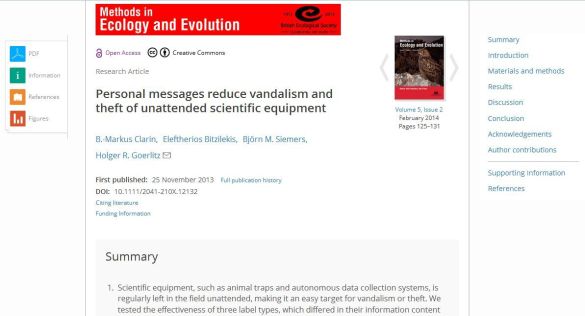
Wiley have just launched the Anywhere Article, which is an enhanced version of the HTML article. It allows readers to view an article on any device – whether at a desktop, or on the move with a tablet or smart phone, and it includes a host of useful new features.

Anywhere article example

Here are a few of the features that an Anywhere Article offers:
o Superfluous information is kept tucked away under a hyperlink, which you can click on for further information if you choose e.g. an author’s contact information and links to any of their previous publications stored on Wiley Online Library.
o There’s a panel on the left-hand side of the screen where you can view the article information, the reference list, download a PDF, and open the interactive figure viewer.
o There’s a menu on the right-hand side of the screen that lets you skip between sections.
o If you click on a reference within the article, the full details will pop-up in the left-hand panel, along with links to the abstract online, and details of it’s previous citations.
o You can open figures in the figure viewer, which allows you to zoom in, download as a Continue reading “Enhanced articles (HTML)”

What method has transformed your field the most, during your career?

In the 4th and final installment of Barb Anderson’s INTECOL 2013 podcasts, she asks a number of delegates: What method has transformed your field the most, during your career?

The answers in this podcast are given by the following people:

  1. Steve Hubbell, University of California, Los Angeles, USA (00.21)
  2. Georgina Mace, University College London, UK (00.44)
  3. Carsten Dormann, University of Freiburg, Germany (01.07)
  4. Continue reading “What method has transformed your field the most, during your career?”

Issue 5.2

mee-5-2-coverlargeIssue 5.2 is now available online!

This month we have papers on equipment, physiology, decomposition, community ecology and movement. There are 2 open access articles included: Simplifying data acquisition in plant canopies- Measurements of leaf angles with a cell phone by Adrián G. Escribano-Rocafort et al., and Personal messages reduce vandalism and theft of unattended scientific equipment by Markus Clarin et al.

The Max Plank Institute for Ornithology published a press release, Hands off – please!, about Markus’s paper, which came to the interesting conclusion that leaving friendly information signs on scientific equipment in the field can actually reduce the incidence of vandalism.

About the cover: Besides the surging interest in social behaviour, the influence of conspecifics on movement behavior is still an area in which the development of Continue reading “Issue 5.2”

Senior Editor vacancy

Methods in Ecology and Evolution (MEE) is seeking a new Senior Editor to strengthen and complement the existing team, and to continue raising the Journal’s profile worldwide. The candidate will join Executive Editor, Professor Rob Freckleton, and Senior Editor, Dr Bob O’Hara, who are supported by an international board of 47 Associate Editors along with an in-house editorial team.

MEE promotes the development of new methods in ecology and evolution, and facilitates their dissemination and uptake by the research community. MEE brings together papers from previously disparate sub-disciplines to provide a single forum for tracking Continue reading “Senior Editor vacancy”