Issue 5.4

Issue 5.4 is now online! Included are 2 freely available application articles: PopGenReport: simplifying basic population genetic analyses in R, by Aaron T. Adamack and Bernd Gruber, and RangeShifter: a platform for modelling spatial eco-evolutionary dynamics and species’ responses to environmental changes by Greta Bocedi et al. There is also an open access article: Measuring telomere length and telomere dynamics in evolutionary biology and ecology, … Continue reading Issue 5.4

2013 Robert May Prize Winner

The Robert May Prize is awarded annually for the best paper published in Methods by a young author at the start of their research career. We’re delighted to announce that the 2013 winner is Will Pearse, for his Application article “phyloGenerator: an automated phylogeny generation tool for ecologists”. Although ecologists frequently want to make use of phylogenies, they often lack the skills to create detailed … Continue reading 2013 Robert May Prize Winner

Issue 5.3

Issue 5.3 is now online, including research on stable isotopes, distribution modelling, agriculture, habitat monitoring and surveys. There is a freely available Application article, Geographic assignment with stable isotopes in IsoMAP, by Gabe Bowen et al., and an open access article, Predicting local and non-local effects of resources on animal space use using a mechanistic step selection model, by Jonathan Potts et al. About the cover: Vegetation … Continue reading Issue 5.3

Enhanced articles (HTML)

Wiley have just launched the Anywhere Article, which is an enhanced version of the HTML article. It allows readers to view an article on any device – whether at a desktop, or on the move with a tablet or smart phone, and it includes a host of useful new features.
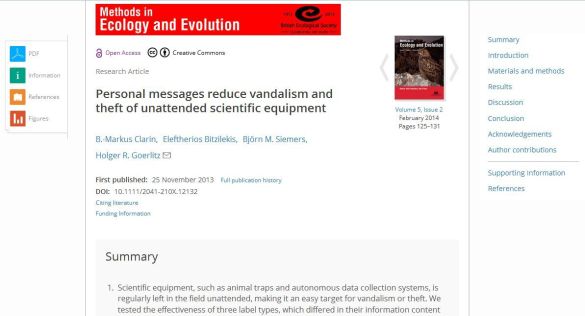
Anywhere article example

Here are a few of the features that an Anywhere Article offers:
o Superfluous information is kept tucked away under a hyperlink, which you can click on for further information if you choose e.g. an author’s contact information and links to any of their previous publications stored on Wiley Online Library.
o There’s a panel on the left-hand side of the screen where you can view the article information, the reference list, download a PDF, and open the interactive figure viewer.
o There’s a menu on the right-hand side of the screen that lets you skip between sections.
o If you click on a reference within the article, the full details will pop-up in the left-hand panel, along with links to the abstract online, and details of it’s previous citations.
o You can open figures in the figure viewer, which allows you to zoom in, download as a Continue reading “Enhanced articles (HTML)”

What method has transformed your field the most, during your career?

In the 4th and final installment of Barb Anderson’s INTECOL 2013 podcasts, she asks a number of delegates: What method has transformed your field the most, during your career?

The answers in this podcast are given by the following people:

  1. Steve Hubbell, University of California, Los Angeles, USA (00.21)
  2. Georgina Mace, University College London, UK (00.44)
  3. Carsten Dormann, University of Freiburg, Germany (01.07)
  4. Continue reading “What method has transformed your field the most, during your career?”

Issue 5.2

mee-5-2-coverlargeIssue 5.2 is now available online!

This month we have papers on equipment, physiology, decomposition, community ecology and movement. There are 2 open access articles included: Simplifying data acquisition in plant canopies- Measurements of leaf angles with a cell phone by Adrián G. Escribano-Rocafort et al., and Personal messages reduce vandalism and theft of unattended scientific equipment by Markus Clarin et al.

The Max Plank Institute for Ornithology published a press release, Hands off – please!, about Markus’s paper, which came to the interesting conclusion that leaving friendly information signs on scientific equipment in the field can actually reduce the incidence of vandalism.

About the cover: Besides the surging interest in social behaviour, the influence of conspecifics on movement behavior is still an area in which the development of Continue reading “Issue 5.2”

Senior Editor vacancy

Methods in Ecology and Evolution (MEE) is seeking a new Senior Editor to strengthen and complement the existing team, and to continue raising the Journal’s profile worldwide. The candidate will join Executive Editor, Professor Rob Freckleton, and Senior Editor, Dr Bob O’Hara, who are supported by an international board of 47 Associate Editors along with an in-house editorial team.

MEE promotes the development of new methods in ecology and evolution, and facilitates their dissemination and uptake by the research community. MEE brings together papers from previously disparate sub-disciplines to provide a single forum for tracking Continue reading “Senior Editor vacancy”

A review of the Methods blog in 2013

The WordPress.com stats helper monkeys prepared a 2013 annual report for this blog. Here’s an excerpt: The concert hall at the Sydney Opera House holds 2,700 people. This blog was viewed about 22,000 times in 2013. If it were a concert at Sydney Opera House, it would take about 8 sold-out performances for that many people to see it. Click here to see the complete … Continue reading A review of the Methods blog in 2013

BES Virtual Issue: Pollinator Ecology

To celebrate the joint meeting on the impact of pesticides on bee health in January, hosted by the Biochemical Society, the British Ecological Society and the Society for Experimental Biology, the BES has compiled a free virtual issue on Pollinator Ecology. The papers included are drawn from all five BES journals and provide examples of the latest research in pollinator ecology from flower visitation and … Continue reading BES Virtual Issue: Pollinator Ecology

Issue 5.1

The first issue of 2014 is now online, and is freely available – enjoy! This month we have included articles on estimating extinction rates, demographics, missing data, networks, and large-scale experiments. There are 2 open access articles: Using time-to-event analysis to complement hierarchical methods when assessing determinants of photographic detectability during camera trapping by Richard Bischof et al., and Designing forest biodiversity experiments: general considerations … Continue reading Issue 5.1