Today we are welcoming two new Associate Editors to Methods in Ecology and Evolution: Huijie Qiao (Chinese Academy of Sciences, China) and Veronica Zamora-Gutierrez (Unidad Durango, Mexico and University of Southampton, UK). They have both joined on a three-year term and you can find out more about them below. Huijie Qiao “My research is focused broadly on macroecology. I work to clarify the theory and methodology behind ecological niche modelling … Continue reading New Associate Editors
The premise of this post is that it might provide some useful advice on how to achieve a tenable work-life balance and find a satisfying, successful career in science.
I’m writing this post, but there is no way that I would hold myself up as an example of success. I have a job that’s a great fit for me, but there was probably no-one else who wanted it, and there are so many others with more prestigious and high-profile jobs. I sometimes manage to divide my time well between my family and my work goals, but I actually feel like I am shortchanging both of them, basically all the time. And how long ago was the last time I got enough sleep, enough exercise, enough personal time? I often feel like someday very soon everyone is going to realise that I really don’t have it all together.
But here’s the thing: almost all the successful, self-aware people I know feel this way, at least some of the time. Impostor syndrome seems to be incredibly common, and I think at least partly it grows out of a genuine awareness of the privilege and luck that helped pave the way to your achievements. Impostor syndrome that interferes with your mental health or limits your potential is clearly unhealthy, and the part where you refuse to believe in your own competence must go immediately. But if it can peacefully coexist with confidence in your own abilities and healthy ambition, it might even be a good thing (or at least, an honest thing). Continue reading “Balance: Time for Your Life and Your Career”
Today, we are pleased to be welcoming a new member of the Methods in Ecology and Evolution Associate Editor Board. Johan Kotze joins us from the University of Helsinki, Finland and you can find out a little more about him below. Johan Kotze “I am an entomologist with a broad interest in all things urban. In particular, my research focuses on beetles (and other insect communities) in urban … Continue reading New Associate Editor: Johan Kotze
I’m delighted to be the newest member of the diverse team of Senior and Associate Editors who have made Methods in Ecology and Evolution one of the premier journals in the field. After 15 years working on the lead editorial teams of Ecologyand Ecological Monographs, I’m really looking forward to applying my editorial energies to the ESA’s friendly competitor on the other side of the ‘pond’.
research and teaching on the natural history and population, community, and landscape ecology of plants and animals (mostly invertebrates) in the marine intertidal and subtidal, among salt marshes and mangroves, tropical and temperate forests, and carnivorous plant bogs
extensive forays into statistics, mathematics, and software engineering
increasing attention to the history and practice of art and architecture and their relationship to ecological theory
and more than two decades of work in editing and publishing journals with scientific societies.
All of these things contribute to my open, catholic approach to scientific research, teaching, and publishing, and their relationship to the broader world.
The editors of Methods are always interested in seeing papers on methodological advances and approaches that lead to new directions. We love reading about creative solutions for new challenges in ecological and evolutionary research and applications in the broadest sense. As a new Senior Editor, I’m especially hoping to encourage more papers in three areas: field methods (about which I’ve published two of my own papers in Methods), reproducibility, and science communication. Continue reading “Virtually Trekking Across the Pond with the Newest Senior Editor: Aaron M. Ellison”
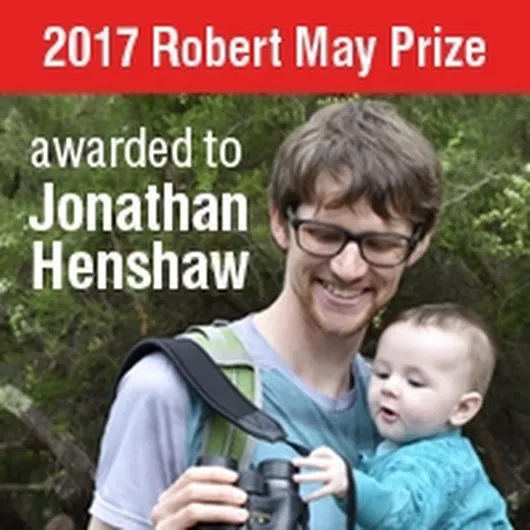
The standard approach to quantifying natural selection, developed by Lande and Arnold, does not allow for comparable metrics between linear (i.e. selection on the mean phenotype) and nonlinear (i.e. selection on all other aspects of the phenotypic distribution, including variance and the number of modes) selection gradients. Jonathan Henshaw’s winning submission provides the first integrated measure of the strength of selection that applies across qualitatively different selection regimes (e.g. directional, stabilizing or disruptive selection). Continue reading “2017 Robert May Prize Winner: Jonathan Henshaw”
After being a postdoc for almost ten years, I landed a permanent academic job in the city I wanted to live and raise my daughter in. I have great colleagues and I love my job as a researcher and teacher. I feel incredibly lucky: I am a female scientist and I “made it”.
When I showed the previous paragraph to a close friend and fellow “scientist who made it” he reminded me that a male colleague could easily have written exactly the same thing, only replacing “female” with “male”. Although I agree with his observation, I was deeply frustrated by what could be implied by his response.
His response illustrates a problem: some people may think it’s “all fine” now or that the issue of gender inequality has been solved. They cite the numerous measures in place at different levels to help women enter STEM fields and to ensure female scientists get an equal chance at staying in the game. It might be close to “all fine” in Scandinavia – a region known for long periods of parental leave and ingrained culture to put children and families above work – but it’s not all chocolate mousse and cheesecake everywhere in the world. Continue reading “Bias, Role Models and Women in STEM”
Last year, I introduced R to petrified first-year biology students in a set of tutorials. I quickly realised that students were getting bogged down in error messages (even on very simple tasks), so most of my time was spent jumping between students like a wayward Markov chain. I would often find a desperate face at the end of a raised hand looking hopelessly towards their R console muttering some version of “What the $%# does this mean?”. I instantly morphed from teacher to translator and our class progress was slower than a for-loop caught in the second Circle.
Today, we are pleased to welcome the latest new member of the Methods in Ecology and Evolution Associate Editor Board. Chris Sutherland joins us from the University of Massachusetts, USA and you can find out a little more about him below. Chris Sutherland “I’m an applied ecologist with a focus on spatial population ecology. I am particularly interested in understanding how spatial processes such as movement, … Continue reading New Associate Editor: Chris Sutherland
The way we do science is changing — data are getting bigger, analyses are getting more complex, and governments, funding agencies and the scientific method itself demand more transparency and accountability in research. One way to deal with these changes is to make our research more reproducible, especially our code.
Although most of us now write code to perform our analyses, it’s often not very reproducible. We’ve all come back to a piece of work we haven’t looked at for a while and had no idea what our code was doing or which of the many “final_analysis” scripts truly was the final analysis! Unfortunately, the number of tools for reproducibility and all the jargon can leave new users feeling overwhelmed, with no idea how to start making their code more reproducible. So, we’ve put together the Guide to Reproducible Code in Ecology and Evolution to help. Continue reading “A Guide to Reproducible Code in Ecology and Evolution”
Today, we are pleased to be the latest new member of the Methods in Ecology and Evolution Associate Editor Board. Edward Codling joins us from the University of Essex, UK and you can find out a little more about him below. Edward Codling “My research is focused on using new mathematical and computational techniques to study problems in biology and ecology. In particular, I’m interested in movement ecology, and … Continue reading New Associate Editor: Edward Codling





 Methods Blog