Bats, Acoustic Methods and Conservation 4.0: An Interview with Kate Jones

At this year’s International Statistical Ecology Conference (ISEC 2018) David Warton interviewed Kate Jones, Chair in Ecology and Biodiversity at University College, London. Their conversation mainly focused on how to classify bats from acoustic data, with particular reference to ‘Acoustic identification of Mexican bats based on taxonomic and ecological constraints on call design‘ by Veronica Zamora‐Gutierrez et al. They also discuss Conservation 4.0! We’ll have more … Continue reading Bats, Acoustic Methods and Conservation 4.0: An Interview with Kate Jones

An Interview with Alan Gelfand

David Warton interviews Alan Gelfand, a keynote speaker at the Statistics in Ecology and Environmental Monitoring (SEEM) conference in Queenstown, NZ. Alan is best known for proposing Bayesian estimation of a posterior distribution using Gibbs sampling, in his classic papers ‘Sampling-Based Approaches to Calculating Marginal Densities‘ and ‘Illustration of Bayesian Inference in Normal Data Models Using Gibbs Sampling‘. David and Alan discuss the origins of … Continue reading An Interview with Alan Gelfand

Practical Tools: A New Article Type and a Virtual Issue

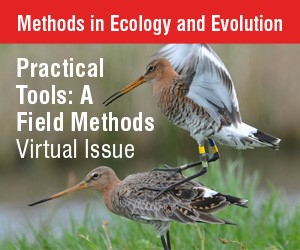
Today, we’re pleased to announce that we’re launching a new article type for Methods in Ecology and Evolution: Practical Tools. Like our Applications articles, Practical Tools will be short papers (up to 3000 words). They’ll focus on new field techniques, equipment or lab protocols. From this point forward, our Applications papers will solely focus on software and code.

Practical tools need to clearly demonstrate how tools designed for specific systems or problems can be adapted for more general use. Online supporting information can include specific instructions, especially for building equipment. You can find some examples of Applications that would now fit into this article type here and here.

To help launch our new article type, we asked four of our Associate Editors – Pierre Durand, Graziella Iossa, Nicolas Lecomte and Andrew Mahon – to put together a Virtual Issue of papers about Field Methods that have previously been published in the journal. All of the articles in ‘Practical Tools: A Field Methods Virtual Issue‘ will be free to everyone for the next month. You can find out a bit more about each of the four sections of the Virtual Issue below. Continue reading “Practical Tools: A New Article Type and a Virtual Issue”

ANDe™: High‐Throughput eDNA Sampling in a Fully Integrated System

Current eDNA sampling technologies consist mainly of do‐it‐yourself solutions. The lack of purpose‐built sampling equipment is limiting the efficiency and standardization of eDNA studies. So, Thomas et al. (a team of molecular ecologists and engineers) designed ANDe™. In this video, the authors highlight the key features and benefits of ANDe™. This integrated system includes a backpack-portable pump that integrates sensor feedback, a pole extension with remote pump … Continue reading ANDe™: High‐Throughput eDNA Sampling in a Fully Integrated System

Virtually Trekking Across the Pond with the Newest Senior Editor: Aaron M. Ellison

Post Provided by Aaron Ellison

I’m delighted to be the newest member of the diverse team of Senior and Associate Editors who have made Methods in Ecology and Evolution one of the premier journals in the field. After 15 years working on the lead editorial teams of Ecology and Ecological Monographs, I’m really looking forward to applying my editorial energies to the ESA’s friendly competitor on the other side of the ‘pond’.

My background includes:

  • an undergraduate degree in East Asian Philosophy
  • a PhD in evolutionary ecology
  • research and teaching on the natural history and population, community, and landscape ecology of plants and animals (mostly invertebrates) in the marine intertidal and subtidal, among salt marshes and mangroves, tropical and temperate forests, and carnivorous plant bogs
  • extensive forays into statistics, mathematics, and software engineering
  • increasing attention to the history and practice of art and architecture and their relationship to ecological theory
  • a quirky social-media persona
  • and more than two decades of work in editing and publishing journals with scientific societies.

All of these things contribute to my open, catholic approach to scientific research, teaching, and publishing, and their relationship to the broader world.

The editors of Methods are always interested in seeing papers on methodological advances and approaches that lead to new directions. We love reading about creative solutions for new challenges in ecological and evolutionary research and applications in the broadest sense. As a new Senior Editor, I’m especially hoping to encourage more papers in three areas: field methods (about which I’ve published two of my own papers in Methods), reproducibility, and science communication. Continue reading “Virtually Trekking Across the Pond with the Newest Senior Editor: Aaron M. Ellison”

2017 Robert May Prize Winner: Jonathan Henshaw

The Robert May Prize is awarded annually for the best paper published in Methods in Ecology and Evolution by an Early Career Researcher. We’re delighted to announce that the 2017 winner is Jonathan Henshaw, for his article ‘A unified measure of linear and nonlinear selection on quantitative traits.

The standard approach to quantifying natural selection, developed by Lande and Arnold, does not allow for comparable metrics between linear (i.e. selection on the mean phenotype) and nonlinear (i.e. selection on all other aspects of the phenotypic distribution, including variance and the number of modes) selection gradients. Jonathan Henshaw’s winning submission provides the first integrated measure of the strength of selection that applies across qualitatively different selection regimes (e.g. directional, stabilizing or disruptive selection). Continue reading “2017 Robert May Prize Winner: Jonathan Henshaw”

Issue 9.2

Issue 9.2 is now online!

The February issue of Methods is now online!

This double-size issue contains six Applications articles (one of which is Open Access) and two Open Access research articles. These eight papers are freely available to everyone, no subscription required.

 Temperature Manipulation: Welshofer et al. present a modified International Tundra Experiment (ITEX) chamber design for year-round outdoor use in warming taller-stature plant communities up to 1.5 m tall.This design is a valuable tool for examining the effects of in situ warming on understudied taller-stature plant communities

 ZoonThe disjointed nature of the current species distribution modelling (SDM) research environment hinders evaluation of new methods, synthesis of current knowledge and the dissemination of new methods to SDM users. The zoon R package aims to overcome these problems by providing a modular framework for constructing reproducible SDM workflows.

 BEIN R Package: The Botanical Information and Ecology Network (BIEN) database comprises an unprecedented wealth of cleaned and standardised botanical data. The bien r package allows users to access the multiple types of data in the BIEN database. This represents a significant achievement in biological data integration, cleaning and standardisation.

Continue reading “Issue 9.2”

An Interview with Tony Ives

David Warton interviews Tony Ives, a Keynote speaker at the Statistics in Ecology and Environmental Monitoring (SEEM) conference in Queenstown, NZ. Tony has published a few papers in Methods in Ecology and Evolution over the last couple of years – first we discuss the exchanges on log-transformation of counts (including a paper co-authored with David Warton). Tony and David then talk about a recent paper … Continue reading An Interview with Tony Ives

New Associate Editor: Chris Sutherland

Today, we are pleased to welcome the latest new member of the Methods in Ecology and Evolution Associate Editor Board. Chris Sutherland joins us from the University of Massachusetts, USA and you can find out a little more about him below. Chris Sutherland “I’m an applied ecologist with a focus on spatial population ecology. I am particularly interested in understanding how spatial processes such as movement, … Continue reading New Associate Editor: Chris Sutherland

Policy on Publishing Code: Encouraging Good Practice to Ensure Quality

Following on from our sponsorship of the Guide to Reproducible Code in Ecology and Evolution and our collaboration with rOpenSci, we have now released a new policy on publishing code. The main objective of this policy is to make sure that high quality code is readily available to our readers.

We’ve set out four key principles to help achieve this, as well as explaining what code outputs we publish, giving some examples of things that make it easier to review code, and giving some advice on how to store code once it’s been published. Below is a summary of some highlights of the policy, but you can find it in full on the Methods in Ecology and Evolution website. Continue reading “Policy on Publishing Code: Encouraging Good Practice to Ensure Quality”