Black bears in Yosemite National Park that don’t seek out human foods subsist primarily on plants and nuts, according to a study conducted by biologists at UC San Diego who also found that ants and other sources of animal protein, such as mule deer, make up only a small fraction of the bears’ annual diet.
As you may know, tomorrow (Saturday 22 August) is National Honey Bee Day in the USA. To mark the day we will be highlighting some of the best papers that have been published on bees and pollinators in Methods in Ecology and Evolution.
You can find out more about National Honey Bee Day (and about bees in general) HERE.
Without further ado though, here are a few of the best Methods papers related to Honey Bees:
Honey Bee Risk Assessment
Our Honey Bee highlights begin with Hendriksma et al.’s article ‘Honey bee risk assessment: new approaches for in vitro larvae rearing and data analyses‘. Robust laboratory methods for assessing adverse effects on honey bee brood are required for research into the issues contributing to global bee losses. To facilitate this, the authors of this article recommend in vitro rearing of larvae and suggest some appropriate statistical tools for the related data analyses. Together these methods can help to improve the quality of environmental risk assessment studies on honey bees and secure honey bee pollination. As this article was published over two years ago, it can be accessed for free by anyone.
This month’s issue contains two Applications article and one Open Access article, all of which are freely available.
– LEA: This R package enables users to run ecological association studies from the R command line. It can perform analyses of population structure and genome scans for adaptive alleles from large genomic data sets. The package derives advantages from R programming functionalities to adjust significance values for multiple testing issues and to visualize results.
–PIPITS: An open-source stand-alone suite of software for automated processing of Illumina MiSeq sequences for fungal community analysis. PIPITS exploits a number of state of the art applications to process paired-end reads from quality filtering to producing OTU abundance tables.
Giovanni Strona and Joseph Veech provide this month’s Open Access article. Many studies have focused on nestedness, a pattern reflecting the tendency of network nodes to share interaction partners, as a method of measuring the structure of ecological networks. In ‘A new measure of ecological network structure based on node overlap and segregation‘ the authors introduce a new statistical procedure to measure both this kind of structure and the opposite one (i.e. species’ tendency against sharing interacting partners).
Scientists designed a new, on-site method for studying potential impacts rising sea levels can have on vital wetlands, said a University of Alabama researcher who led a study publishing in Methods in Ecology and Evolutiontoday describing the modifiable apparatuses.
Primarily using materials available at the local hardware store, the scientists, including UA’s Dr Julia Cherry, designed, constructed and tested low-cost enclosures, called weirs, to realistically simulate three flooding levels on coastal wetlands. Simulating impacts of sea level rise on-site and at larger scales had previously proven difficult.
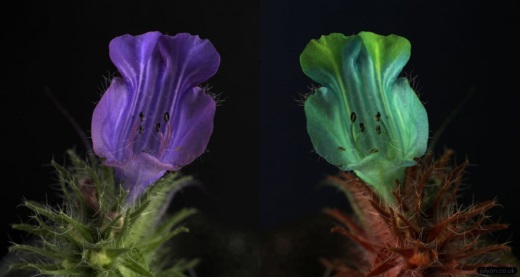
New camera technology that reveals the world through the eyes of animals has been developed by University of Exeter researchers. The details are published today in the journal Methods in Ecology and Evolution.
Echium angustifolium in Tenerife (Borage family). To us the flowers are a fairly uniform purple, but bees can see two UV absorbent patches at the top of the flower.
The software, which converts digital photos to animal vision, can be used to analyse colours and patterns and is particularly useful for the study of animal and plant signalling, camouflage and animal predation, but could also prove useful for anyone wanting to measure colours accurately and objectively.
Applied ecology can be defined as scientific knowledge that helps in making good management decisions. Scientists have a natural desire to collect information, managers want that information so that they know they are doing the right thing, and both generally act under the assumption that more information equals better decisions. This is generally correct, since information helps us make, well, informed decisions. Therefore, when our ecological knowledge is uncertain (which is practically always the case) we usually advocate further research.
On the other hand, however, information comes at a cost. It may cost money to collect it and take time to set up studies: both are usually in short supply. We can’t learn everything and often the information we can actually collect is still imperfect. So how do we determine if that additional piece of information we’d like to have is really valuable for our management?
In decision analysis, the value of information is the improvement in the outcomes of our actions that we would expect if we could reduce or eliminate uncertainty before making a decision. Previously applied in engineering, economics and healthcare planning, VOI is also intuitively appealing for environmental management, where decisions must be made in the face of ubiquitous uncertainty. Knowing the value of information can assist in designing monitoring and experimental programs, implementing adaptive management and prioritising sources of uncertainty. In other words, it can help applied ecologists and conservation managers find a focused, transparent way to address the inevitable need for “more data”.
An increasing number of studies are applying VOI to conservation management; however, in spite of its potential the technique is still underused in real-world applications, particularly beyond the small community of applied ecologists trained in decision-analytic methods.
Click Image to begin a Prezi Presentation on Value of Information
In summary, three things determine the value of information:
How much we already know (the more we know, the less beneficial it is to collect more information)
Whether and how we would react to that extra information by changing actions, and how much better would the updated action be
How good is the information we can actually get (think about sample sizes, imperfect detection, time lags, etc)
This month’s issue contains two Applications article and one Open Access article, all of which are freely available.
– fuzzySim: Binary similarity indices are widely used in ecology. This study proposes fuzzy versions of the binary similarity indices most commonly used in ecology, so that they can be directly applied to continuous (fuzzy) rather than binary occurrence values, producing more realistic similarity assessments. fuzzySim is an open source software package which is also available for R.
–Actave.net: A freely accessible, web-based analysis tool for complex activity data, actave.net provides cloud-based and automatic computation of daily aggregates of various activity parameters based on recorded immersion data. It provides maps and graphs for data exploration, download of processed data for modelling and statistical analysis, and tools for sharing results with other users.
Anna Sturrock et al. provide this month’s Open Access article. In ‘Quantifying physiological influences on otolith microchemistry‘ the authors test relationships between otolith chemistry and environmental and physiological variables. The influence of physiological factors on otolith composition was particularly evident in Sr/Ca ratios, the most widely used elemental marker in applied otolith microchemistry studies. This paper was reported on in the media recently. You can read more about it here.
It may sound counter-intuitive, but crushing up bees into a ‘DNA soup’ could help conservationists understand and even reverse their decline – according to University of East Anglia scientists.
Research published today in the journal Methods in Ecology and Evolution shows that collecting wild bees, extracting their DNA, and directly reading the DNA of the resultant ‘soup’ could finally make large-scale bee monitoring programmes feasible.
This would allow conservationists to detect where and when bee species are being lost, and importantly, whether conservation interventions are working.
The UK’s National Pollinator Strategy outlines plans for a large-scale bee monitoring programme. Traditional monitoring involves pinning individual bees and identifying them under a microscope. But the number of bees needed to track populations reliably over the whole country makes traditional methods infeasible.
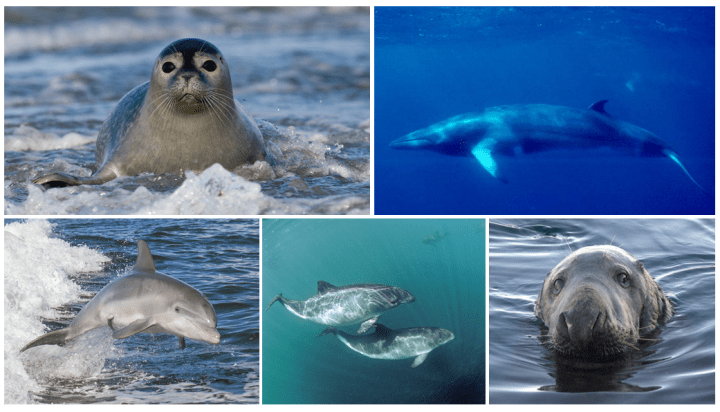
A team of scientists from the University of St Andrews has developed a new desktop tool for assessing the impact of noise from human disturbance, such as offshore wind development on marine mammal populations.
The team, led by Prof. John Harwood,have developed the interim Population Consequences of Disturbance (PCoD) framework for assessing the consequences of human induced noise disturbance on animal populations. The study was published yesterday in the journal Methods in Ecology and Evolution.
Changes in natural patterns of animal behaviour and physiology resulting from animals being disturbed may alter the conservation status of a population if the activity affects the ability of individuals to survive, breed or grow. However, information to forecast population-level consequences of such changes is often lacking. The project team developed an interim framework to assess impacts when empirical information is sparse. Crucially, the model shows how daily effects of being disturbed, which are often straightforward to estimate, can be scaled to the duration of disturbance and to multiple sources of disturbance.
“We have developed a novel framework that can be used to broadly forecast the consequences of anthropogenic disturbance on animal populations, which in principal can be applied to a range of marine and terrestrial species and different types of disturbance.” – Dr Stephanie King
One important application for the interim PCoD framework is in the marine industry. Many industries use practices that involve the generation of underwater noise. These include shipping, oil and gas exploration, defence activities and port, harbour and renewable energy construction. Continue reading “New Tool to Assess Effects of Powerful Man-Made Underwater Sounds”
This month’s issue contains one Applications article and one Open Access article.
– VirtualCom: A simple and readily usable tool that will help to resolve theoretical and methodological issues in community ecology. VirtualCom simulates the evolution of the pool of regionally occurring species, the process-based assembly of native communities and the invasion of novel species into native communities. One of the authors of this Application is the 2014 Robert May Young Investigator Prize Winner, Laure Gallien.
Calibrating animal-borne proximity loggers, this month’s only Open Access article, comes from Christian Rutz et al. The authors calibrated a recently developed digital proximity-logging system (‘Encounternet’) for deployment on a wild population of New Caledonian crows. They show that, using signal-strength information only, it is possible to assign crow encounters reliably to predefined distance classes, enabling powerful analyses of social dynamics. Their study demonstrates that well-calibrated proximity-logging systems can be used to chart social associations of free-ranging animals over a range of biologically meaningful distances.





 The team, led by

