Enhanced articles (HTML)

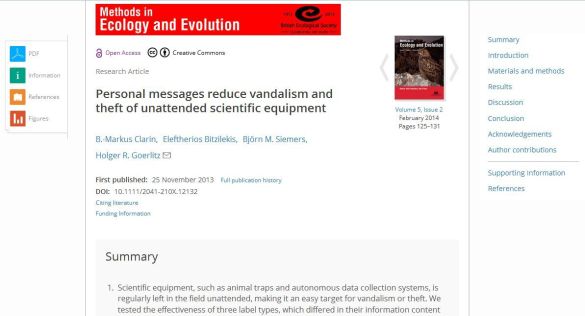
Wiley have just launched the Anywhere Article, which is an enhanced version of the HTML article. It allows readers to view an article on any device – whether at a desktop, or on the move with a tablet or smart phone, and it includes a host of useful new features.
Anywhere article example

Here are a few of the features that an Anywhere Article offers:
o Superfluous information is kept tucked away under a hyperlink, which you can click on for further information if you choose e.g. an author’s contact information and links to any of their previous publications stored on Wiley Online Library.
o There’s a panel on the left-hand side of the screen where you can view the article information, the reference list, download a PDF, and open the interactive figure viewer.
o There’s a menu on the right-hand side of the screen that lets you skip between sections.
o If you click on a reference within the article, the full details will pop-up in the left-hand panel, along with links to the abstract online, and details of it’s previous citations.
o You can open figures in the figure viewer, which allows you to zoom in, download as a Continue reading “Enhanced articles (HTML)”

Issue 5.2

mee-5-2-coverlargeIssue 5.2 is now available online!

This month we have papers on equipment, physiology, decomposition, community ecology and movement. There are 2 open access articles included: Simplifying data acquisition in plant canopies- Measurements of leaf angles with a cell phone by Adrián G. Escribano-Rocafort et al., and Personal messages reduce vandalism and theft of unattended scientific equipment by Markus Clarin et al.

The Max Plank Institute for Ornithology published a press release, Hands off – please!, about Markus’s paper, which came to the interesting conclusion that leaving friendly information signs on scientific equipment in the field can actually reduce the incidence of vandalism.

About the cover: Besides the surging interest in social behaviour, the influence of conspecifics on movement behavior is still an area in which the development of Continue reading “Issue 5.2”

BES Virtual Issue: Pollinator Ecology

To celebrate the joint meeting on the impact of pesticides on bee health in January, hosted by the Biochemical Society, the British Ecological Society and the Society for Experimental Biology, the BES has compiled a free virtual issue on Pollinator Ecology. The papers included are drawn from all five BES journals and provide examples of the latest research in pollinator ecology from flower visitation and … Continue reading BES Virtual Issue: Pollinator Ecology

Issue 5.1

The first issue of 2014 is now online, and is freely available – enjoy! This month we have included articles on estimating extinction rates, demographics, missing data, networks, and large-scale experiments. There are 2 open access articles: Using time-to-event analysis to complement hierarchical methods when assessing determinants of photographic detectability during camera trapping by Richard Bischof et al., and Designing forest biodiversity experiments: general considerations … Continue reading Issue 5.1

Data archiving mandate

Until now, Methods and the other BES Journals have recommended that authors should archive any data associated with their papers; from 6th January 2014, this will be required for publication. The thinking behind this is that all raw data should be preserved in a usable form for future generations of researchers; a third-party should be able to reproduce a study independently and perform their own … Continue reading Data archiving mandate

Issue 4.12

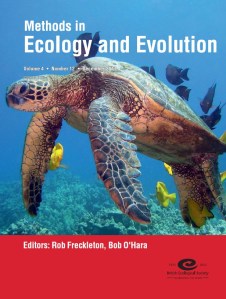
mee-4-12-coverlargeThe final issue of the year is now available online!

One of this month’s articles, ‘Calculating the ecological impacts of animal-borne instruments on aquatic organisms’ by Todd Jones et al., was picked up by the press after the University of British Columbia published the press release ‘Tagging aquatic animals can disrupt natural behaviour‘. Todd also summarises his study in an accompanying video which can be viewed on the Methods YouTube channel.

There are 2 freely available application articles included in this issue: ‘Animal social Continue reading “Issue 4.12”

An interview with the Tea Bag Index team

The Tea Bag Index is an innovative, cost-effective, well-standardised method recently covered in MEE, used to gather data on decomposition rate and litter stabilisation using commercially available tea bags as standardised test kits. In this video, David Warton interviews 2 of the authors, Joost Keuskamp and Mariet Hefting from Utrecht University, who explain how it works and what they plan to do with it in … Continue reading An interview with the Tea Bag Index team

Issue 4.11

Issue 4.11 is now online! This issue includes articles on distance sampling, statistics, survey data, seed dispersal, decomposition, food webs and species diversity. This month we’d like to highlight 2 open access papers: Rapid Bayesian inference of heritability in animal models without convergence problems, by Jon Ahlinder and Mikko J. Sillanpää, and Spatial models for distance sampling data: recent developments and future directions, by David … Continue reading Issue 4.11

BES Virtual Issue: Ecología en América del Sur

Taking place this week is the joint meeting of the Argentinian Ecological Association and the Chilean Ecological Society. To mark this event, the BES journals would like to highlight some of our South American content to date. Read the Virtual Issue here: Ecología en América del Sur. Continue reading BES Virtual Issue: Ecología en América del Sur

Tagging aquatic animals can disrupt natural behavior

In this video Todd Jones gives a summary of his recent study, which aims to increase our understanding of the impact that carrying electronic tags can have on aquatic animals. Does the increased drag have power implications? Do the tags themselves affect the behavior of the animals? To answer these questions Todd and his colleagues made cast models of sea turtles and put them in … Continue reading Tagging aquatic animals can disrupt natural behavior