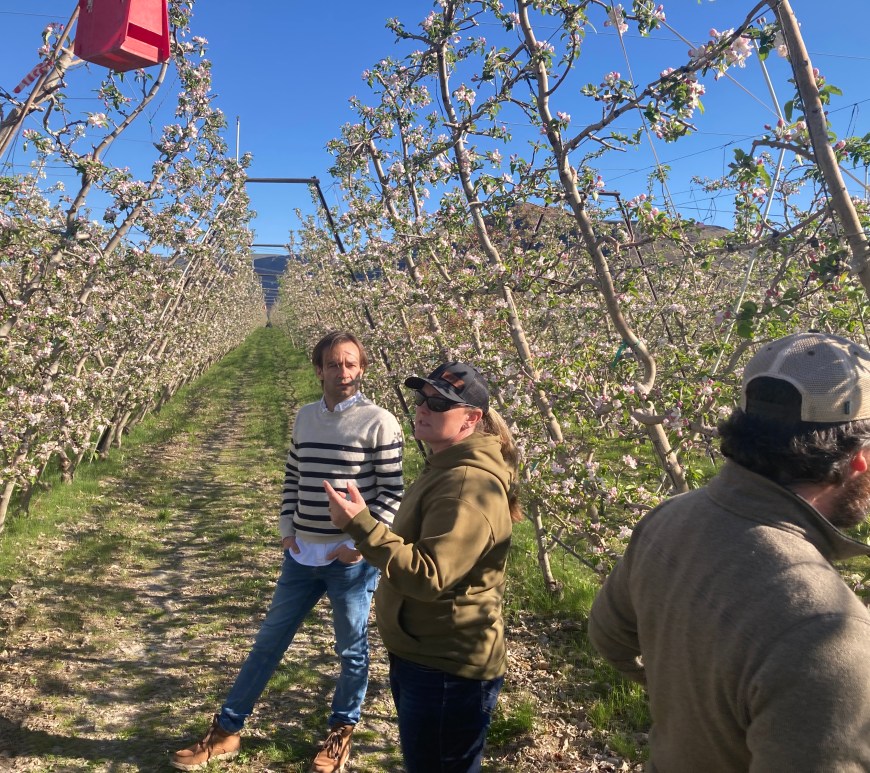
International Women’s Day 2025- Nomthi Khanyile

To celebrate International Women’s Day 2025, we are excited to share a collection of blog posts showcasing the work of some of the BES community. In each post, they discuss their experiences in ecology, as well as what this year’s theme, ‘Accelerate Action’, means to them. What work do you do?  I consider myself primarily an ecologist and, perhaps secondarily, an entomologist. I am fascinated … Continue reading International Women’s Day 2025- Nomthi Khanyile

From a frustrated undergraduate to a motivated PhD: The story of YOLO-Behaviour for automated behavioural coding from videos

Post provided by Alex Chan Hoi Hang, PhD student, Centre for the Advanced Study of Collective Behaviour, University of Konstanz The story of this project can be traced back to 2019, as a second-year undergraduate in biological sciences at Imperial College London, UK, where I took an animal behaviour course. For one of the hands-on sessions, Dr. Julia Schroeder (who later became my undergraduate and … Continue reading From a frustrated undergraduate to a motivated PhD: The story of YOLO-Behaviour for automated behavioural coding from videos

Addressing observational biases in data-driven approaches of zoonotic hazard prediction

Post provided by Andrea Tonelli Over the past five decades, more than half of emerging infectious diseases in humans originated from animals, with zoonotic pathogens posing a growing threat to global health. Shifts in land use, climate change, direct use of wildlife and biodiversity loss all influence human exposure to pathogens of wild animals, shaping the likelihood of zoonotic spillover events. In the wake of … Continue reading Addressing observational biases in data-driven approaches of zoonotic hazard prediction

Unde Venis Species? RRphylogeography, a new accurate method finds the area of origin of species

Post provided by Pasquale Raia (he/him), Alessandro Mondanaro (he/him) and Silvia Castiglione (she/her) Quo Vadis? Latin for Where Are You Going? was a huge 1951 box office hit produced by Metro Goldwyn Mayer. The film (which is based on an 1896 book wrote by the Polish novelist Henryk Sienkiewicz) was set in ancient Rome during Nero’s reign and is credited for saving MGM from bankruptcy … Continue reading Unde Venis Species? RRphylogeography, a new accurate method finds the area of origin of species

Into the Swarm-Verse: quantifying collective motion across species and contexts

Post provided by Marina Papadopoulou Authors We are three researchers interested in collective animal behaviour. Marina Papadopoulou is a postdoctoral researcher at Tuscia University in Italy, Simon Garnier is a Professor at the New Jersey Institute of Technology (USA), and Andrew King is an Associate Professor at Swansea University (UK). As a Greek-French-Welsh team with empirical, mathematical, and computational backgrounds in different study systems, we … Continue reading Into the Swarm-Verse: quantifying collective motion across species and contexts

Our February issue is out now!

This issue contains the latest methods in ecology and evolution. Read to find out about this month’s featured articles and the article behind our cover! Featured Ten practical guidelines for microclimate research in terrestrial ecosystems This review presents 10 practical guidelines for ground-based research of terrestrial microclimates, covering methods and best practices from initial conceptualisation of the study to data analyses. The guidelines encompass the … Continue reading Our February issue is out now!

Avoiding Confusion: Modelling Image Identification Surveys with Classification Errors

Post provided by Jon Barry We are a group comprised of statisticians, ecologists and a computer scientist. Back in 2021 when this work started, we were all employed at the Centre for Environment, Fisheries and Aquacultural Science (Cefas) at Lowestoft, U.K. Since then, Robert, our computer scientist, has ‘jumped ship’ (no pun intended) to the Alan Turing Institute. We were aware that AI image recognition … Continue reading Avoiding Confusion: Modelling Image Identification Surveys with Classification Errors

It is only by understanding what causes sampling bias that we can correct it

Post provided by Rob J. Boyd Colleagues and I recently published a paper in MEE, and its title might induce a bit of head scratching: “Using causal diagrams … to correct geographic sampling biases in biodiversity monitoring data” (Boyd et al., 2025). If you’re familiar with causal inference, you might be wondering, “What have causal diagrams got to do with sampling biases?” And if you’re … Continue reading It is only by understanding what causes sampling bias that we can correct it

Ten practical guidelines for microclimate research in terrestrial ecosystems

Post provided by  Jonas Lembrechts. Blogpost adapted from: http://www.the3dlab.org: Ten practical guidelines | The 3D lab Ecologists and biogeographers are increasingly recognizing the critical role of microclimate in addressing a wide range of research questions. Consequently, many researchers are incorporating microclimate sensors into their studies. While deploying these sensors might seem straightforward—simply plugging them in and collecting data—there are numerous important factors to consider. Until … Continue reading Ten practical guidelines for microclimate research in terrestrial ecosystems

Our January issue is out now!

This issue contains the latest methods in ecology and evolution, including our first Felsenstein Review! Read to find out about this month’s featured articles and the article behind our cover! Featured Simpson’s tachytely or bradytely? The importance of quantifying rate uncertainty The spectacular variation in species forms and richness across space and time can be explored using sophisticated and powerful tools recently developed by evolutionary … Continue reading Our January issue is out now!