A New Way to Study Bee Cognition in the Wild

Understanding how animals perceive, learn and remember stimuli is critical for understanding both how cognition is shaped by natural selection, and how ecological factors impact behaviour.Unfortunately, the limited number of protocols currently available for studying insect cognition has restricted research to a few commercially available bee species, in almost exclusively laboratory settings. In a new video Felicity Muth describes a simple method she developed with Trenton Cooper, Rene … Continue reading A New Way to Study Bee Cognition in the Wild

Microphone Backpacks for Individual-level Acoustic Recordings

To understand the factors shaping vocal communication, we need reliable information about the communicating individuals on different levels. First, vocal behaviour should be recorded from undisturbed animals in meaningful settings. Then we have to separate and assign the individuals’ vocalisations. Finally, the precise timing of vocal events needs to be stored. Microphone backpacks allow researchers to record the vocal behaviour of individual animals in naturalistic settings – even in acoustically challenging … Continue reading Microphone Backpacks for Individual-level Acoustic Recordings

Movement Ecology: Stepping into the Mainstream

Post provided by Theoni Photopoulou

“Movement is the glue that ties ecological processes together”
from Francesca Cagnacci et al. 2010

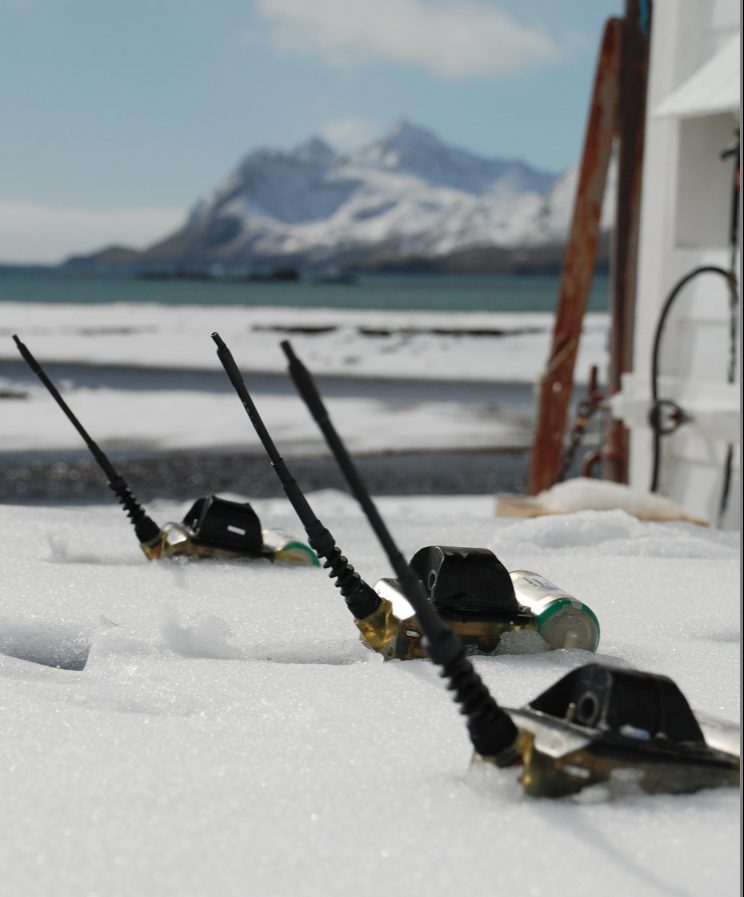
CTD-SRDL telemetry tags being primed for deployment. ©Theoni Photopoulou

Movement ecology is a cross-disciplinary field. Its main aim is to quantitatively describe and understand how movement relates to individual and population-level processes for resource acquisition and, ultimately, survival. Today the study of movement ecology hinges on two 21st century advances:

  1. Animal-borne devices/tags (biologging science, Hooker et al., 2007) and/or remote sensing technology to quantify movement and collect data from remote or otherwise challenging environments
  2. Computational power sufficient to manipulate, process and analyse substantial volumes of data

Although datasets often involve small numbers of individuals, each individual can have thousands – sometimes even millions – of data points associated with it. Study species have tended to be large birds and mammals, due to the ease of tag attachment. However, the trend for miniaturisation of tags and the development of remote detection technologies (such as radar, e.g. Capaldi et al., 2000), have allowed researchers to track and study ever smaller animals. Continue reading “Movement Ecology: Stepping into the Mainstream”

Soaring with Eagles, Swimming with Sharks: Measuring Animal Behaviour with Hidden Markov Models

Post provided by THEONI PHOTOPOULOU, MEGAN MURGATROYD, VIANEY LEOS-BARAJAS Around the world there are concerns over the impacts of land use change and the developments (such as wind farms). These concerns have led to the implementation of tracking studies to better understand movement patterns of animals. Such studies have provided a wealth of high-resolution data and opportunities to explore sophisticated statistical methods for analysis of animal behaviour. We use … Continue reading Soaring with Eagles, Swimming with Sharks: Measuring Animal Behaviour with Hidden Markov Models

Issue 8.2

Issue 8.2 is now online!

The February issue of Methods is now online!

This issue contains four(!) Applications articles and two Open Access articles. These six papers are freely available to everyone – no subscription required.

 Earth Mover’s Distance: The Earth Mover’s Distance (or EMD) is a method commonly used in image retrieval applications. The authors of this paper propose its use to calculate similarity in space use in the framework of movement ecology. This will be helpful for many questions regarding behavioural ecology, wildlife management and conservation.

 warbleR: The R package warbleR is a new package for the analysis of animal acoustic signal structure. It offers functions for downloading avian vocalisations from the open-access online repository Xeno-Canto, displaying the geographic extent of the recordings, manipulating sound files, detecting acoustic signals or importing detected signals from other software, and much more.

– meteR: The open-source R package, meteR directly calculates all of Maximum entropy theory of ecology’s (METE’s) predictions from a variety of data formats; automatically handles approximations and other technical details; and provides high-level plotting and model comparison functions to explore and interrogate models.

– Noise Egg: The Noise Egg is a device that can produce a low-frequency sound, which can be used as an experimental source of noise both in aquaria and in the field. It was developed to study the effects of noise on communication and behaviour in small aquatic animals; however, it could be used for other purposes, such as testing the propagation of certain frequencies in shallow-water habitats.

Continue reading “Issue 8.2”

New Associate Editors

Today we are welcoming three new Associate Editors to Methods in Ecology and Evolution: Nick Golding (University of Melbourne, Australia), Rachel McCrea (University of Kent, UK) and Francesca Parrini (University of the Witwatersrand, South Africa). They have all joined on a three-year term and you can find out more about them below. Nick Golding “I develop statistical models and software for mapping the distributions of species and diseases. I’m particularly interested in … Continue reading New Associate Editors

Issue 6.6

Issue 6.6 is now online!

The June issue of Methods is now online!

This month’s issue contains one Applications article and one Open Access article.

VirtualCom: A simple and readily usable tool that will help to resolve theoretical and methodological issues in community ecology. VirtualCom simulates the evolution of the pool of regionally occurring species, the process-based assembly of native communities and the invasion of novel species into native communities. One of the authors of this Application is the 2014 Robert May Young Investigator Prize Winner, Laure Gallien.

Calibrating animal-borne proximity loggers, this month’s only Open Access article, comes from Christian Rutz et al. The authors calibrated a recently developed digital proximity-logging system (‘Encounternet’) for deployment on a wild population of New Caledonian crows. They show that, using signal-strength information only, it is possible to assign crow encounters reliably to predefined distance classes, enabling powerful analyses of social dynamics. Their study demonstrates that well-calibrated proximity-logging systems can be used to chart social associations of free-ranging animals over a range of biologically meaningful distances.

Our June issue also features articles on Phylogenetic MethodsPhysiological Ecology, Biomonitoring and Conservation, Species Distribution Monitoring and Bioinformatics. Continue reading “Issue 6.6”

Issue 6.5

Issue 6.5 is now online!

The May issue of Methods is now online!

We have two freely available articles this month: one Application and one Open Access Article.

rSPACE: An open-source R package for implementing a spatially based power analysis for designing monitoring programs. This method incorporates information on species biology and habitat to parameterize a spatially explicit population simulation.

Tim Lucas et al. provide this month’s Open Access article: A generalised random encounter model for estimating animal density with remote sensor data. The authors have developed a Generalised Random Encounter Model (gREM) to estimate absolute animal density from count data from both camera traps and acoustic detectors. They show that gREM produces accurate estimates of absolute animal density for all combinations of sensor detection widths and animal signal widths. This model is applicable for count data obtained in both marine and terrestrial environments, visually or acoustically. It could be used for big cats, sharks, birds, echolocating bats, cetaceans and much more. Continue reading “Issue 6.5”