Conservation or Construction? Deciding Waterbird Hotspots

Below is a press release about the Methods in Ecology and Evolution article ‘A comparative analysis of common methods to identify waterbird hotspots‘ taken from Michigan State University.

A mixed flock of waterbirds on the shore of Lake St. Clair. ©Michigan DNR

Imagine your favourite beach filled with thousands of ducks and gulls. Now envision coming back a week later and finding condos being constructed on that spot. This many ducks in one place surely should indicate this spot is exceptionally good for birds and must be protected from development, right?

It depends, say Michigan State University researchers.

In a new paper published in Methods in Ecology and Evolution, scientists show that conservation and construction decisions should rely on multiple approaches to determine waterbird “hotspots,” not just on one analysis method as is often done. Continue reading “Conservation or Construction? Deciding Waterbird Hotspots”

The Dark and Bright Sides of Phylogenetics and Comparative Methods

Five years ago at Evolution 2014, ‘The Dark Side of Phylogenetics’ symposium (organised by Natalie Cooper) explored some of the issues with phylogenetic comparative methods (PCMs). This year at Evolution 2019, Michael Landis and Rosana Zenil-Ferguson are organising a contrasting ‘Bright Side of Phylogenetics‘ spotlight session (featuring Michael Matschiner). They aim to promote research that has overcome these pitfalls and that explores innovations in phylogenetics. Clearly they found our lack of faith disturbing.

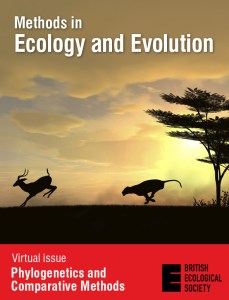
Natalie and Michael have created a Virtual Issue to complement the spotlight session: Phylogenetics and Comparative Methods: The Bright and Dark Sides. It highlights recent Methods in Ecology and Evolution papers that feature either the ‘Bright Side’ or ‘Dark Side’ of phylogenetics and comparative methods. This Virtual Issue also highlights the diversity of researchers around the world working on these exciting questions. We hope you have a good feeling about it! Continue reading “The Dark and Bright Sides of Phylogenetics and Comparative Methods”

Issue 6.11

Issue 6.11 is now online!

The November issue of Methods is now online!

This month’s issue contains two Applications articles and one Open Access article, all of which are freely available.

mvMORPH: A package of multivariate phylogenetic comparative methods for the R statistical environment which allows fitting a range of multivariate evolutionary models under a maximum-likelihood criterion. Its use can be extended to any biological data set with one or multiple covarying continuous traits.

Low-cost soil CO2 efflux and point concentration sensing systems: The authors use commercially available, low-cost and low-power non-dispersive infrared (NDIR) CO2 sensors to develop a soil CO2 efflux system and a point CO2 concentration system. Their methods enable terrestrial ecologists to substantially improve the characterization of CO2 fluxes and concentrations in heterogeneous environments.

This month’s Open Access article comes from Jolyon Troscianko and Martin Stevens. In ‘Image calibration and analysis toolbox – a free software suite for objectively measuring reflectance, colour and pattern‘ they introduce a toolbox that can convert images to correspond to the visual system (cone-catch values) of a wide range of animals, enabling human and non-human visual systems to be modelled. The toolbox is freely available as an addition to the open source ImageJ software and will considerably enhance the appropriate use of digital cameras across multiple areas of biology. In particular, researchers aiming to quantify animal and plant visual signals will find this useful. This article received some media attention upon Early View publication over the summer. You can read the Press Release about it here.

Our November issue also features articles on Population Genetics, Macroevolution, Modelling species turnover, Abundance modelling, Measuring stress and much more. Continue reading “Issue 6.11”

Methods Digest – February 2010

This monthly digest is a bit late as we have been busy writing an editorial and finalizing the running order for the first issue of the journal. That should be online in a couple of weeks. Pre-publication versions of papers are here, whilst an up-to-date list of accepted papers is here. The very latest updates are also available via Twitter and Facebook. In Ecology Letters, … Continue reading Methods Digest – February 2010

Phylogenetic comparative methods

Phylogenetic comparative methods are always an area of hot discussion and lots of methodological development. So I thought it would be useful to highlight some recent papers that have developed new methods in the past year. Please email me or leave a comment if there is anything I have omitted or if something new comes out. Thomas Hansen and colleagues have introduced a new method … Continue reading Phylogenetic comparative methods