Key Technologies Used to Build the plant Package (and Maybe Soon Some Other Big Simulation Models in R)

Post provided by RICH FITZJOHN and DANIEL FALSTER

Our paper in Methods in Ecology and Evolution describes a new software package, plantplant is an individual-based simulation model that simulates the growth of individual trees, stands of competing plants, or entire metacommunities under a disturbance regime, using common physiological rules and trait-based functional trade-offs to capture differences among species.

Non-Linear Processes and Thousands of Plants

Since the development of gap models in the 1970s (e.g. Botkin 1972), researchers have been using computer simulations to investigate how elements of plant biology interact with competition and disturbance regimes to influence vegetation demography, structure and diversity. Simulating the competitive interactions among many thousands of plants, however, is no easy task.

Despite widespread recognition of the importance of key non-linear processes — such as size-structured competition, disturbance, and trait-based trade-offs — for vegetation dynamics, relatively few researchers have been brave (or daft) enough to try and incorporate such processes into their models. The situation is most extreme in theoretical ecology, where much contemporary theory (e.g. coexistence theory, neutral theory) is still built around completely unstructured populations.

Features of plant
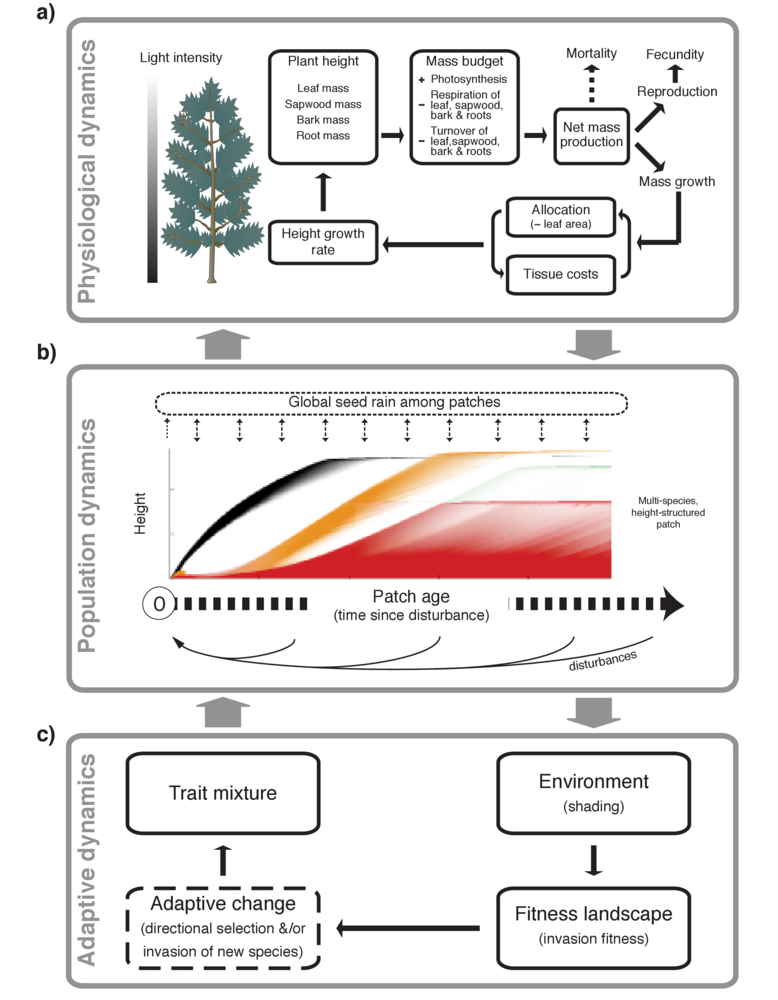
Key processes modelled within the plant package.

The plant package attempts to change that by providing an extensible, open source framework for studying trait-, size- and patch-structured dynamics. One thing that makes the plant model significant is the focus on traits. plant is one of several attempts seeking to integrate current understanding about trait based trade-offs into a model of individual plant function (see also Moorcroft et al 2001Sakschewski et al 2015).

A second feature that makes the plant software significant, is it that is perhaps the first example where a computationally intensive model has been packaged up in a way that enables widespread usage, makes the model more usable and doesn’t  sacrifice speed.

In this post we will describe the key technologies used to build the plant software. Continue reading “Key Technologies Used to Build the plant Package (and Maybe Soon Some Other Big Simulation Models in R)”

Demography Beyond the Population Webinar: Register for Free Now

Webinar logoRegister for FREE for the first ever BES Publishing webinar based on our forthcoming Demography Beyond the Population Special Feature.

This hour long webinar will begin at 1pm (GMT) on Tuesday 1 March. It highlights some of the excellent articles soon to be published in the British Ecological Society journals Special Feature entitled “Demography Beyond the Population”. The Special Feature is a collaborative effort including articles in all six BES journals. This is the first time such a large ecological collaboration has been attempted worldwide. Using a cross-journal approach has allowed us to highlight the strongly interdisciplinary nature of the field of demography to its fullest potential as well as to lay down the foundations for future directions at the interface of ecology, evolution, conservation biology and human welfare. The webinar has several international speakers and will discuss the articles in the Special Feature and the implications for demography research going forward. Continue reading “Demography Beyond the Population Webinar: Register for Free Now”

Issue 7.1

Issue 7.1 is now online!

The January issue of Methods is now online!

As always, the first issue of the year is our sample issue. You can access all of the articles online free of charge. No subscription or membership is required!

We have two Open Access articles and two Applications papers in our January issue.

Recognizing False Positives: Environmental DNA (eDNA) is increasingly used for surveillance and detection of species of interest in aquatic and soil samples. A significant risk associated with eDNA methods is potential false-positive results due to laboratory contamination. To minimize and quantify this risk, Chris Wilson et al. designed and validated a set of synthetic oligonucleotides for use as species-specific positive PCR controls for several high-profile aquatic invasive species.

BiMat: An open-source MATLAB package for the study of the structure of bipartite ecological networks. BiMat enables both multiscale analysis of the structure of a bipartite ecological network – spanning global (i.e. entire network) to local (i.e. module-level) scales – and meta-analyses of many bipartite networks simultaneously. The authors have chosen to make this Applications article Open Access.

Gemma Murray et al. provide this month’s second Open Access article. In ‘The effect of genetic structure on molecular dating and tests for temporal signal‘ the authors use simulated data to investigate the performance of several tests of temporal signal, including some recently suggested modifications. The article shows that all of the standard tests of temporal signal are seriously misleading for data where temporal and genetic structures are confounded (i.e. where closely related sequences are more likely to have been sampled at similar times). This is not an artifact of genetic structure or tree shape per se, and can arise even when sequences have measurably evolved during the sampling period.

Our January issue also features articles on Monitoring, Population Ecology, Genetics, Evolution, Community Ecology, Diversity and more. Continue reading “Issue 7.1”

Methods in Ecology and Evolution 2015: The Year in Review

Happy New Year! We hope that you all had a wonderful Winter Break and that you’re ready to start 2016. We’re beginning the year with a look back at some of our highlights of 2015. Here’s how last year looked at Methods in Ecology and Evolution.

The Articles

We published some amazing articles in 2015, too many to mention them all here. However, we would like to say a massive thank you to all of the authors, reviewers and editors who contributed to the journal last year. Without your hard work, knowledge and generosity, the journal would not be where it is today. We really appreciate all of your time and effort. THANK YOU!

mee312268_CoverOpportunities at the Interface between Ecology and Statistics

There was only one Special Feature in the journal this year, but it was a great one. Arising from the 2013 Eco-Stats Symposium at the University of New South Wales and guest edited by Associate Editor David Warton, Opportunities at the Interface between Ecology and Statistics was one of the highlights of 2015 for us. It consists of seven articles written collaboratively by statisticians and ecologists and highlights the benefits of cross-disciplinary partnerships. Continue reading “Methods in Ecology and Evolution 2015: The Year in Review”

Maximising the Exposure of Your Research: Search Engine Optimisation and why it matters

This post is an outcome of the ‘Maximising the Exposure of Your Research’ Workshop at the BES 2015 Annual Meeting in Edinburgh (UK). If you’re interested in joining us for our 2016 Annual Meeting in Liverpool (UK), you can find some more information and pre-register HERE.

© Got Credit
© Got Credit

In recent years there has been a significant increase in the number of academic articles published. At the same time, readers are changing how they find content, tending towards a point of entry at article level as opposed to journal level. These two factors mean that it is increasingly necessary for authors to make their articles easy for relevant readers to find. Search Engine Optimisation (SEO) is one of the best ways to do this.

While writing your paper, there are a few things that you can do to optimise it for search engines, such as Google Scholar. The tips below focus on three areas that are prioritised by search engines when looking for content. Following these tips will help you to maximise the exposure of your research. Continue reading “Maximising the Exposure of Your Research: Search Engine Optimisation and why it matters”

Issue 6.12

Issue 6.12 is now online!

The December issue of Methods is now online! 

Our final issue of 2015 contains one Applications article and two Open Access articles, all of which are freely available.

stagePOP: A tool for predicting the deterministic dynamics and interactions of stage-structured populations (i.e. where the life cycle consists of distinct stages, for example eggs, juveniles and reproductive adults). The continuous-time formulation enables stagePop to easily simulate time-varying stage durations, overlapping generations and density-dependent vital rates.

Julia Cherry et al. provide one of this month’s Open Access articles. In ‘Testing sea-level rise impacts in tidal wetlands: a novel in situ approach‘ the authors describe the use of experimental weirs that manipulate water levels to test sea-level rise impacts in situ and at larger spatial scales. This new method can provide more robust estimates of sea-level rise impacts on tidal wetland processes. This article was accompanied by a press release when it was published in Early View. You can read more about this article here.

Our September issue also features articles on Biodiversity, Demography, Predator-Prey Interactions, Animal Communication and much more. Continue reading “Issue 6.12”

A Quickstart Guide for Building Your First R Package

Post Provided By DR IAIN STOTT

Iain is a Postdoctoral Researcher at the Max Planck Institute for Demographic Research and the MaxO Center at the University of Southern Denmark. He is currently working as a part of MaxNetAging, a Research Network on Aging. Iain was one of the presenters at the UK half of the Methods in Ecology and Evolution 5th Anniversary Symposium in April. You can watch his talk, ‘Methods Put to Good Use: Advances in population ecology through studies of transient demography’ here.

If you’re anything like me, you might experience a minor existential crisis weekly. As scientists we question the world around us and, for me, this questioning turns all-too-often inwards to my career. I don’t think that’s unusual: ask any scientist about their ‘Plan B’, and the extent to which it’s thought through is often astonishing (if a café-cum-cocktail bar ever opens in Glasgow’s West End, which specialises in drinks that employ spice blends from around the world and are named after old spice trade routes and trading vessels, then you know I’ve jumped the science ship).

Contributing open-source software is something which has made my work feel a bit more relevant and helped me feel a bit less of an imposter. I’ll explain why that is, give some tips to beginners for building a first R package, and hopefully persuade other (especially early-career) researchers to do the same. Continue reading “A Quickstart Guide for Building Your First R Package”

There’s Madness in our Methods: Improving inference in ecology and evolution

Post provided by JARROD HADFIELD

Last week the Center for Open Science held a meeting with the aim of improving inference in ecology and evolution. The organisers (Tim Parker, Jessica Gurevitch & Shinichi Nakagawa) brought together the Editors-in-chief of many journals to try to build a consensus on how improvements could be made. I was brought in due to my interest in statistics and type I errors – be warned, my summary of the meeting is unlikely to be 100% objective.

True Positives and False Positives

The majority of findings in psychology and cancer biology cannot be replicated in repeat experiments. As evolutionary ecologists we might be tempted to dismiss this because psychology is often seen as a “soft science” that lacks rigour and cancer biologists are competitive and unscrupulous. Luckily, we as evolutionary biologists and ecologists have that perfect blend of intellect and integrity. This argument is wrong for an obvious reason and a not so obvious reason.

We tend to concentrate on significant findings, and with good reason: a true positive is usually more informative than a true negative. However, of all the published positives what fraction are true positives rather than false positives? The knee-jerk response to this question is 95%. However, the probability of a false positive (the significance threshold, alpha) is usually set to 0.05, and the probability of a true positive (the power, beta) in ecological studies is generally less than 0.5 for moderate sized effects. The probability that a published positive is true is therefore 0.5/(0.5+0.05) =91%. Not so bad. But, this assumes that the hypotheses and the null hypothesis are equally likely. If that were true, rejecting the null would give us very little information about the world (a single bit actually) and is unlikely to be published in a widely read journal. A hypothesis that had a plausibility of 1 in 25 prior to testing would, if true, be more informative, but then the true positive rate would be down to (1/25)*0.5/((1/25)*0.5+(24/25)*0.05) =29%. So we can see that high false positive rates aren’t always the result of sloppiness or misplaced ambition, but an inevitable consequence of doing interesting science with a rather lenient significance threshold. Continue reading “There’s Madness in our Methods: Improving inference in ecology and evolution”

Why Accurate Stable Isotope Discrimination Factors are so Important: A cautionary tale (involving kea)

Post provided by AMANDA GREER

Stable isotopes as a tool for ecologists

Our research into the foraging ecology of this cheeky parrot (kea: Nestor notabilis) prompted us to develop a simple method to establish discrimination factors © Andruis Pašukonis
Our research into the foraging ecology of this cheeky parrot (kea: Nestor notabilis) prompted us to develop a simple method to establish discrimination factors © Andruis Pašukonis

Isotopes are atoms that have the same number of protons and electrons but differ in their number of neutrons; they are lighter and heavier forms of the same element. Unlike radioactive isotopes, stable isotopes do not decay over time.

The ratio of heavy to light stable carbon (δ13C) and nitrogen (δ15N) isotopes in an animal’s tissues depend on its diet, although offset by a certain amount. This integration of δ13C and δ15N from an animal’s diet into its tissues allows ecologists to use stable isotope analysis to investigate a species’ present and historical diets, food-web structures, niche shifts,  migration patterns and more.   Continue reading “Why Accurate Stable Isotope Discrimination Factors are so Important: A cautionary tale (involving kea)”

Issue 6.11

Issue 6.11 is now online!

The November issue of Methods is now online!

This month’s issue contains two Applications articles and one Open Access article, all of which are freely available.

mvMORPH: A package of multivariate phylogenetic comparative methods for the R statistical environment which allows fitting a range of multivariate evolutionary models under a maximum-likelihood criterion. Its use can be extended to any biological data set with one or multiple covarying continuous traits.

Low-cost soil CO2 efflux and point concentration sensing systems: The authors use commercially available, low-cost and low-power non-dispersive infrared (NDIR) CO2 sensors to develop a soil CO2 efflux system and a point CO2 concentration system. Their methods enable terrestrial ecologists to substantially improve the characterization of CO2 fluxes and concentrations in heterogeneous environments.

This month’s Open Access article comes from Jolyon Troscianko and Martin Stevens. In ‘Image calibration and analysis toolbox – a free software suite for objectively measuring reflectance, colour and pattern‘ they introduce a toolbox that can convert images to correspond to the visual system (cone-catch values) of a wide range of animals, enabling human and non-human visual systems to be modelled. The toolbox is freely available as an addition to the open source ImageJ software and will considerably enhance the appropriate use of digital cameras across multiple areas of biology. In particular, researchers aiming to quantify animal and plant visual signals will find this useful. This article received some media attention upon Early View publication over the summer. You can read the Press Release about it here.

Our November issue also features articles on Population Genetics, Macroevolution, Modelling species turnover, Abundance modelling, Measuring stress and much more. Continue reading “Issue 6.11”