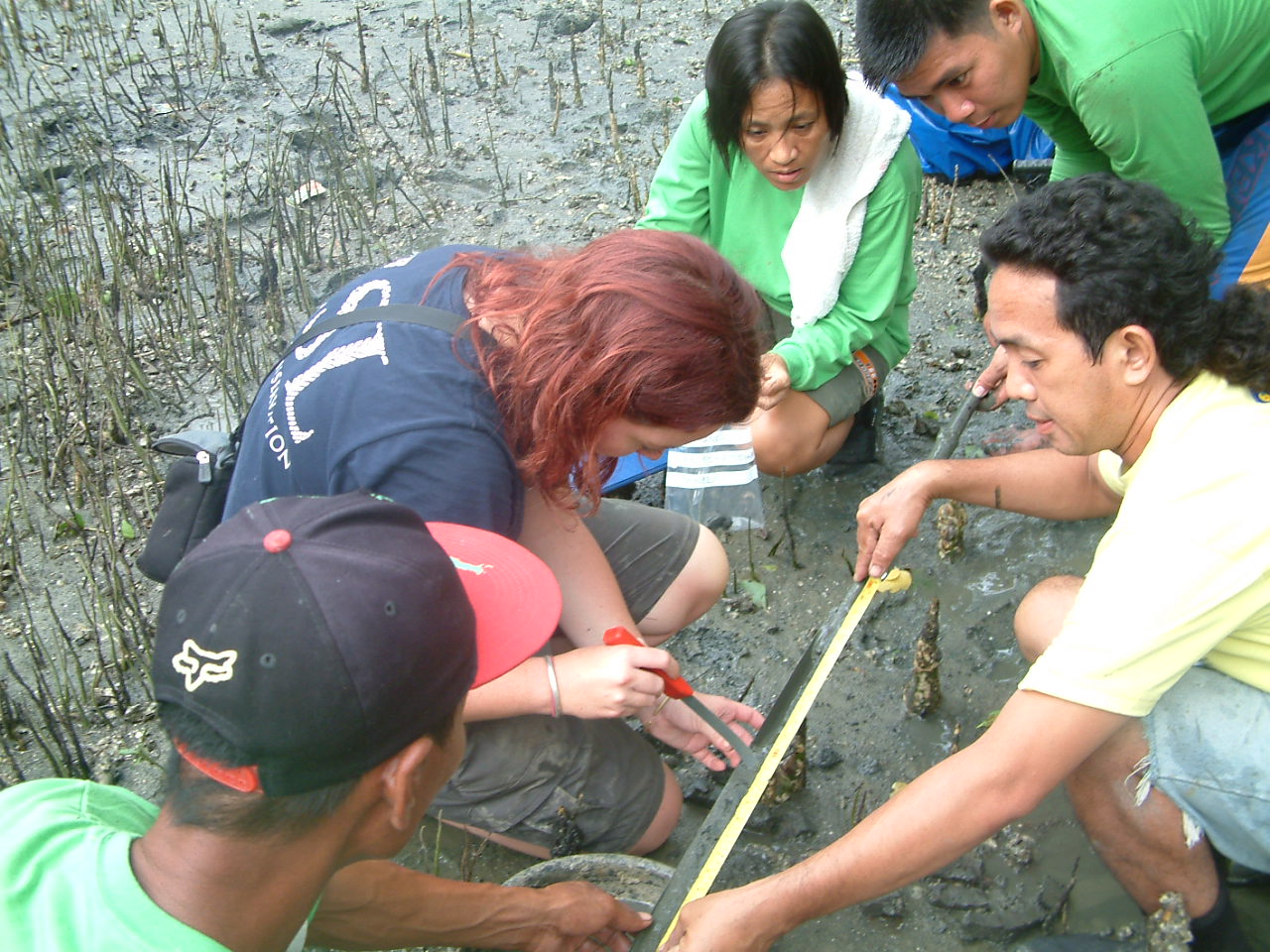
Scientists designed a new, on-site method for studying potential impacts rising sea levels can have on vital wetlands, said a University of Alabama researcher who led a study publishing in Methods in Ecology and Evolutiontoday describing the modifiable apparatuses.
Primarily using materials available at the local hardware store, the scientists, including UA’s Dr Julia Cherry, designed, constructed and tested low-cost enclosures, called weirs, to realistically simulate three flooding levels on coastal wetlands. Simulating impacts of sea level rise on-site and at larger scales had previously proven difficult.
Applied ecology can be defined as scientific knowledge that helps in making good management decisions. Scientists have a natural desire to collect information, managers want that information so that they know they are doing the right thing, and both generally act under the assumption that more information equals better decisions. This is generally correct, since information helps us make, well, informed decisions. Therefore, when our ecological knowledge is uncertain (which is practically always the case) we usually advocate further research.
On the other hand, however, information comes at a cost. It may cost money to collect it and take time to set up studies: both are usually in short supply. We can’t learn everything and often the information we can actually collect is still imperfect. So how do we determine if that additional piece of information we’d like to have is really valuable for our management?
In decision analysis, the value of information is the improvement in the outcomes of our actions that we would expect if we could reduce or eliminate uncertainty before making a decision. Previously applied in engineering, economics and healthcare planning, VOI is also intuitively appealing for environmental management, where decisions must be made in the face of ubiquitous uncertainty. Knowing the value of information can assist in designing monitoring and experimental programs, implementing adaptive management and prioritising sources of uncertainty. In other words, it can help applied ecologists and conservation managers find a focused, transparent way to address the inevitable need for “more data”.
An increasing number of studies are applying VOI to conservation management; however, in spite of its potential the technique is still underused in real-world applications, particularly beyond the small community of applied ecologists trained in decision-analytic methods.
Click Image to begin a Prezi Presentation on Value of Information
In summary, three things determine the value of information:
How much we already know (the more we know, the less beneficial it is to collect more information)
Whether and how we would react to that extra information by changing actions, and how much better would the updated action be
How good is the information we can actually get (think about sample sizes, imperfect detection, time lags, etc)
This month’s issue contains two Applications article and one Open Access article, all of which are freely available.
– fuzzySim: Binary similarity indices are widely used in ecology. This study proposes fuzzy versions of the binary similarity indices most commonly used in ecology, so that they can be directly applied to continuous (fuzzy) rather than binary occurrence values, producing more realistic similarity assessments. fuzzySim is an open source software package which is also available for R.
–Actave.net: A freely accessible, web-based analysis tool for complex activity data, actave.net provides cloud-based and automatic computation of daily aggregates of various activity parameters based on recorded immersion data. It provides maps and graphs for data exploration, download of processed data for modelling and statistical analysis, and tools for sharing results with other users.
Anna Sturrock et al. provide this month’s Open Access article. In ‘Quantifying physiological influences on otolith microchemistry‘ the authors test relationships between otolith chemistry and environmental and physiological variables. The influence of physiological factors on otolith composition was particularly evident in Sr/Ca ratios, the most widely used elemental marker in applied otolith microchemistry studies. This paper was reported on in the media recently. You can read more about it here.
Matt is an Associate Editor for Methods in Ecology and Evolution. He was the principle organiser of this year’s SEEM conference. His research interests include Bayesian inference and hierarchical modelling, computational methodology, ecological statistics and much more. Matt is based at the University of Otago.
A photo taken during a lunch break at the conference
The Statistics in Ecology and Environmental Monitoring (SEEM) conference was held in Queenstown, New Zealand on June 22-26, 2015. Queenstown is a resort town in the Southern Alps of New Zealand that looks out on Lake Wakatipu, surrounded by snow-capped mountains. The venue gave a chance to explore some of the natural beauty of New Zealand, with excursions to local ski fields, wineries and various hiking trails.
SEEM conferences have been organized by members of the Statistics group at the University of Otago since 1993. The first SEEM conference was held in Dunedin, New Zealand and conferences were then held regularly (every 3 years) until 2002. The last SEEM conference, in 2007, also served as the EURING (European Union for Bird Ringing) technical meeting. With nearly ten years passing since 2007, we had a smaller conference of around 50 attendees this year. There was an engaging atmosphere during the meeting and productive discussion followed each of the 40 talks. The SEEM 2015 meeting maintained the tradition of previous SEEM conferences with delegates from across a broad spectrum of statistical ecology coming together to discuss research. Continue reading “Statistics in Ecology and Environmental Monitoring: A Look Back at the SEEM 2015 Conference”
Thomson-Reuters have just released this year’s Impact Factors. The Methods in Ecology and Evolution Impact Factor is now an astounding 6.554, up from a truly dismal 5.322 last year. We now have enough years of Impact Factors to make it worthwhile drawing a graph.
The Methods in Ecology and Evolution Impact Factor goes up and up (…except when it doesn’t).
This puts us ninth in Ecology, and we would be fifth in Evolutionary Biology if Thomson-Reuters thought we published stuff in Evolutionary Biology. We would also be top in Statistics and Substance Abuse if we could get ourselves into either of those categories. Continue reading “The Methods in Ecology and Evolution 5th Anniversary Impact Factor”
This month’s issue contains one Applications article and one Open Access article.
– VirtualCom: A simple and readily usable tool that will help to resolve theoretical and methodological issues in community ecology. VirtualCom simulates the evolution of the pool of regionally occurring species, the process-based assembly of native communities and the invasion of novel species into native communities. One of the authors of this Application is the 2014 Robert May Young Investigator Prize Winner, Laure Gallien.
Calibrating animal-borne proximity loggers, this month’s only Open Access article, comes from Christian Rutz et al. The authors calibrated a recently developed digital proximity-logging system (‘Encounternet’) for deployment on a wild population of New Caledonian crows. They show that, using signal-strength information only, it is possible to assign crow encounters reliably to predefined distance classes, enabling powerful analyses of social dynamics. Their study demonstrates that well-calibrated proximity-logging systems can be used to chart social associations of free-ranging animals over a range of biologically meaningful distances.
If there is one question I hear over and over again, it’s this: “why, oh why, do you use satellite data instead of ground-based data in your research?” People seem to think that I believe satellite data are better than ground-based data. Do I not value fieldwork? Do I not trust ground-based data? My answer to all of this is: you’ll never catch me preaching that satellite remote sensing can solve the entire data collection gap in ecological monitoring.
Yes, satellite-based techniques can address spatial and temporal domains inaccessible to traditional, on-the-ground, approaches, but I am the first to acknowledge that satellite remote sensing cannot match the accuracy, precision and thematic richness of in-situ measurement and monitoring.
In spite of this, data collected on the ground are currently difficult to use for mapping and predicting regional or global changes in the spatio-temporal distribution of biodiversity (a problem for those of us trying to tackle these kinds of issues). Ground-based data can also be expensive and tend to come from a single annual time period. This makes it difficult to gather information on temporal changes and phenology. Continue reading “In Defence of Satellite Data: The Perfect Companion to Ground-Based Research”
Mark is a statistician with Biomathematics & Statistics Scotland, based in Aberdeen. His main statistical research interests are Species Distribution Modelling, Compositional Data Analysis, Bayesian Mixture Modelling and Bayesian Ordinal Regression. Mark was one of the presenters at the UK half of the Methods in Ecology and Evolution 5th Anniversary Symposium in April. You can watch his talk, ‘Model Selection and the Cult of AIC’ here.
The level of statistical analysis in ecology journals is far higher than in most other disciplines. Ecological journals lead the way in the development of statistical methodology, necessitated by challenging practical problems involving complex data sets. As a statistician, publishing also in hydrology, soil science, social science and forensic science journals, I’ve found papers in those areas are much more likely to only use well-established methods than papers in ecology.
Here’s the big question though: why then do I have the most difficulty with ecological journals when it comes to statistical analyses? Let’s be clear here: when I say “difficulty”, I mean I receive reviews which are just plain wrong. Most statisticians I’ve spoken to who work in ecology have anecdotes from reviews which demonstrate a lack of understanding by the non-statistician reviewer (including the all-too-frequent “perhaps you should consult a statistician”). So, why the apparent disconnect?
The difference seems to be in how non-statisticians in different disciplines treat the statistics in a paper. In many subject areas, reviewers are almost deferential to the statistical analysis; in ecology, reviewers can be forthright in their condemnation, often without justification. Reviewers have every right to question the statistical analysis in a paper, but the authors have the exact same right to expect a high quality review from a genuine expert in the field. Has ecology become blasé about statistics? Continue reading “Ten Top Tips for Reviewing Statistics: A Guide for Ecologists”
We have two freely available articles this month: one Application and one Open Access Article.
– rSPACE: An open-source R package for implementing a spatially based power analysis for designing monitoring programs. This method incorporates information on species biology and habitat to parameterize a spatially explicit population simulation.
Tim Lucas et al. provide this month’s Open Access article: A generalised random encounter model for estimating animal density with remote sensor data. The authors have developed a Generalised Random Encounter Model (gREM) to estimate absolute animal density from count data from both camera traps and acoustic detectors. They show that gREM produces accurate estimates of absolute animal density for all combinations of sensor detection widths and animal signal widths. This model is applicable for count data obtained in both marine and terrestrial environments, visually or acoustically. It could be used for big cats, sharks, birds, echolocating bats, cetaceans and much more. Continue reading “Issue 6.5”
The April issue of Methods, which includes our latest Special Feature: “Opportunities at the Interface Between Ecology and Statistics” is now online!
Opportunities ar the Interface Between Ecology and Statistics is a collection of eight articles which arose from the Eco-Stats Symposium at the University of New South Wales (Australia) in July 2013.This Symposium was designed to be a collaborative forum for researchers with interests in ecology and statistics. It brought together internationally recognised leaders in these two fields (such as Jane Elith, Trevor Hastie, Anne Chao and Shirley Pledger) – many of whom have contributed articles to this Special Feature.
The Eco-Stats Symposium was arranged around five special topics, all of which are represented in this issue of Methods. Those five topics are:
In his Editorial for the Special Feature, Guest Editor David Warton suggests that one of the reasons for the success of Methods in Ecology and Evolution may be that it provides a forum for statisticians and ecologists to interact. The articles in this issue, and the conference that gave rise to them, show that these interactions can provide significant benefits for both groups.






 Methods Blog