International Day of Forests: Generation Restoration

Post provided by Chloe Robinson
Credit: Food and Agriculture Organization of the United Nations.

Forests, across all ecozones and in all shapes and sizes, are essential for life on earth. Around 80% of the world’s land-based biodiversity call forests home and over 1 billion people, including more than 2,000 Indigenous cultures, rely on forests for food, shelter, energy and income. As with many other ecosystems, forests worldwide are under increasing threat from human activities, with the current rate of deforestation estimated at 13 million hectares per year.

Continue reading “International Day of Forests: Generation Restoration”
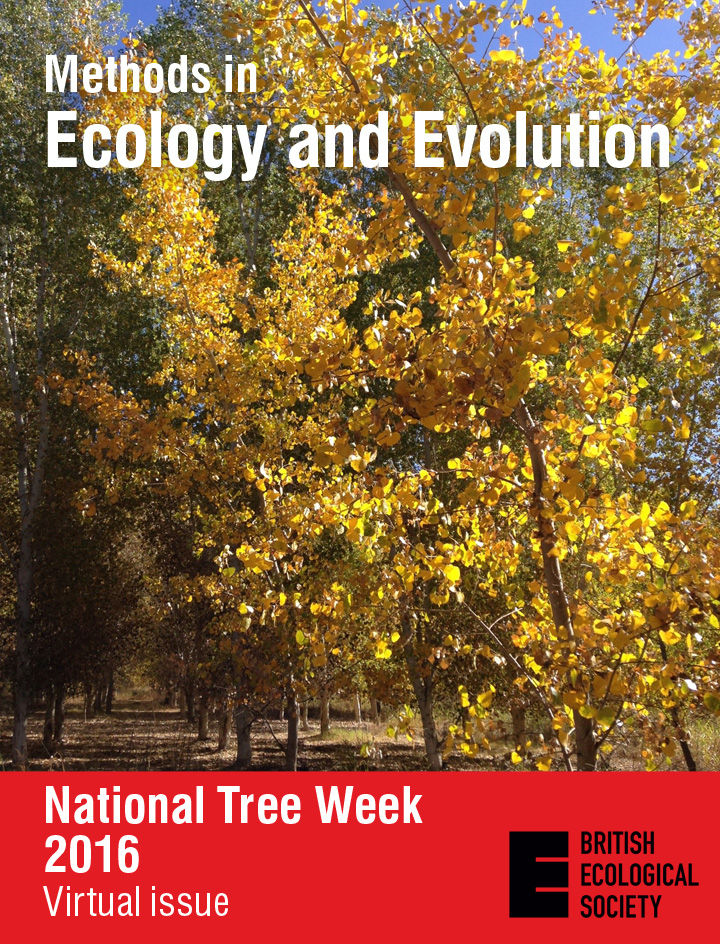
National Tree Week Virtual Issue

mee-nationaltreeweek-cover-720pxlIn the UK, National Tree Week (26 November – 4 December) celebrates tree planting within local communities. The latest BES cross-journal Virtual Issue contains recent papers that highlight the global importance of trees and forests as habitat – for species from insects to primates – and in meeting human needs for fuel and agriculture. The selected papers also demonstrate novel methods scientists are using to study trees and forests.

National Tree Week is the UK’s largest tree celebration. It was started in 1975 by the Tree Council and has grown into an event that brings hundreds of organisations together to mark the beginning of Britain’s winter tree planting season.

This Virtual Issue was compiled by Methods in Ecology and Evolution Associate Editors Sarah Goslee and Sean McMahon. All of the articles in this Virtual Issue are free for a limited time and we have a little bit more information about each of the Methods papers included here:

Connecting Forest Patches

Sagebrush steppe in eastern Idaho, USA
© Brittany J. Teller

Landscape connectivity is important for the ecology and genetics of populations threatened by climate change and habitat fragmentation. To begin our Virtual Issue Rayfield et al. present a method for identifying a multipurpose network of forest patches that promotes both short- and long-range connectivity. Their approach can be tailored to local, regional and continental conservation initiatives to protect essential species movements that will allow biodiversity to persist in a changing climate. The authors illustrate their method in the agroecosystem bordered by the Laurentian and Appalachian mountain ranges, that surrounds Montreal.

Continue reading “National Tree Week Virtual Issue”

Issue 7.10

Issue 7.10 is now online!

The October issue of Methods is now online!

This month’s issue contains three Applications articles and two Open Access articles, all of which are freely available.

– CODYN: New analytical tools applied to long-term data demonstrate that ecological communities are highly dynamic over time. The R package, library(“codyn”), helps ecologists implement these tools and gain insi–ghts into ecological community dynamics.

– Geometric Morphometrics: A tool for the R statistical environment that optimises the smoothing procedure for 3D surfaces used in Geometric Morphometrics.

– TRAPPER: Open source, multi-user software that facilitates analysis of videos and images, provides spatial filtering and web-mapping, allows flexible implementation of specific data collection protocols, and supports data re-use and (re)discovery.

Continue reading “Issue 7.10”