From lost Wood Thrushes to scientific breakthroughs: How a fieldwork challenge sparked a new way to think about occupancy models

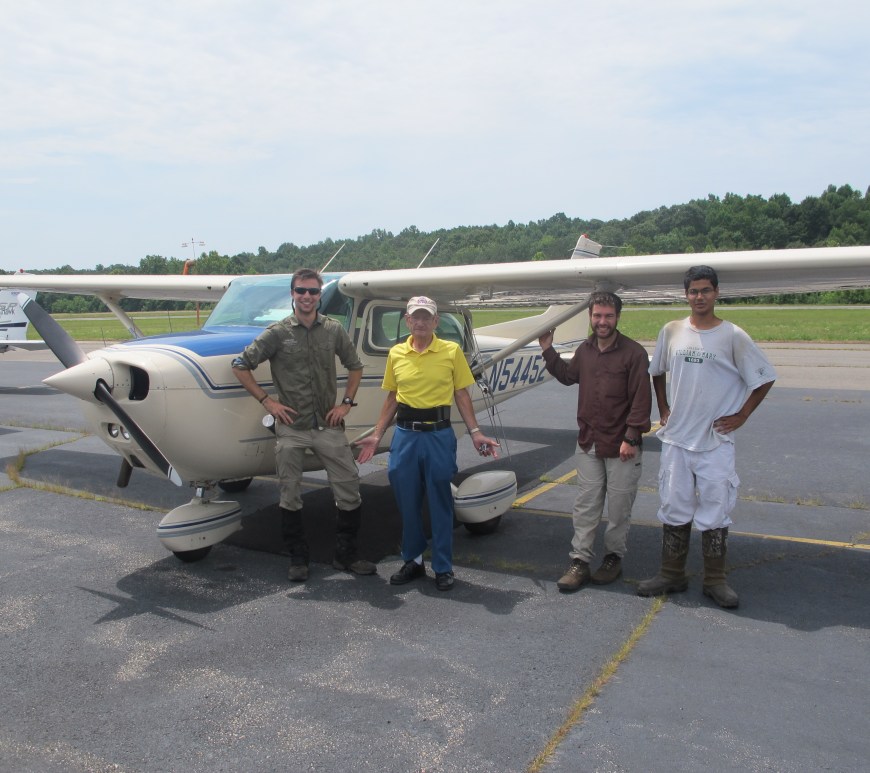
Post provided by Vitek Jirinec In 2013, I found myself knee-deep in the marshes and forests of southeastern Virginia, USA, embarking on what would become an unpredictable journey in my career. Fresh into my graduate thesis at the College of William & Mary under the guidance of Matthias Leu, the plan was studying the habitat use of Wood Thrushes—a species that is often researched, but … Continue reading From lost Wood Thrushes to scientific breakthroughs: How a fieldwork challenge sparked a new way to think about occupancy models

Conditional Occupancy Design Explained

Occupancy surveys are widely used in ecology to study wildlife and plant habitat use. To account for imperfect detection probability many researchers use occupancy models. But occupancy probability estimates for rare species tend to be biased because we’re unlikely to observe the animals at all and as a result, the data aren’t very informative. In their new article – ‘Occupancy surveys with conditional replicates: An … Continue reading Conditional Occupancy Design Explained

Issue 8.4: Technological Advances at the Interface of Ecology and Statistics

Issue 8.4 is now online!

The April issue of Methods, which includes our latest Special Feature – “Technological Advances at the Interface of Ecology and Statistics” – is now online!

This new Special Feature is a collection of five articles (plus an Editorial from Guest Editor David Warton) inspired by the December 2015 Eco-Stats conference at the University of New South Wales in Australia. It shows how interdisciplinary collaboration help to solve problems around estimating biodiversity and how it changes over space and time.

The five articles are based on joint talks given at the conference. They focus on:

As David Warton states in his Editorial, “interdisciplinary collaboration and the opportunities offered by recent technological advances have potential to lead to interesting and sometimes surprising findings, and will continue to be fertile ground for scientists in the foreseeable future”. Meetings like Eco-Stats 15 and Special Features like this one will, hopefully, help to encourage these sorts of collaborative research projects.

All of the articles in the ‘Technological Advances at the Interface of Ecology and Statistics‘ Special Feature will be freely available for a limited time.
Continue reading “Issue 8.4: Technological Advances at the Interface of Ecology and Statistics”

Issue 7.5

Issue 7.5 is now online!

The May issue of Methods is now online!

This month’s issue contains two Applications articles and two Open Access articles, all of which are freely available.

piecewiseSEM: A practical implementation of confirmatory path analysis for the R programming language. This package extends the method to all current (generalized) linear, (phylogenetic) least-square, and mixed effects models, relying on familiar R syntax. The article also includes two worked examples.

 RPANDA: An R package that implements model-free and model-based phylogenetic comparative methods for macroevolutionary analyses. It can be used to:

  1. Characterize phylogenetic trees by plotting their spectral density profiles
  2. Compare trees and cluster them according to their similarities
  3. Identify and plot distinct branching patterns within trees
  4. Compare the fit of alternative diversification models to phylogenetic trees
  5. Estimate rates of speciation and extinction
  6. Estimate and plot how these rates have varied with time and environmental variables
  7. Deduce and plot estimates of species richness through geological time. Continue reading “Issue 7.5”