Like many of the other British Ecological Society journals, MEE has recently transitioned to a double anonymous peer review model. This decision was made after the results of a recent study conducted from 2019-2022 on the Journal of Functional Ecology. Below are some frequently asked questions to help with the preparation of your submission to Methods in Ecology and Evolution. Can I publish a preprint … Continue reading Double anonymous peer review frequently asked questions
We’re starting a new initiative to make our peer review process more open and visible. If you submit a manuscript to Methods in Ecology and Evolution from today onwards, you’ll be able to choose to make the review process transparent.
But what does that actually mean? How will the process work? And why are we doing it?
As many of you will already know, this week is Peer Review Week (16-20 September). Peer Review Week is a global event celebrating the vital work that is done by reviewers in all disciplines. Throughout the week, we’ve been looking back at some of the peer review advice and guidance that we’ve published on the blog. The theme for this year’s Peer Review Week is … Continue reading Thank You to All of Our Reviewers: Peer Review Week 2019
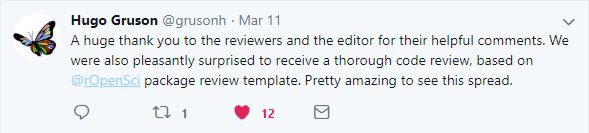
Some things are just irresistible to a community manager – PhD student Hugo Gruson’s recent tweets definitely fall into that category.
I was surprised and intrigued to see an example of our software peer review guidelines being used in a manuscript review, independent of our formal collaboration with the journal Methods in Ecology and Evolution (MEE). This is exactly the kind of thing rOpenSci is working to enable by developing a good set of practices that broadly apply to research software.
But who was this reviewer and what was their motivation? What role did the editors handling the manuscript play? I contacted the authors and then the journal and, in less than a week we had everyone on board to talk about their perspectives on the process. Continue reading “When Standards Go Wild: Software Review for a Manuscript”
Science is global, which means that peer review is a global activity. When Editors look for people to review manuscripts, they want to find the best people to comment on the topic – regardless of their background or primary language. While science and peer review are conducted in different languages all around the world, English has become the international language of science (for reasons we won’t go into in this post). English doesn’t just belong to people from English-speaking countries, it belongs to all scientists. For some people though, language can feel like a barrier to reviewing scientific papers.
That’s not to say that all non-native English speakers struggle with the language. Many reviewers for whom English is a second language have only ever reviewed in English and will only ever review in English and are comfortable, confident and experienced in the task. For some, reviewing in a second language is not all that different to reviewing in their native tongue. Many people who did not grow up speaking English are great English speakers, but for those who didn’t get much of their scientific training in English, language can impose an unwanted and unnecessary disadvantage.
The theme of this year’s Peer Review Week is Diversity in Peer Review, so we’ve asked the Methods in Ecology and Evolution Associate Editors for some advice on reviewing in a second language. We hope that these tips will help people who aren’t fluent in their second (or third, fourth, etc.) language to feel more confident reviewing in it. Our journal is published in English, so we’ve focused on English as a second language in this post. However, the advice should be helpful regardless of what language your reviewing in or whether you’re a native speaker. Continue reading “Ten Top Tips for Reviewing in a Language You Aren’t Fluent In”
The role of science journals is to publish papers about scientific research. We need to maintain some quality in what is published, so we use peer review, and ask experts in the subject of a paper to read it and check that it is correct, the arguments make sense etc.
One of the types of paper we publish is Applications, most of which describe software that will help ecologists and evolutionary biologists to do their research. Our focus is on the paper itself, but we also want to be confident that the software is well written, e.g. that it has no obvious bugs, and that it is written so that future versions will not break.
Of course, it takes a lot of time to thoroughly review software, and that is not the primary job of the journal’s peer review process. But we appreciate that this needs to be done, and indeed many of our reviewers and editors put a lot of time into doing just this, something we really appreciate. But can we do this better?
Fortunately, we were approached by the rOpenSci organisation, who wanted to collaborate with us to do this (a huge thanks to Scott Chamberlain for this initial approach and all of his hard work in putting this collaboration together). They are a group of coders, mainly in ecology, who have written a large number of open source R packages for a variety of tasks (e.g. importing data, visualisation). They also want to maintain good quality code, so they have implemented a variety of methods to do this.
One of these is code review. This is another form of peer review, but focused on the code, not the paper. This means the reviewer can concentrate on checking that the code works, that it is well written and documented (so other people can read the code and adapt it), and that it has the right sets of tests, so that if something changes, it is straightforward to check that it still works. Continue reading “Software Review Collaboration with rOpenSci”
Today is the first day of peer review week. One of the issues that many people bring up about the current system of peer review is that there is very little formal training. There are guidance documents available (including the BES Guide to Peer Review), workshops on peer review can be found at some conferences and some senior academics teach their PhD students or post-docs about the process. In general though, peer review training is fairly hard to come by.
This is something that people have told us (the BES publications team) at conferences and through surveys, so we’re doing something about it. From October 2017 until April 2018 Methods in Ecology and Evolution is going to be partnering with the BES Quantitative Ecology Special Interest Group to run a trial Peer Review Mentoring Scheme.
The trial scheme is going to focus on statistical ecology (as we receive a lot of statistical papers at Methods in Ecology and Evolution), but if it goes well, we’ll be looking at other areas of expertise too.
This week is Peer Review Week, the slightly more popular academic celebration than pier review week. Peer review is an essential part of scientific publication and is – like Churchill’s democracy – the worst system to do it. Except for all of the others. The reason it’s imperfect is mainly that it’s done by people, so there is a natural desire to try to improve it.
One suggestion for improvement is to us double blind reviews. At the moment most journals (including Methods in Ecology and Evolution) use single blind reviewing, where the author isn’t told the identity of the reviewers. The obvious question is whether double blind reviewing does actually improve reviews: does it reduce bias, or improve quality? There have been several studies in several disciplines which have looked at this and related questions. After having looked at them, my summary is that double blind reviewing is fairly popular, but makes little or no difference to the quality of the reviews, and reviewers can often identify the authors of the papers.
Subject area experts are asked to review a lot of papers!
The primary challenge Associate Editors face is finding Reviewers for manuscripts. When times get desperate, it may feel like anyone with a pulse will do! But of course the reality is that Reviewers need some relevant expertise. They also need to be able to carve out time from busy schedules. These two requirements are remarkably efficient at eliminating every name on a list of candidate Reviewers.
This Reviewer drought slows down the publishing process, and frustrates and stresses all involved. It also runs the risk of affecting quality – busy experts have no time to contribute to reviews of papers in their area, so manuscripts end up being reviewed hastily or by people in adjacent fields. However, so much effort goes into writing a manuscript (even a bad one), and so much in science depends fundamentally on the peer review process, that finding the right Reviewers is an important academic – and even ethical – obligation as Editors. Continue reading “Next-Gen Peer Review: Solving Today’s Problems with Tomorrow’s Solutions”
For many academics, especially Early Career Researchers, writing a review can seem like quite a daunting task. Direct training is often hard to come by and not all senior academics have the time to act as mentors. As this week is Peer Review Week, we wanted to provide some advice on what makes a good review and what makes a bad review. This advice has been kindly provided by the Methods in Ecology and Evolution Associate Editors – all of whom are authors and reviewers as well.
The BES Guide to Peer Review in Ecology and Evolution
Before we dive into the tips from our Editors though, we want to highlight one of the best resources for anyone looking for peer review guidance – the BES Guide to Peer Review in Ecology and Evolution. This booklet is intended as a guide for Early Career Researchers, who have little or no experience of reviewing journal articles but are interested in learning more about what is involved. It provides a succinct overview of the many aspects of reviewing, from hands-on practical advice about the actual review process to explaining less tangible aspects, such as reviewer ethics. You can get the PDF version of the guide (and the other BES guides) for free on the BES website. Continue reading “What Makes a Good Peer Review: Peer Review Week”



 Stefanie Butland, rOpenSci Community Manager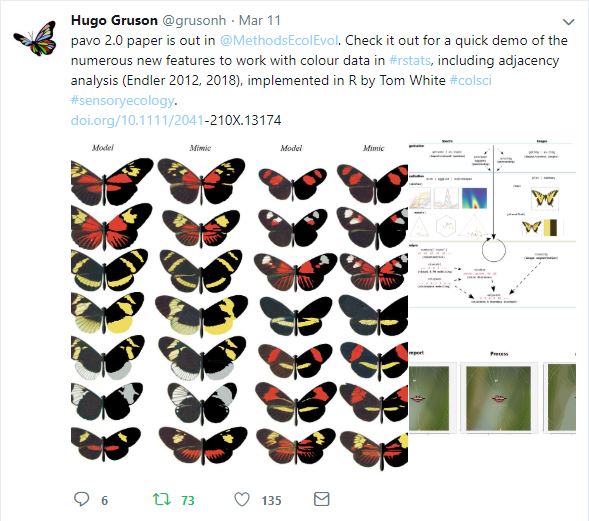



 Methods Blog