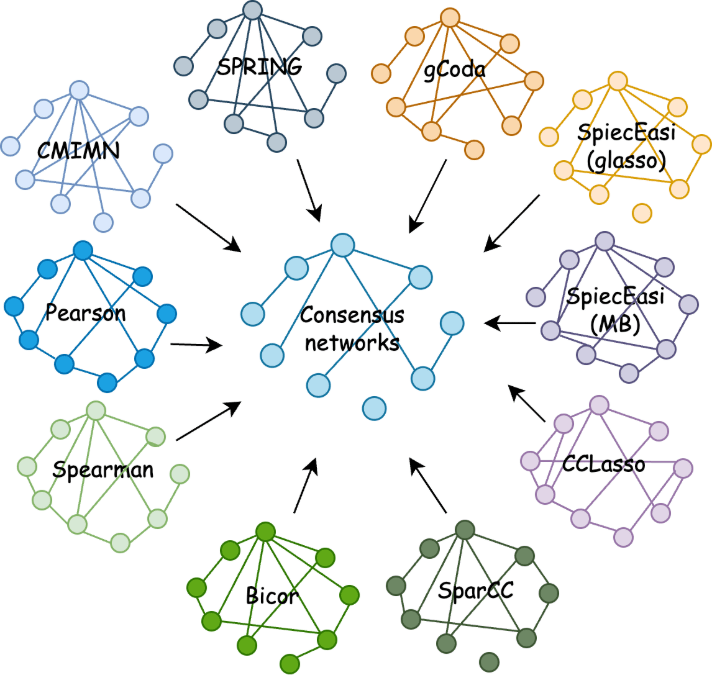
CMiNet: Building Reliable Microbiome Networks Through Consensus. 

Post provided by Rosa Aghdam I am a scientist at the Solís-Lemus Lab at the University of Wisconsin–Madison, working at the intersection of microbiome networks and computational biology. My research focuses on understanding the invisible world inside and around us. Microbial communities form intricate social systems, and my goal is to build tools that help researchers study those systems more clearly and more reliably. You … Continue reading CMiNet: Building Reliable Microbiome Networks Through Consensus. 

Peering through the shell: tracking stress with heartbeats

Post provided by Lima F. P.; Pereira F. L.; Loureiro B.; Humet M.; Seabra R. How can we tell when an animal is stressed, long before it dies? For marine invertebrates like mussels, limpets, oysters, or crabs, one of the clearest signals comes from their hearts. Heart rate can vary in response to changes in the environment (such as temperature or oxygen), offering a non-invasive … Continue reading Peering through the shell: tracking stress with heartbeats

An easy-to-manage tool for forest ecosystem modeling—The pnetr R package

Post provided by Xiaojie Gao I am a remote sensing ecologist currently working as a postdoctoral researcher at Harvard Forest department of Harvard University. My research focuses on mapping and understanding the impacts of climate change and human activities on the terrestrial vegetation ecosystems. The development of the pnetr R package for forest ecosystem modeling was inspired by my own research interest in understanding how … Continue reading An easy-to-manage tool for forest ecosystem modeling—The pnetr R package

Nicolas Mongiardino Koch: Chronospaces: An R package for the statistical exploration of divergence times promotes the assessment of methodological sensitivity

Throughout March and April, we are featuring articles shortlisted for the 2024 Robert May Prize. The Robert May Prize is awarded by the British Ecological Society each year for the best paper in Methods in Ecology and Evolution written by an early career author. Nicolas Mongiardino Koch’s article ‘Chronospaces: An R package for the statistical exploration of divergence times promotes the assessment of methodological sensitivity‘ is one … Continue reading Nicolas Mongiardino Koch: Chronospaces: An R package for the statistical exploration of divergence times promotes the assessment of methodological sensitivity

Our March issue is out now!

This issue contains the latest methods in ecology and evolution. Read to find out about this month’s featured articles and the article behind our cover! Featured Bayesian views of generalized additive modelling This study aims to highlight useful links (and differences) between Bayesian and frequentist approaches to smoothing, as detailed in the statistical literature, in an accessible way, with a focus on the mgcv implementation. By … Continue reading Our March issue is out now!

Unde Venis Species? RRphylogeography, a new accurate method finds the area of origin of species

Post provided by Pasquale Raia (he/him), Alessandro Mondanaro (he/him) and Silvia Castiglione (she/her) Quo Vadis? Latin for Where Are You Going? was a huge 1951 box office hit produced by Metro Goldwyn Mayer. The film (which is based on an 1896 book wrote by the Polish novelist Henryk Sienkiewicz) was set in ancient Rome during Nero’s reign and is credited for saving MGM from bankruptcy … Continue reading Unde Venis Species? RRphylogeography, a new accurate method finds the area of origin of species

Into the Swarm-Verse: quantifying collective motion across species and contexts

Post provided by Marina Papadopoulou Authors We are three researchers interested in collective animal behaviour. Marina Papadopoulou is a postdoctoral researcher at Tuscia University in Italy, Simon Garnier is a Professor at the New Jersey Institute of Technology (USA), and Andrew King is an Associate Professor at Swansea University (UK). As a Greek-French-Welsh team with empirical, mathematical, and computational backgrounds in different study systems, we … Continue reading Into the Swarm-Verse: quantifying collective motion across species and contexts

Introducing sabinaNSDM: A New R Package for Improved Species Distribution Modeling based on Spatially-Nested Hierarchical models

Post provided by Teresa Goicolea and Alejandra Zarzo Esta publicación también está disponible en español. Species Distribution Models (SDMs) are essential tools for scientists and conservationists to predict where species are likely to be found, where they have existed in the past, and where they might appear in the future. As we face urgent issues like climate change and biodiversity loss, producing accurate predictions is … Continue reading Introducing sabinaNSDM: A New R Package for Improved Species Distribution Modeling based on Spatially-Nested Hierarchical models

Introducción a sabinaNSDM: Un nuevo paquete de R para mejorar los modelos de la distribución de especies basado en modelos jerárquicos anidados espacialmente

Post escrito por Teresa Goicolea y Alejandra Zarzo This post in also available in English. Los Modelos de Distribución de Especies (SDMs, por sus siglas en inglés) son herramientas esenciales para que científicos y especialistas de la conservación puedan predecir dónde es probable encontrar especies, dónde han existido en el pasado y dónde podrían aparecer en el futuro. Ante problemas urgentes como el cambio climático … Continue reading Introducción a sabinaNSDM: Un nuevo paquete de R para mejorar los modelos de la distribución de especies basado en modelos jerárquicos anidados espacialmente

wingen: mapping genetic diversity using moving windows

Post provided by Anusha Bishop (she/her)

Global biodiversity loss and increased availability of genomic-scale data has motivated a growing interest in conserving genetic diversity. To do so, we need tools that help us understand how genetic diversity is distributed. In pursuit of this, we have developed a new method for creating maps of genetic diversity using spatial moving windows, which we have implemented in the R package wingen.

Continue reading “wingen: mapping genetic diversity using moving windows”