voluModel: a new R package to model species distributions in 3 dimensions

Post provided by Hannah Owens (she/her)

One of the base units of analysis for biogeography and conservation science is the species range map. Once we know where a species is, we can ask questions like “Why is it there?”, “How did it get there?”, or “What can we do to make this place better for it?” Especially these days, I am very interested in mapping marine fish distributions, which, it turns out, is not as simple as mapping terrestrial species.

Continue reading “voluModel: a new R package to model species distributions in 3 dimensions”

Creating a package to infer species coexistence

Post provided by Ignasi Bartomeus, David García-Callejas, and Oscar Godoy

Ignasi Bartomeus and colleagues share the story behind their recent Methods article ‘cxr: A toolbox for modelling species coexistence in R’.

This post recalls the journey on how we ended up developing cxr (acronym for CoeXistence relationships in R), an R package for quantifying interactions among species and their coexistence relationships. In other words, it provides tools for telling apart the situations in which different species can persist together in a community from the cases in which one species completely overcomes another.

Continue reading “Creating a package to infer species coexistence”

Ecology Hackathon at Ecology Across Borders 2017

Post provided by Gergana Daskalova

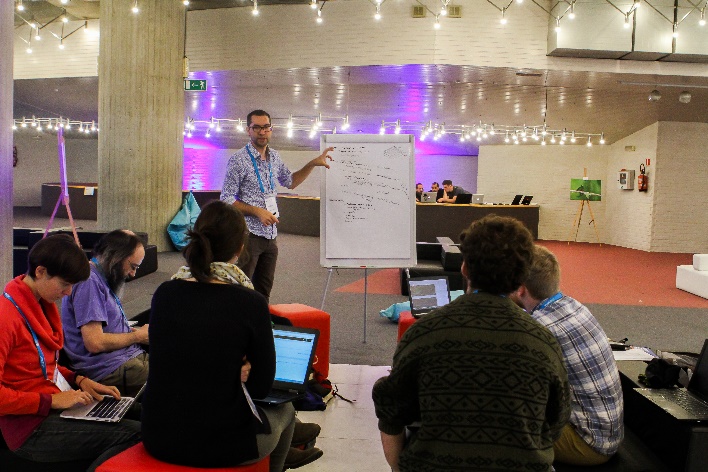
Brainstorming ideas at the Ecology Hackathon in Ghent.
Brainstorming ideas at the Hackathon.

Imagine an ecologist. Now imagine a programmer. Did you imagine the same person? If you were at the Ecology Hackathon on the day before the Ecology Across Borders (#EAB2017) conference in Ghent, Belgium (a joint conference between the BES, GFÖ, NecoV and EEF), you probably did (or at least we hope you did!).

Ecology is becoming increasingly quantitative and, as a result, we can add one more item on our daily to do lists as scientists:

  • Think of questions
  • Go on fieldwork / run simulations
  • Supervise students
  • Meet with our own supervisors
  • Teach
  • Write articles and review manuscripts
  • Answer emails
  • And now code as well

A Coding Community

Coding doesn’t need to be a lonely activity – one of the areas where it truly shines is collaborative coding. This can take us across borders and bring us together to figure out the best way to answer our research questions. That is exactly what the EAB Ecology Hackathon set out to do. Continue reading “Ecology Hackathon at Ecology Across Borders 2017”