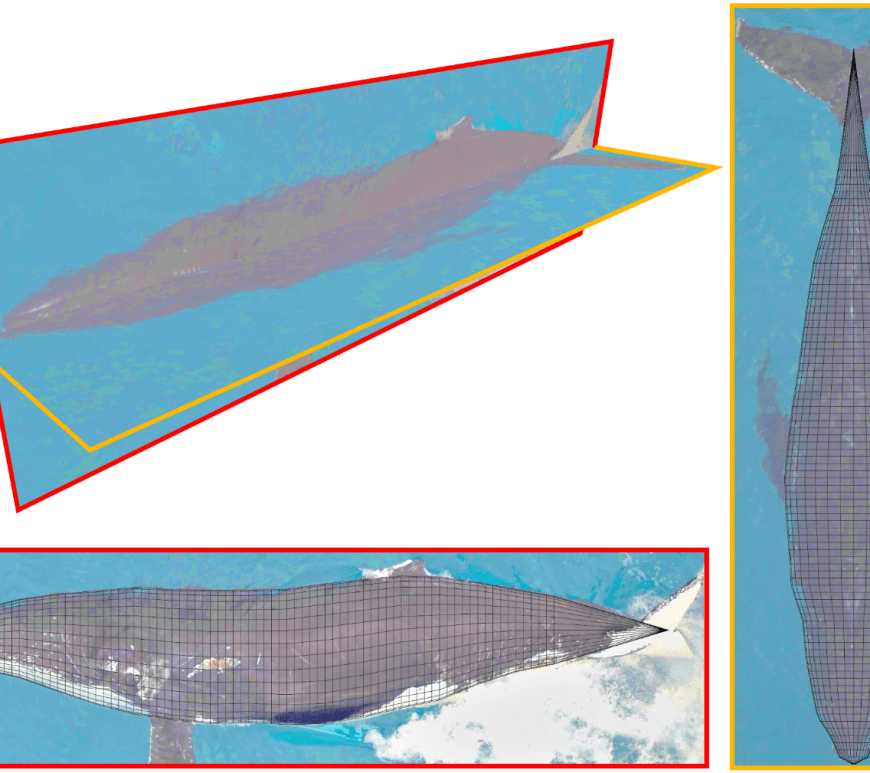
A whale’s size not only provides information on its own health, but also the status of the marine ecosystem in which it lives. So how do scientists weigh the biggest creatures on planet?In this blog post, Nathan Hirtle shares insight from his recent paper on measuring the volume of whales using drone images.
Post provided by Christophe Laplanche, Tiago Marques and Len Thomas
1km Deep
Most marine mammal species spend the majority of their lifetime at sea… underwater. Some species (like sperm whales, beaked whales, and elephant seals) can go routinely as deep as 1000m below sea level. To mammals like us, these incredible depths seem uninhabitable. It’s cold, dark, under high pressure (100kg/cm²) and 1km fromair! Yet deep-diving marine mammals thrive there and have colonized every deep ocean on the planet. They have developed amazing capabilities for that purpose – including efficient swimming, an advanced auditory system, sonar (in some cases), thermal insulation, extreme breath holding abilities and resistance to high pressure.
How is that possible?
Spending most of their time at depth makes them quite difficult to study. And we have a lot of questions to ask them. How do they balance swimming cost versus food intake? Do they forage cooperatively, in groups? For those with sonar, how does it work? With increasing human activities (oil exploration, military sonar, sea transport, fishing etc.) an important new question arises: how do they cope with us?
A round-up of methods papers published in the last month. If there are any papers that you think should be featured, email me or leave a comment and I will add them. Liam Revell has a paper in Evolution on size correction and principal components analysis of phylogenetic comparative data. Olivier Gimenez and colleagues also have a paper in the same issue on generating fitness … Continue reading Methods Digest – December 2009


 Methods Blog