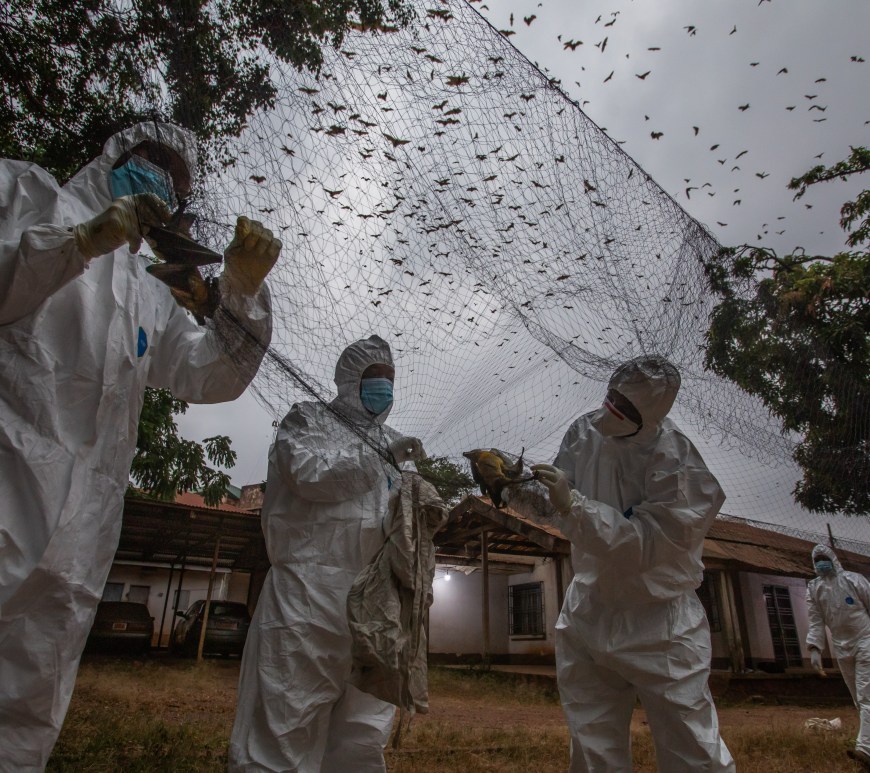
Addressing observational biases in data-driven approaches of zoonotic hazard prediction

Post provided by Andrea Tonelli Over the past five decades, more than half of emerging infectious diseases in humans originated from animals, with zoonotic pathogens posing a growing threat to global health. Shifts in land use, climate change, direct use of wildlife and biodiversity loss all influence human exposure to pathogens of wild animals, shaping the likelihood of zoonotic spillover events. In the wake of … Continue reading Addressing observational biases in data-driven approaches of zoonotic hazard prediction

Rhodamine B – a non-toxic biomarker for assessing the distance travelled by rats in urban slums

Post provided by Awoniyi Michael Adedayo Each year Methods in Ecology and Evolution awards the Robert May Prize to the best paper published in the journal by an author at the start of their career. Ten Early Career Researchers made the shortlist for this year’s prize, including Awoniyi Michael Adedayo, who recently defended his PhD from the Federal University of Bahia (UFBA) Brazil. In this … Continue reading Rhodamine B – a non-toxic biomarker for assessing the distance travelled by rats in urban slums

Predicting Disease Outbreaks Using Environmental Changes

Below is a press release about the Methods paper ‘Environmental-mechanistic modelling of the impact of global change on human zoonotic disease emergence: a case study of Lassa fever‘ taken from the University College London.

The multimammate rat (Mastomys natalensis) transmits Lassa virus to humans. ©Kelly, et al.
The multimammate rat transmits Lassa virus to humans. ©Kelly, et al.

A model that predicts outbreaks of zoonotic diseases – those originating in livestock or wildlife such as Ebola and Zika – based on changes in climate, population growth and land use has been developed by a UCL-led team of researchers.

“This model is a major improvement in our understanding of the spread of diseases from animals to people. We hope it can be used to help communities prepare and respond to disease outbreaks, as well as to make decisions about environmental change factors that may be within their control,” said lead author Professor Kate Jones, UCL Genetics, Evolution & Environment and the Zoological Society of London. Continue reading “Predicting Disease Outbreaks Using Environmental Changes”

Issue 7.6: Methods in Ecology and Evolution 5th Anniversary Special Feature

Issue 7.6 is now online!
The June issue of Methods, which includes our latest Special Feature – “5th Anniversary of Methods in Ecology and Evolution” – is now online!

Our 5th Anniversary Special Feature is a collection of six articles (plus an Editorial from Executive Editor Rob Freckleton) that highlights the breadth and depth of topics covered by the journal so far. It grew out of our 5th Anniversary Symposium – a joint event held in London, UK and Calgary, Canada and live-streamed around the world in April 2015 – and contains papers by Associate Editors, a former Robert May prize winner and regular contributors to the journal.

The six articles are based on talks given at last May’s Symposium. They focus on:

In his Editorial for the Special Feature, Rob Freckleton looks to the future. In his words: “we hope to continue to publish a wide range of papers on as diverse a range of topics as possible, exemplified by the diversity of the papers in this feature”.

All of the articles in the Special Feature will be freely available for a limited time. In addition to this, two of the articles (Shedding light on the ‘dark side’ of phylogenetic comparative methods and Perturbation analysis of transient population dynamics using matrix projection models) are Open Access.
Continue reading “Issue 7.6: Methods in Ecology and Evolution 5th Anniversary Special Feature”