2018 Robert May Prize Winner: Laura Russo

The Robert May Prize is awarded annually for the best paper published in Methods in Ecology and Evolution by an Early Career Researcher. We’re delighted to announce that the 2018 winner is Laura Russo, for her article ‘Quantitative evolutionary patterns in bipartite networks: Vicariance, phylogenetic tracking or diffuse co‐evolution?‘.

Plant-pollinator interactions are often considered to be the textbook example of co-evolution. But specialised interactions between plants and pollinators are the exception, not the rule. Plants tend to be visited by many different putative pollinator species, and pollinating insects tend to visit many plant hosts. This means that diffuse co-evolution is a much more likely driver of speciation in these communities. So, the standard phylogenetic methods for evaluating co-evolution aren’t applicable in most plant-pollinator interactions. Also, many plant-pollinator communities involve insect species for which we do not yet have fully resolved phylogenies. Continue reading “2018 Robert May Prize Winner: Laura Russo”

Volunteer Ornithological Survey Shows Effects of Temperatures on Eurasian Jay Population

Below is a press release about the Methods in Ecology and Evolution article ‘Incorporating fine‐scale environmental heterogeneity into broad‐extent models‘ taken from the University of Southampton.

A study led by researchers at the University of Southampton has used data collected by volunteer bird watchers to study how the importance of wildlife habitat management depends on changing temperatures for British birds.

The team studied data from the British Trust for Ornithology’s Bird Atlas 2007 – 11 on the abundance of the Eurasian jay over the whole of Great Britain. The University of Southampton researchers focused on jays for this trial as they are a species of bird known to frequent a mixture of different natural environments. Continue reading “Volunteer Ornithological Survey Shows Effects of Temperatures on Eurasian Jay Population”

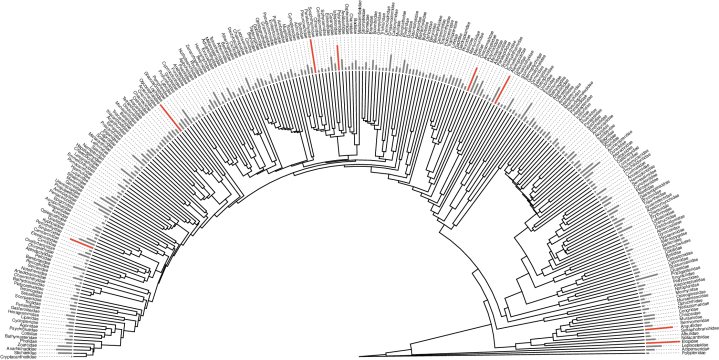
Introducing fishtree and fishtreeoflife.org

This post was originally published on Jonathan Chang’s blog.

In our recent publication (Rabosky et al. 2018) we assembled a huge phylogeny of ray-finned fishes: the most comprehensive to date! While all of our data are accessible via Dryad, we felt like we could go the extra mile to make it easy to repurpose and reuse our work. I’m pleased to report that this effort has resulted in two resources for the community: the Fish Tree of Life website, and the fishtree R package. The package is available on CRAN now, and you can install it with:

install.packages("fishtree")

The source is on GitHub in the repository jonchang/fishtree. The manuscript describing these resources has been published in Methods in Ecology and Evolution (Chang et al. 2019).

Continue reading “Introducing fishtree and fishtreeoflife.org”

When Standards Go Wild: Software Review for a Manuscript

Post provided by STEFANIE BUTLAND, NICK GOLDING, CHRIS GRIEVES, HUGO GRUSON, THOMAS WHITE, HAO YE

This post is published on the rOpenSci and Methods in Ecology and Evolution blogs

Stefanie Butland, rOpenSci Community Manager
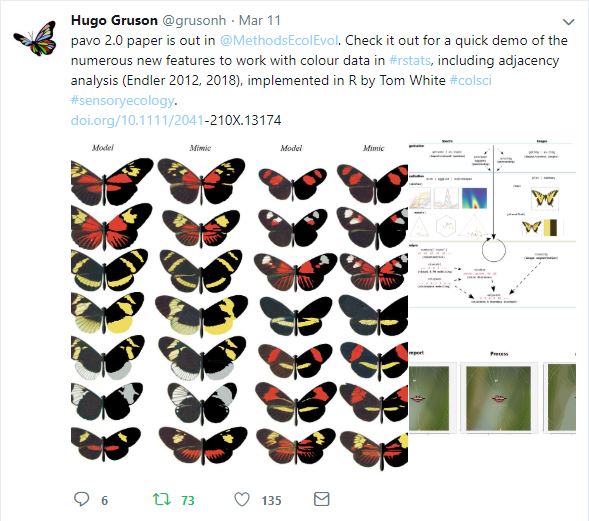
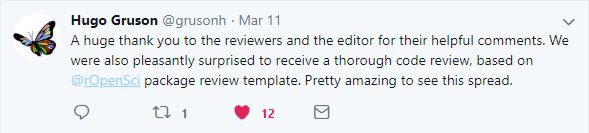
Some things are just irresistible to a community manager – PhD student Hugo Gruson’s recent tweets definitely fall into that category.

I was surprised and intrigued to see an example of our software peer review guidelines being used in a manuscript review, independent of our formal collaboration with the journal Methods in Ecology and Evolution (MEE). This is exactly the kind of thing rOpenSci is working to enable by developing a good set of practices that broadly apply to research software.

But who was this reviewer and what was their motivation? What role did the editors handling the manuscript play? I contacted the authors and then the journal and, in less than a week we had everyone on board to talk about their perspectives on the process. Continue reading “When Standards Go Wild: Software Review for a Manuscript”

Studying Wild Bats with Small On-Board Sound and Movement Recorders

Post provided by LAURA STIDSHOLT

Releasing a female Greater mouse-eared bat with the tag in collaboration with Holger Goerlitz, Stefan Greif and Yossi Yovel. ©Stefan Greif

The way that bats acrobatically navigate and forage in complete darkness has grasped the interest of scientists since the 18th century. These seemingly exotic animals make up one in four mammalian species and play important roles in many ecosystems across the globe from rainforests to deserts. Yet, their elusive ways continue to fascinate and frighten people even today. Over the last 200 years, dedicated scientists have worked to uncover how bats hunt and navigate using only their voice and ears while flying at high speed in complete darkness. Still, the inaccessible lifestyle of these small, nocturnal fliers continues to challenge what we know about their activities in the wild.

Understanding the impact bats have on their ecosystems – for example how many insects a bat catches per night – has still not been directly measured. Most of our knowledge on the natural behaviour and foraging ecology is based on elaborate, but ground-based experiments carried out in the wild. These experiments generally track their behaviour using radio-telemetry, record snapshots of their emitted echolocation calls with microphones, or involve extensive observations. Continue reading “Studying Wild Bats with Small On-Board Sound and Movement Recorders”

What Biases Could Your Sampling Methods Add to Your Data?

Post provided by ROGER HO LEE

這篇博客文章也有中文版

Have you ever gone fishing? If so, you may have had the experience of not catching any fish, while the person next to you got plenty. If you walked along the pier or bank, you may have seen that other fishermen and -women caught fish of various shapes and sizes. You’d soon realise that each person was using a different set of equipment and baits, and of course, that the anglers differed in their skills and experience. Beneath the water were many fish, but whether you could catch them, or which species could even be caught, all depended on your fishing method, as well as where and how the fish you were targeting lived.

Designing Sampling Protocols

Head view of different ant species found in Hong Kong and further in SE Asia.
Head view of different ant species found in Hong Kong and further in South East Asia.

This is a lot like the situation that ecologists often face when designing sampling protocols for field surveys. While a comprehensive survey will yield the most complete information, few of us have the resources to capture every member of the community we’re studying. So, we take representative samples instead. But the method(s) used for sampling will only allow us to collect a subset of the species which are present. This selection of the species is not random per se – it’s dependent on species’ life history. Continue reading “What Biases Could Your Sampling Methods Add to Your Data?”

採樣方法會帶來怎樣的數據偏差?

作者:李灝

This blog post is also available in English

你有釣魚的經驗嗎?若有的話,以下的經歷對你應該不會陌生。自己釣了大半天,魚杆動也沒動過,但身旁的釣手卻滿載而歸。感到灰心時,你沿著碼頭或岸邊巡視,你看到其他人的魚獲大大小小的也有﹑形態不同的的也有。心裡被疑惑與不甘的思緒纏繞著的一刻,你突然意識到每個人都在使用不同的釣具和魚餌(當然每位垂釣者的技能和經驗也不同)。在水中有各種各樣的魚,但你能否釣到牠們,或者釣到那一些品種,都取決於你釣魚的方法,以及你目標魚種的活動範圍和生活方式。

採樣方案的設計

Head view of different ant species found in Hong Kong and further in SE Asia.
香港和東南亞地區的螞蟻品種。

上述的經歷與生態學家在設計野外調查時所遇到的情況非常相似。雖然全面的調查能取得最完整的資料,但我們很少會有充足的資源去完整地採集整個物種群落。取而代之的是我們只能採集一部份的物種來作寫照。值得我們留意的是每種採樣方法只允許我們收集到群落中的某些物種;這些物種不是隨機地被選中,而是取決於物種的生活史。 Continue reading “採樣方法會帶來怎樣的數據偏差?”

How Can Understanding Animal Behaviour Help Support Wildlife Conservation?

Below is a press release about the Methods in Ecology and Evolution article ‘A novel biomechanical approach for animal behaviour recognition using accelerometers‘ taken from the EPFL.

©Arpat Ozgul, University of Zurich

Researchers from EPFL and the University of Zurich have developed a model that uses data from sensors worn by meerkats to gain a more detailed picture of how animals behave in the wild.

Advancement in sensor technologies has meant that field biologists are now collecting a growing mass of ever more precise data on animal behaviour. Yet there is currently no standardised method for determining exactly how to interpret these signals. Take meerkats, for instance. A signal that the animal is active could mean that it is moving; alternatively, it could indicate that it is digging in search of its favourite prey, scorpions. Likewise, an immobile meerkat could be resting – or keeping watch.

In an effort to answer these questions, researchers from EPFL’s School of Engineering Laboratory of Movement Analysis and Measurement (LMAM) teamed up with colleagues from the University of Zurich’s Population Ecology Research Group to develop a behavior recognition model. The research was conducted in affiliation with the Kalahari Research Centre. Continue reading “How Can Understanding Animal Behaviour Help Support Wildlife Conservation?”

Revisiting Past Biodiversity with the divDyn R Package

Post provided by ÁDÁM T. KOCSIS

The source of occurrence data: fossil collections (Early Jurassic ammonites in the collection of the University of Erlangen-Nuremberg, photo by Konstantin Frisch)
The source of occurrence data: fossil collections (photo by Konstantin Frisch).

To find out about changes in ancient ecosystems we need to analyse fossil databases that register the taxonomy and stratigraphic (temporal) positions of fossils. These data can be used to detect changes of taxonomic diversity and to draft time series of originations and extinctions.

The story would be so simple if it wasn’t the effects of heterogeneous and incomplete sampling: the white spots in our understanding of where and when species lived exactly. This phenomenon decreases the fidelity of face-value patterns extracted from the fossil record, making them less reliable. It must be considered if we want to get a glimpse into the biology or the distribution of life in space and time. Naturally, several metrics have been proposed to overcome this problem, each claiming to accurately depict the patterns of ancient life. Continue reading “Revisiting Past Biodiversity with the divDyn R Package”

Issue 10.4: Bayesian Models, Isoscapes, Camera Traps and More

The April issue of Methods is now online!

This month we’re thinking about hierarchical Bayesian models and Approximate Bayesian Computation, improving ecological niche models, and learning how to make our own Environmental Microcontroller Units (more on that below). We’ve got articles on Phylogenetics, Space (not outer space), Camera Traps and much more. Plus, there are six papers that are completely free to everybody, no subscription required!

Find out a little more about the new issue of Methods in Ecology and Evolution (including details about the bobcat on this month’s cover) below. Continue reading “Issue 10.4: Bayesian Models, Isoscapes, Camera Traps and More”