
Post provided by Marta Skowron Volponi
Has the buzzing sound of a wasp flying past your ear ever made you recoil in fear of being stung? What if these buzzes are a warning display aimed at potential predators, just like the bees’ and wasps’ bright colouration that sends a message: “don’t touch me, I’m dangerous”? Or perhaps they are audio messages meant for other wasps? Through playback experiments with various animals, researchers can find out what insect buzzes actually mean. We created the buzzOmeter system, a simple tool for recording insects in the wild, without capturing or tethering them.
Recording the sound of a small insect in motion is a challenge
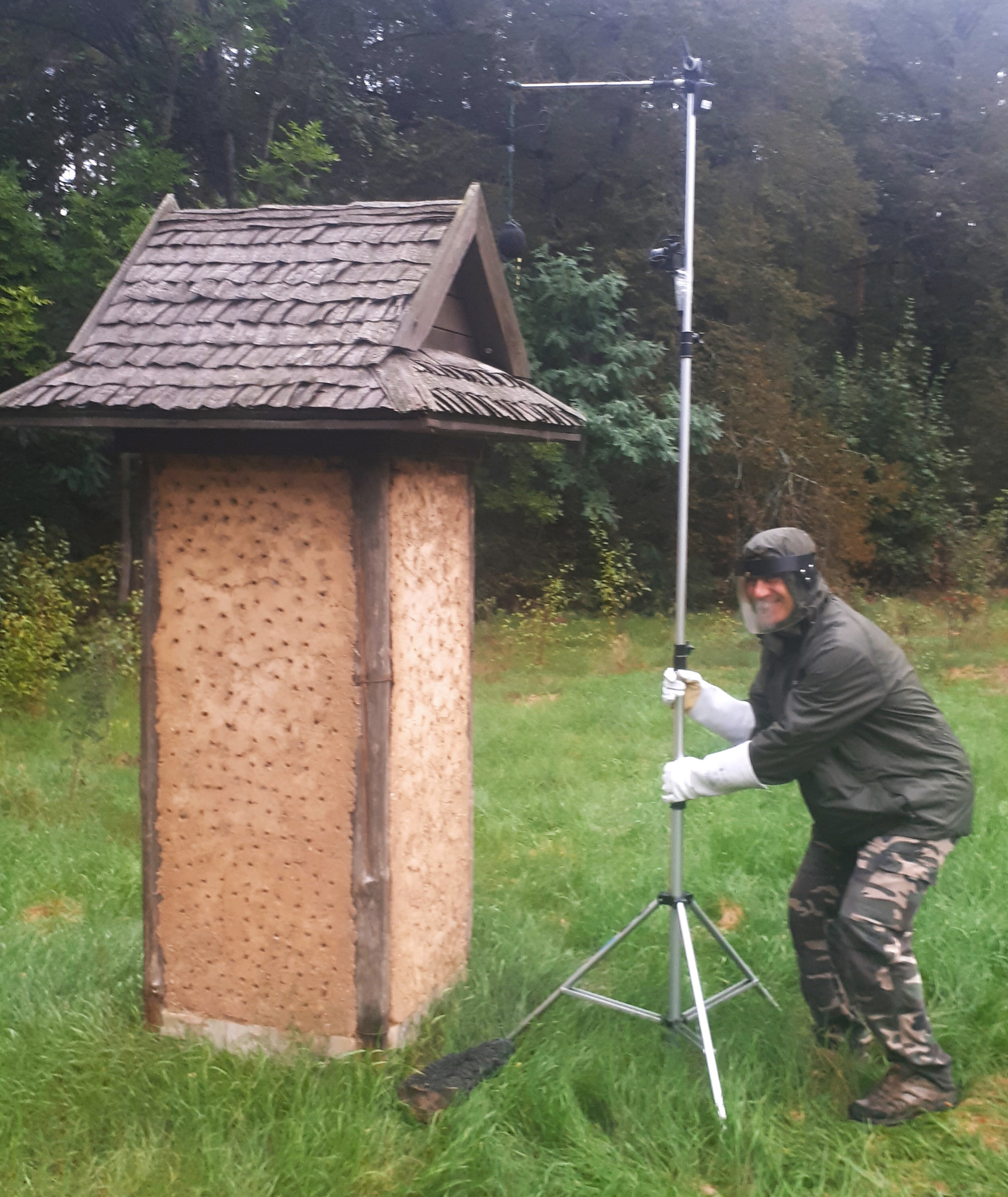
To be able to record the buzzing of all these insects in flight was like winning a challenge. We had to understand the character of each species to succeed, their particular behaviour in flight. The bumblebees are careless, as if saying, “I’m big and noisy and I’m not afraid of anything.” The hawkmoth’s character is: “I’m fast and nervous; if you approach me too rapidly, I’ll fly to a flower higher or further.” The wasps on flowers are predictable and docile, but their return to the nest is fast and straightforward. Hornets, on the other hand, command respect. How do you place a microphone ten centimetres away from a flying hornet without disturbing it (and without getting stung)? How many hours of observations, trials, and errors with the buzzOmeter in hand, how many beautiful days on flowering meadows chasing hawkmoths, wasps, bumblebees, and hornets! Using the buzzOmeter forces you to get to intimately know your subjects, admire their peculiarities, and spend unforgettable days with them. In the end, we could distinguish a flying hornet from a bumblebee, hawkmoth or even a common wasp without seeing them, just by hearing them in flight. Amazing! – says first author Paolo Volponi, who came up with the concept of the recording device.

It is made out of commercially available elements and you could probably use a camera you already have to make it work. The buzzOmeter has two setups, a stationary one to be placed in front of a nest entrance, insect burrow or lure, and a handheld one to follow foraging insects. If you want to record dangerous critters such as hornets, you can trigger the recording from a safe distance. Our article includes a supplementary practical guide for the tool assembly and use.
An advantage of the system is that it produces audio and video recordings from which a lot of information can be extracted: not only frequency-related parameters but also measures of sound magnitude, which requires the determination of the distance of the sound source from the microphone. Apart from the recording device, we have developed a means of extracting fragments of audio recordings when the insect is at the perfect, determined distance from the microphone, using open access software. A video tutorial explaining the process is included in the publication. Once you’ve got the fragments you need, you may use them for playback behavioural experiments or proceed with analyses of acoustical parameters, aimed, for example to assign the buzzes to species. We have written an R script based on mixture discriminant analyses that does just that.
Social insects such as bees and wasps are highly unique animals, characterized by distinct castes with significant morphological differences among them and individuals that closely resemble each other within the same caste. Males and females also often differ in form and behaviour. We expected each species to have many “acoustic forms” corresponding to these groups and utilized a specific form of discriminant analysis capable of forming multiple groups of acoustic emissions for each species. However, the best discrimination was achieved by imposing a single acoustic group per species, demonstrating that, at least for the species we studied, our system differentiates well regardless of intraspecific variation. We were even surprised when we realized that we could distinguish the vast majority of individuals belonging to two bumblebee species (Bombus terrestris and Bombus pascuorum). The buzzOmeter, thanks to the ability to assess the precise distance of the insect from the microphone, allows for the extraction of many parameters that other methods do not, such as sound energy. When we attempted to omit those acoustic variables, the success rate of proper species assignment dropped significantly. – says Leonardo Dapporto, co-author of the study who developed the species classification part of the buzzOmeter system.
What did we use the buzzOmeter for?
In our proof-of-concept, we recorded nine species of insects in Poland and Italy. These included bumblebees, wasps and day-flying moths, such as the remarkable bee hawkmoth. We then synchronized the generated audio and video files and selected fragments for further acoustical analyses in the free DaVinci Resolve software for filmmakers. Then, using the free Praat software, we calculated (a lot of) acoustical parameters that are often used in bioacoustics studies and based on these, we assigned the buzzes to species with a high success rate.
What else can the buzzOmeter be used for?
The best thing about the buzzes obtained through the buzzOmeter system is that they can be played out at the correct, real-life volume to measure animals’, or even plants’, response to sound.
I find studying species interactions absolutely fascinating but believe that in order to truly understand what is going on between predator and prey, model and mimic, parasite and host, animals have to be studied in the wild, not in artificial conditions in which stress alters their behaviours. To study the reaction to sound, you need recordings from a natural setting – and that’s where the buzzOmeter can be of use – says lead author, Marta Skowron Volponi.
Can predators remember past unpleasant encounters based on sound? Which parasitoids locate their hosts by eavesdropping? Does the buzzing of blood-sucking or stinging insects cause aversive behaviours across different taxa? Do mimics imitate model species’ buzzes, calls or hisses to avoid attack? Obtaining decent recordings of insect auditory signals is the starting point for addressing the role of sound in the complex network of animal and plant–animal interactions.
 Methods Blog