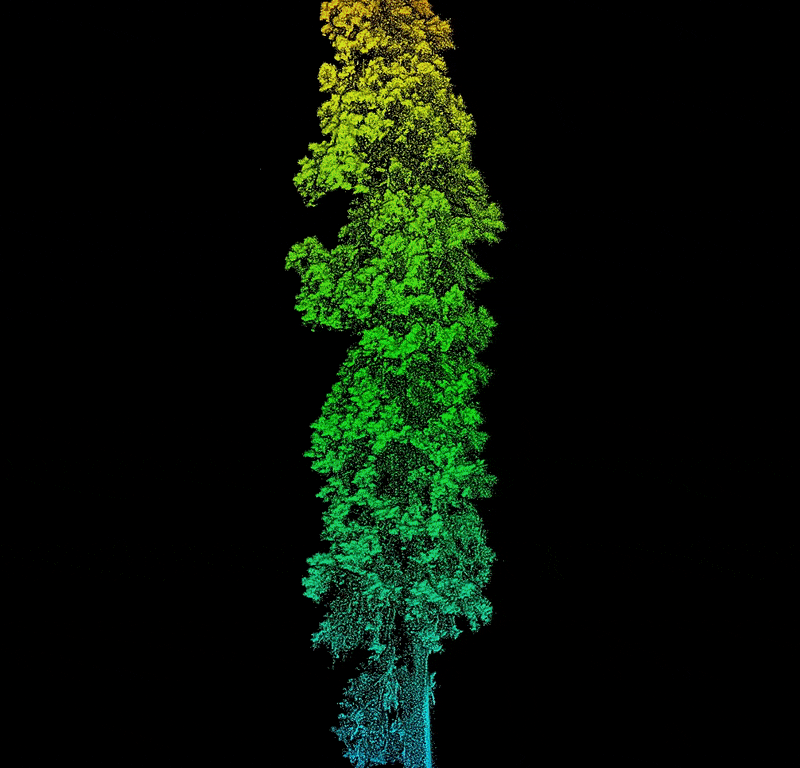
It has been a few weeks since the 15th Chinese Symposium on Biodiversity Science and Conservation, where the first “Seminar on Methods in Ecology and Evolution in China” was held. In these blog posts, we hear from some of the winners of the “Outstanding Young Scholar Award in Ecological and Evolutionary Methodology in China”. Here, winner Yu Ren discusses their presentation ‘Discovering and measuring giant trees through the integration of multi-platform lidar data’.
Post provided by Yu Ren.
Over the past few years, my team and I have been on an exciting expedition to discover and measure Asia’s tallest tree using a novel lidar-based framework. I’d love to share the story behind our research, the adventures we encountered, and the groundbreaking findings we’ve uncovered.
The Spark Behind Our Exploration
Giant trees are among Earth’s most magnificent and ecologically significant organisms. They create essential microclimates, provide habitats for countless species, and play pivotal roles in carbon sequestration. However, our knowledge about these giants has been limited, primarily because they often reside in remote, dense forests, making them difficult to locate and study.
Our journey began with a simple question: How can we efficiently discover and accurately measure these towering trees in the vast, unexplored forests of the world?

Blending Technology with Exploration
Traditional methods of finding and measuring giant trees often rely on chance discoveries or labor-intensive ground surveys, which are not feasible for large, inaccessible areas. To overcome this, we developed a lidar-based framework that integrates spaceborne, UAV (Unmanned Aerial Vehicle), and backpack lidar systems.
Lidar technology allows us to create detailed 3D representations of forest structures by emitting laser pulses and measuring their reflections. By combining data from different platforms, we could scan vast areas from above and then hone in on specific regions of interest with good precision.
One memorable moment was when we first obtained the data of giant trees in the Yarlung Zangbo Grand Canyon from the UAV. It was like unveiling a hidden world—the intricate details of the forest canopy emerged, revealing towering trees that stood out among their peers.
The Thrill of Discovery: Asia’s Tallest Tree
Our efforts culminated in a remarkable discovery. In May 2023, using our lidar framework, we identified a Cupressus austrotibetica standing at an astonishing 102.3 meters, making it the tallest known tree in Asia and the second tallest living tree by species globally.
But that wasn’t all. Within a 22.4-hectare area surrounding this tree, we found over 25 trees exceeding 85 meters in height. The density and size of these giants in such a concentrated area were beyond our expectations. It was a humbling experience to stand at the base of these ancient beings, knowing that we were among the first to witness their grandeur.

Adventures and Anecdotes from the Field
Our expedition was not without its challenges and adventures. Navigating the rugged terrains of the Yarlung Zangbo Grand Canyon tested both our technical skills and our endurance. On one occasion, our UAV encountered severe signal loss due to the remote and rugged terrain—a tense moment that required quick thinking to safely retrieve the equipment.
Interacting with local communities was another highlight. The indigenous people shared folklore about the “sky-reaching trees,” adding cultural richness to our scientific quest. Their knowledge and respect for the forest deepened our appreciation for the ecological and cultural significance of these giants.
Paving the Way for Future Research
Our findings demonstrate the effectiveness of using a multi-platform lidar approach for ecological exploration. This method not only increases efficiency but also provides highly accurate, verifiable data without disturbing the natural environment—a significant advantage over traditional methods that might involve tree climbing or ground-based measurements.
Looking ahead, we aim to:
Expand Our Search Globally: Apply our framework to other unexplored primary forests to discover more giant trees and understand their distribution patterns.
Enhance Ecological Understanding: Investigate the factors that contribute to the growth of these giants, including climate, soil conditions, and ecological interactions, to inform conservation strategies.
Promote Conservation Efforts: Collaborate with local and international organizations to protect these ancient trees and their habitats from deforestation and climate change impacts
Reflecting on the Journey
This research has been a profound journey of discovery and learning. It has shown us that even in the age of satellites and global mapping, there are still wonders hidden in plain sight, waiting to be found with the right tools and curiosity.
I’m incredibly grateful to my dedicated team, the supportive local communities, and the organizations that made this expedition possible. Their combined efforts turned a visionary idea into a tangible achievement.
Join the Conversation
I hope our story inspires you to appreciate the incredible natural treasures that our planet holds. Giant trees are more than just tall plants; they are vital pillars of their ecosystems and living testaments to the Earth’s biological richness.
Feel free to reach out if you’d like to learn more or discuss potential collaborations. You can find me at renyu_rs@pku.edu. Let’s work together to uncover more of nature’s hidden giants and ensure their preservation for generations to come.
Post edited by Sthandiwe Nomthandazo Kanyile.
 Methods Blog