Post provided by Matthew Lattanzio.
Hello there! My name is Matthew Lattanzio, and I am an Associate Professor at Christopher Newport University where I study how reptiles and amphibians interact with and respond to environmental variability. I grew up as a nature enthusiast, and so it is exciting to still carry that curiosity through to my career, constantly challenging myself and my students to think broadly about biological phenomena and most importantly, think outside the box. My latest project, described in a recent Methods in Ecology and Evolution paper, started with a simple question: Why isn’t ultraviolet (UV) light studied more in ecology?
Challenges in UV Light Data Collection
Okay let’s step back for a moment: eons ago (in 2019), my research attention shifted to UV light, an area of significant importance in reptile care but often overlooked in academic research. As someone who’s kept reptiles as pets since childhood, I knew firsthand the role UV plays in animal health, from vitamin D synthesis to good health, behaviour, and survival. Yet, despite this importance, most research on animal-environment interactions has been laser-focused on temperature. And that realization was eye-opening for me, leading me to that simple yet important question. Clearly, UV light is another key sunlight resource, so why was attention to UV lacking in comparison to temperature?
Upon reviewing the available literature on UV relationships with organismal traits, a significant roadblock to our ability to study UV became increasingly clear to me: there was simply no commercially available UV data logger that could continuously record UV exposure over time. Handheld sensors like the Solarmeter 6.5r only provided snapshot UV readings, making long-term studies impossible without frequent human intervention. That’s when I realized that the best way to enhance appreciation for UV light in organismal ecology and physiology centred on the need for a reliable, affordable way to track UV light over time.

Developing a Solution with Arduino
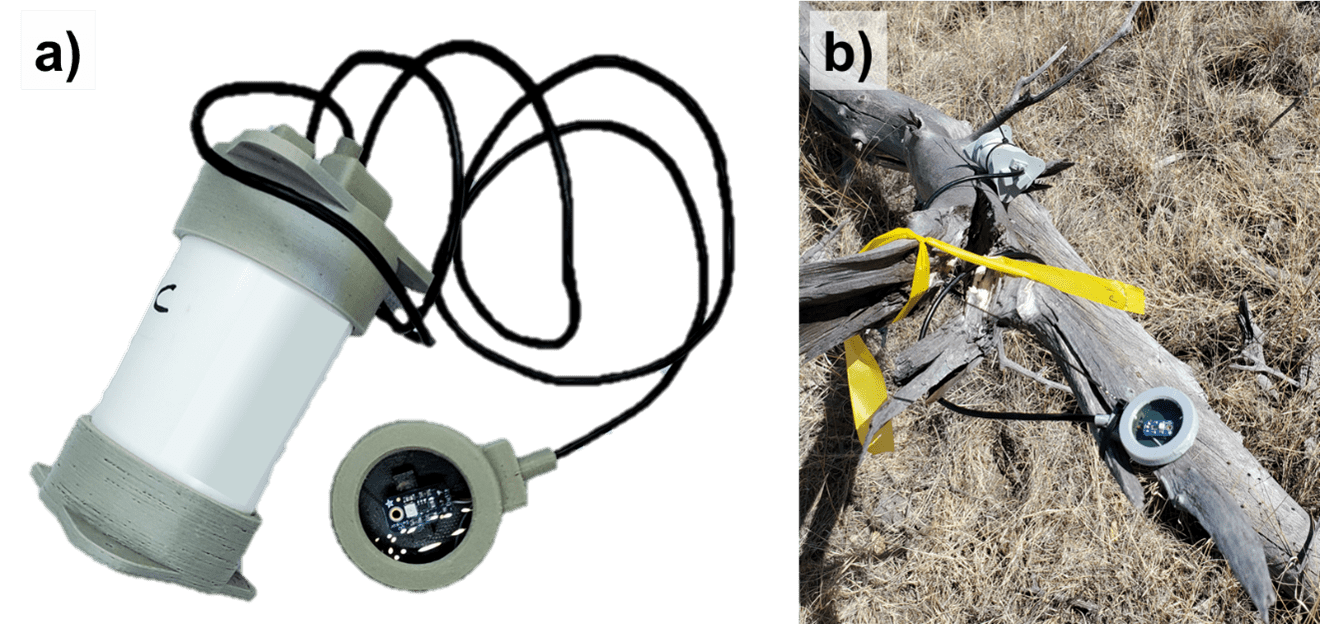
Enter Arduino—a low-cost, open-source small electronics platform. With no prior electronics experience, I was admittedly nervous about diving into an entirely new field and creating my own device. But thanks to an amazing community of hobbyists and scientists using Arduino for other purposes (and posting helpful tips on message boards), I quickly realized that I could build this tool myself. After a lot of trial and error (again, no background in electronics here!), I developed a UV data logger that not only worked but could also be customised and expanded with additional sensor capabilities. My UV data logger is weather-resistant, and capable of logging UV exposures for months in the field or in captive settings—all for under $55. My design is fully open source, meaning anyone can replicate or adapt it for their research or home usage.
The process taught me a valuable lesson: You don’t need to be an engineer to build an Arduino-based device, you just need to be willing to take a chance at something new. These open-source platforms make it easy for anyone to create custom scientific tools. So, if you’ve ever thought about creating your own scientific tools or just want a fun project (by the way: building new devices for fun is also a new hobby of mine—ask me about our pup’s doorbell or automated wildlife feeders!), don’t be afraid to dive into the world of small electronics. You might just create something that changes how we think about the world around us.

Want to Build Your Own?
If you’re ready to dive in, everything you need to build a UV data logger is available on Zenodo (e.g., wiring diagrams, 3D printing files, and a detailed build guide in the supporting information]), see: here. Whether you’re a researcher or a hobbyist, I hope you’ll find this device useful for your UV exposure logging needs, whether they be in natural habitats or controlled indoor environments. Feel free to reach out if you have any questions, concerns, or simply want to share your own Arduino adventures (the data logger, or anything else you create). Happy engineering!
Post edited by Sthandiwe Nomthandazo Kanyile
 Methods Blog