This issue contains the latest methods in ecology and evolution. Read to find out about this month’s featured articles and the article behind our cover!
Featured
Bayesian views of generalized additive modelling
This study aims to highlight useful links (and differences) between Bayesian and frequentist approaches to smoothing, as detailed in the statistical literature, in an accessible way, with a focus on the mgcv implementation. By harnessing these links researchers can expand the set of modelling tools we have at our disposal, as well as our understanding of how existing methods work. Two important topics for quantitative ecologists are covered in detail: model term selection and uncertainty estimation.
calibrar: An R package for fitting complex ecological models
Oliveros-Ramos and Shin present a novel R package, calibrar, designed for parameter estimation for a wide range of ecological models, including complex and stochastic models. The package combines various optimisation functionalities in a single interface, enabling the implementation of the latest advancements in complex model calibration. The package provides support for multiple sequential phases and box constrained optimisation with the possibility of using several algorithms available in R. In particular, by using a “black-box” approach, the package allows the calibration of models implemented in any programming language. It provides a generic interface with models and allows the construction of the objective function, within R, without requiring any changes in the models’ code.

EcologicalNetworksDynamics.jl: A Julia package to simulate the temporal dynamics of complex ecological networks
Lajaaiti et al. present EcologicalNetworksDynamics, a Julia package implementing the bio-energetic food web model with several extensions that include: (1) competition between producers; (2) an explicit nutrient uptake model for producers; (3) a temperature dependence of the model parameters; and (4) non-trophic interactions. The package is ideal for theoreticians seeking to explore the effects of different types of species interactions on the dynamics of complex ecological communities, but also for empiricists seeking to confront their empirical findings with theoretical expectations. It allows modelling communities from few parameters, while making it possible to customize the model by mixing interaction types and external drivers with ease.

RRphylogeography: A new method to find the area of origin of species and the history of past contacts between species
This study presents a new tool written in R, named RRphylogeography, meant to find the area of origin (AOO) of species, and to locate feasible zones of contact between species throughout their history. RRphylogeography starts from the bioclimatic modelling of the species, identifies potential habitat patches occupied during speciation and finds the habitat patches most likely to represent the AOO or contact. By using virtual species simulations, we compared RRphylogeography to common historical biogeography tools. They found RRphylogeography statistically outcompetes these alternatives under all study conditions, reaching especially accurate predictions.
Repairing gaps in ecological time series
Carpenter et al. introduce multiview cross-mapping (MVCM), a novel method based in empirical dynamic modelling (EDM) that exploits shared information between dynamically coupled time series. Rather than using points nearby in time, MVCM uses similar system states on an attractor to estimate the value of a missing data point. Using model data from a coupled five-species system, and observational data from a long-term plankton survey in Lake Zurich, Switzerland, they show that MVCM is robust and performs significantly better than linear methods (linear interpolation, linear regression-based imputation) and kNN imputation.

Cover Image

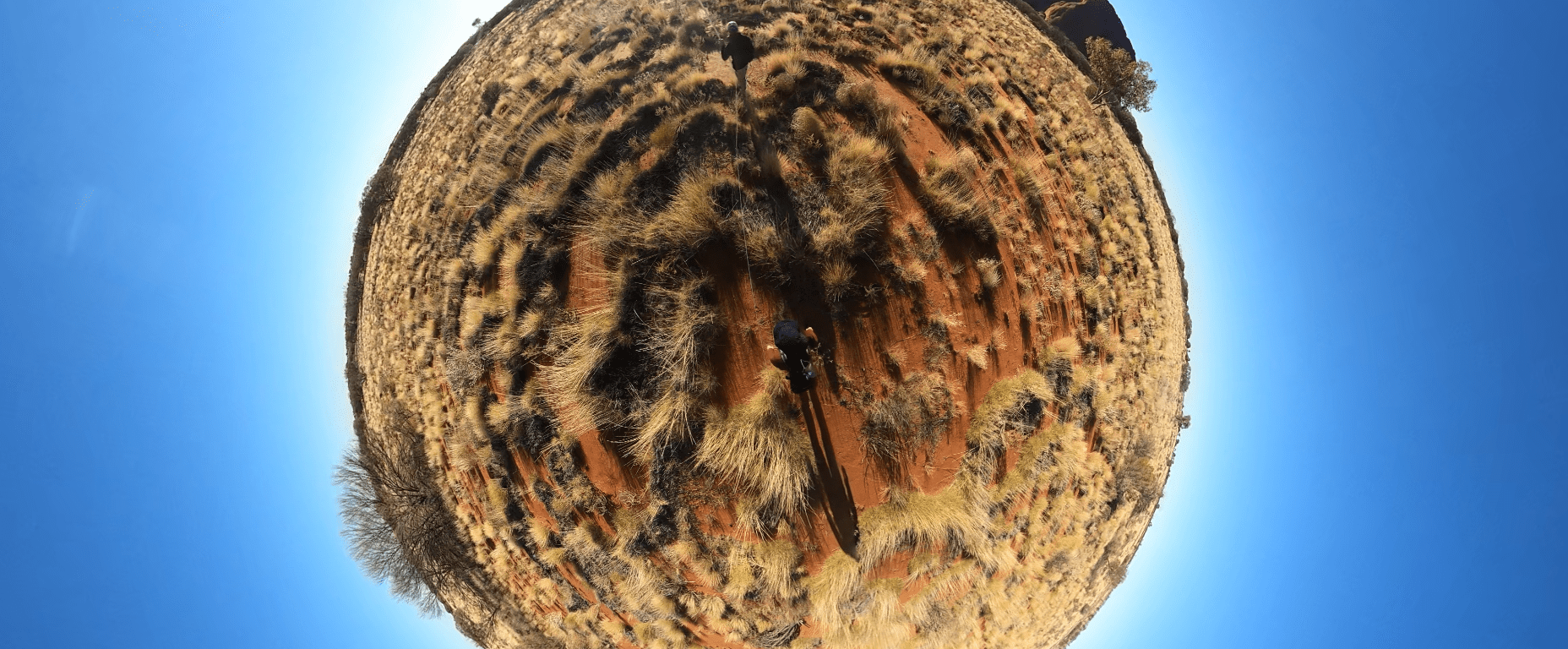
This image shows a single frame of a GoPro Max video captured while collecting field data at Uluru- Kata Tjuta National Park in Australia’s iconic ‘red centre’. The interesting ‘tiny planet’ effect was created by mapping the entire panospheric image, which was taken 3 m above the ground, onto a flat plane. In this image spinifex grassland (Triodia spp., Tjanpi to Anangu people) has been severely affected by drought, with the blackened inner portions of the hummock rings clearly visible. Uluru appears in the top right and another impacted shrub, mulga (Acacia aneura sens. lat.; Wanari) can be seen in the bottom left of the globe. Technological advances in 360-degree cameras and software for working with panospheric imagery have made rapid and inexpensive collection of ecological data over multiple spatial and temporal scales a reality. Read the article here.
 Methods Blog