Throughout March and April, we are featuring articles shortlisted for the 2024 Robert May Prize. The Robert May Prize is awarded by the British Ecological Society each year for the best paper in Methods in Ecology and Evolution written by an early career author. Maëlis Kervellec’s article ‘Bringing circuit theory into spatial occupancy models to assess landscape connectivity‘ is one of those shortlisted for the award.
The paper
What is your shortlisted paper about, and what are you seeking to answer with your research?
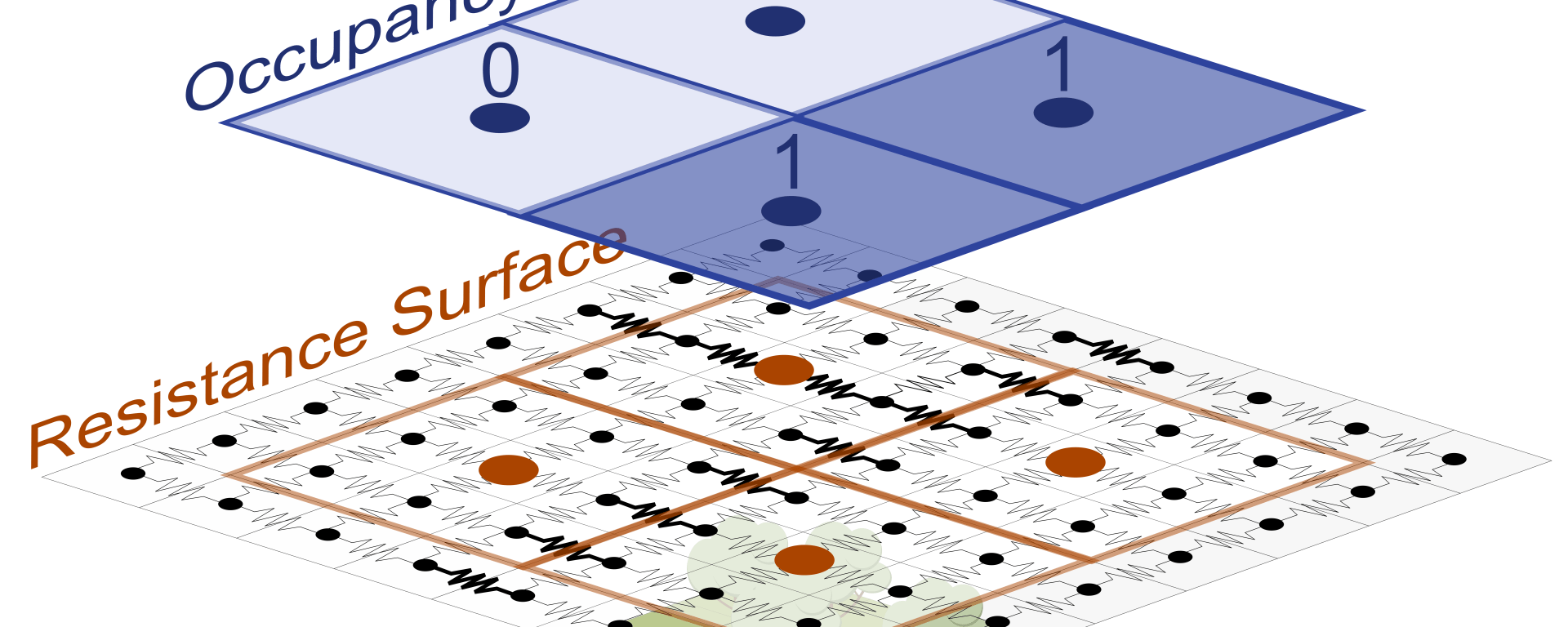
Our paper, accommodates commute-time distance from circuit theory into spatial occupancy models to understand the drivers of species recolonisation in fragmented landscapes. While several non-Euclidean distances exist, only the least-cost path distance, which assumes that species follow the single optimal route, had previously been incorporated into hierarchical models (Howell et al., 2018; Royle et al., 2013). By using commute-time distance, our approach relaxes this assumption by considering all possible movement paths. Moreover, our model provides a unified framework to simultaneously estimate species distribution, movement, and landscape resistance from species detection non-detection data, while accounting for imperfect detection.
Howell, P.E., Muths, E., Hossack, B.R., Sigafus, B.H., Chandler, R.B., 2018. Increasing connectivity between metapopulation ecology and landscape ecology. Ecology 99, 1119–1128. https://doi.org/10.1002/ecy.2189
Royle, J.A., Chandler, R.B., Gazenski, K.D., Graves, T.A., 2013. Spatial capture–recapture models for jointly estimating population density and landscape connectivity. Ecology 94, 287–294. https://doi.org/10.1890/12-0413.1

Were you surprised by anything when working on it? Did you have any challenges to overcome?
One of the main challenges was determining the appropriate spatial and temporal scale (both in terms of resolution and extent) to model population distribution and movement. Defining the appropriate scale is critical, as it influences how well models capture ecological processes and shapes the conclusions we draw. Understanding to which extend the choice of the scale of the resistance surface and the occupancy surface affects model estimations remains an ongoing challenge. Addressing this issue in future research will be essential to improve the accuracy and applicability of these models
What is the next step in this field going to be?
The next step will be to allow for multiple resistance covariates in these models, as we are at present limited to estimating one resistance parameter for one landscape covariate. We are currently developing a computationally efficient method to estimate multiple resistance parameters, which will enable us to more accurately model how different landscape covariates affect species movement, as is done commonly in connectivity studies.
What are the broader impacts or implications of your research for policy or practice?
Our model provides a unified framework for estimating landscape connectivity using long-term species detection and non-detection data, offering valuable insights for evidence-based decision-making. By estimating all parameters within a single model, our approach enables the propagation of uncertainty from the data to connectivity maps. Additionally, integrating all analyses within one framework enhances reproducibility, without having to rely on multiple software
The author
How did you get involved in ecology?
After completing a double bachelor’s degree in biology and mathematics at Sorbonne University, I began to wonder how we acquire knowledge about population ecology, since species are in general difficult to monitor. This led me to a Master’s degree in Biology, Ecology and Evolution at the University of Montpellier, where I was introduced to statistical ecology. During my Master’s degree, I studied occupancy and spatial capture-recapture models to assess the impact of human activities on predator-prey co-occurrence and species distribution. This work led me to my PhD entitled “Connectivity across scales: challenges and opportunities of hierarchical modelling and non-invasive monitoring”.

What is your current position?
I completed my PhD in November and I am currently looking for a postdoctoral position. My research interests lie in developing statistical models to assess the impact of human activities on wildlife populations, including their demography, distribution and movement. As well as developing these methods, I am also interested in developing practical tools to support wildlife management.
Have you continued the research your paper is about?
The broader goal of integrating non-Euclidean distances into hierarchical models was at the core of my PhD and continues to drive my work. We have also explored incorporating least-cost path distance into the movement component of open population spatial capture-recapture (OPSCR) models to quantify the impact of human infrastructures on the recolonisation of an endangered population but using individual level data.
What one piece of advice would you give to someone in your field?
If I could only give one advice, I would say that collaboration is key. Working closely with statisticians, ecologists, and wildlife managers ensures that we develop sound methods that are both scientifically rigorous and practically useful for conservation and management. Effective communication across disciplines, while not always straightforward, leads to more applicable research.
 Methods Blog