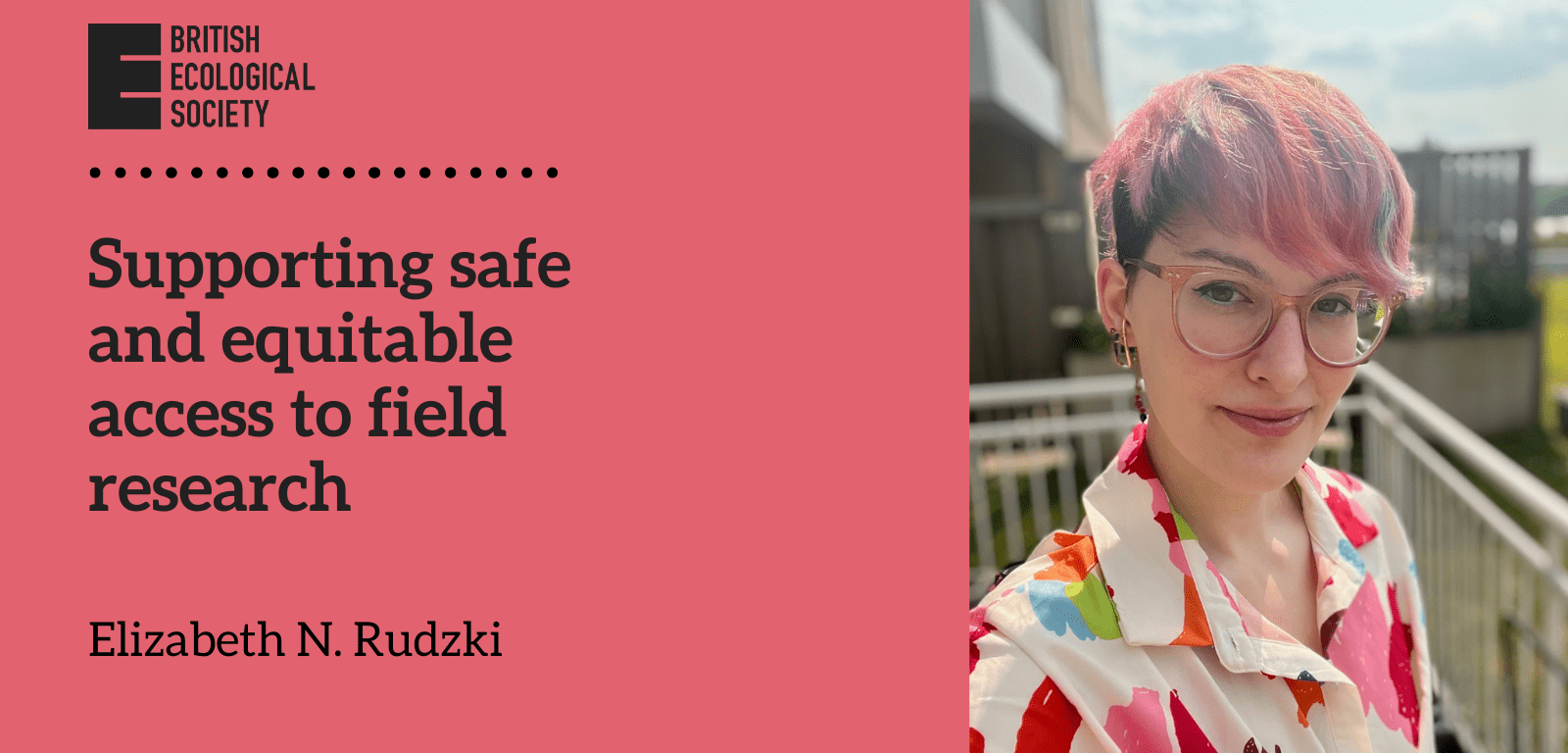
To celebrate Pride Month 2025, we are excited to share a series of blogs and podcasts highlighting useful articles and resources for LGBTQIA+ ecologists and researchers. In each post, the authors behind these resources explain what they are, how they came to produce them, and why they are important. In this post, Elizabeth shares fieldwork advice for researchers with marginalized identities.
Post provided by Elizabeth N. Rudzki
Conducting research in field settings can come with risks to health and safety due to working in remote areas with potentially hazardous topography, wildlife, or inclement weather. Many institutions and departments have created field safety guidelines to help mitigate these risks, especially since field research is an important component for the careers of researchers in numerous academic fields. However, researchers from marginalized groups often face greater or additional risks than those experienced by their peers. As a scientist with disabilities, I have personally experienced novel or exacerbated safety risks during field research, compared to the experiences of my non-disabled colleagues. Addressing these risks that may be unique or exacerbated for marginalized scientists can often put financial constraints upon these trainees unless centralized acknowledgement and support from the training institute is provided. For instance, my typical mobility aide was not compatible with the topography and substrates of one of my excursions, so I ended up purchasing hiking sticks with multiple types of end caps so that I could stabilize myself in various environments such as on slick river stones or deep mud. It is important to mention that marginalized communities often experience a lower socioeconomic status and may not be in a position to financially address these field risks themselves. And in other cases, it may not be possible for an individual researcher to financially “fix” a problem. For example, as ecologists in Pennsylvania (USA), we are often working on state-owned lands that border rural private properties where landowners are not expecting the presence of other individuals and where gun ownership is common. Researchers with marginalized identities (e.g. race, ethnicity, sexual orientation, gender identity, disability, etc.) often experienced more intense and volatile interactions with landowners or members of the public. To address these types of risks, social advocacy and support from colleagues and institutions is necessary.
In the Biological Sciences department at the University of Pittsburgh, we recognized the need for a field safety manual that specifically addresses these exacerbated risks that researchers with marginalized identities encounter in field settings. We gathered a large and diverse group of students, trainees, and principal investigators and through an iterative process of writing, consulting, and discussing, we identified and worked to mitigate a variety of areas where marginalized scientists were experiencing disproportionate risks during field research. When we published our first version of our field safety manual for our department in 2021, we were surprised when the final product was shared outside our department and that it was enthusiastically received even by other schools within our institution. We then decided to share our writing experiences in “A guide for developing a field research safety manual that explicitly considers risks for marginalized identities in the sciences” with the hope that we could lower the activation energy needed to undertake this task at other institutions, departments, or laboratory groups (https://doi.org/10.1111/2041-210X.13970).
In this guide, we addressed social risks such as negative peer-to-peer interactions that researchers can experience. We created centralized guidelines to cultivate a productive and inclusive research team, which included a strict no-tolerance policy for harassment, and specified how team leaders should handle harassment reports or serious conflicts in the field. Additionally, we described how to handle conflicts with non-affiliated members at shared field sites and strongly encourage our researchers to take bystander intervention training and to be active participants in addressing transgressions that occur. We also specified that the financial responsibility of addressing risks should not be on the students and trainees, and that team leads and supervisors should be providing necessary resources such as appropriate field clothing (durable hiking boots, quick-dry pants, waders, etc.) and safety gear such as satellite phones or two-way radios for fully remote field work. For the specific risks that we encounter conducting field research in Pennsylvania, we found that small changes such as providing students with decals to put on their personal vehicles, branded vests / field gear that identify a student or trainee as being affiliated with our institution, or providing guidelines on how team leaders should reach out and communicate with neighboring public and land managers prior to team deployment, have made a positive impact on interactions with the public, as well as how safe students and trainees feel.
I helped write our guide as a graduate student in the Biological Sciences department, and I am now writing this blog as a post-doctoral research associate in the same department. As a scientist with disabilities, I have personally felt a significant positive impact on the inclusivity and accessibility of field research, and a mitigation of safety risks, since the creation of our safety manual. Students of other marginalized identities have expressed similar positive feelings, and I am hopeful that as we welcome new students and trainees with fresh viewpoints and experiences, we will be able to make further improvements to our manual and continue our progress towards more equitable field research opportunities.
One bit of advice I can give for marginalized scientists, especially if you are in a situation where you do not feel comfortable divulging too much about yourself, is to request information about a field site or safety concerns through seemingly “naïve” questions. For instance, I can ask about the availability of refrigeration, and access to ice or coolers, and most would assume I am asking about food or sample storage. You can query the safety of accommodations by expressing interest in how the field site is set up and wanting to know “what to expect” when working there. And finally, always look for allies, even outside of your own research team. Finding a colleague back at your institute, or a collaborator at another institute, that you feel comfortable divulging to and who can advocate on your behalf should issues arise in the field is a valuable safety resource as well.
Since writing the guide, I and one of my co-authors, Dr. Kevin Kohl, surveyed field stations (primarily across North America) in order to identify and quantify accessibility barriers for scientists with disabilities and/or chronic illnesses. As expected, most surveyed field stations had substantial deficits in accessibility, but we were able to pinpoint multiple areas where low cost and easy-to-employ solutions could be proposed, and we identified a common misunderstanding/misconception that had arrested progress towards accessibility at many sites. We then published our findings in Integrative and Comparative Biology (ICB) in 2023 (https://doi.org/10.1093/icb/icad019).
Check out more blog posts in our Pride series here. If you would like to contribute a post yourself, please get in touch.

Check out more blog posts in our Pride series here. If you would like to contribute a post yourself, please do feel free to get in touch with admin@functionalecology.org.
 Methods Blog