
This issue contains the latest methods in ecology and evolution. Read the last issue of the year to find out about this month’s featured articles and the article behind our cover!
Featured
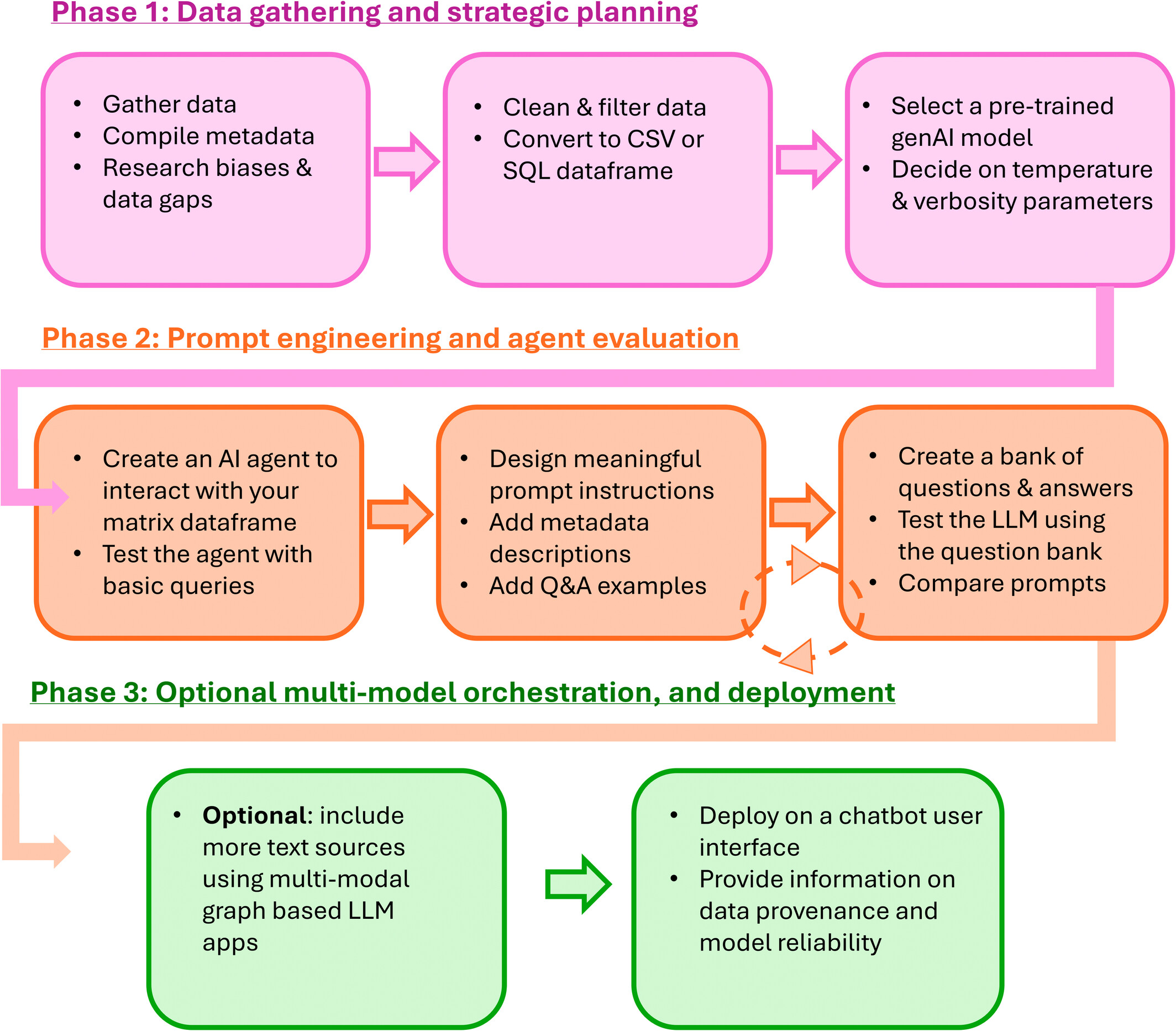
Fast‐tracking ecological interpretation using bespoke quantitative large language models
There is untapped potential to apply large language models (LLMs) to quantitative ecological and environmental datasets. Here, authors present a roadmap for designing and implementing multi-modal LLMs to answer ecological research questions. To build robust ‘virtual quantitative assistants’ capable of fast-tracking data interpretation, they advocate for strategic planning, data stewardship practices, careful prompt engineering and model evaluation as key steps in the LLM development process. They discuss potential use-case examples that apply the LangChain framework to analyse citizen science data. Using their LLM roadmap, authors highlight the importance of iterative and strategic prompt engineering and agent selection, in addition to iteratively evaluating model output.
Full decomposition of phenotypic variance in dichotomous traits: New methods and key implications for behaviour, demography and evolutionary ecology
Authors summarise and synthesise fundamental principles of modelling dichotomous phenotypic variation. They then formulate and solve exact back-transformation equations, linking the continuous latent scale to the dichotomous phenotypic scale. They use these derivations to devise a new methodology to systematically define and quantify all components of phenotypic variance that non-linearly emerge from linear combinations of latent liability-scale effects. Authors thereby provide an easy-to-implement calculation procedure (and R codes) for fully and accurately decomposing phenotypic variance in dichotomous traits using GLMM estimates. By revealing key biological properties that were previously hidden and eliminating inaccuracies and misconceptions that are otherwise likely to be commonplace, authors open broad opportunities to meaningfully dissect dichotomous phenotypic variation in ecological and evolutionary research.
The seismic fingerprint of wind‐induced tree sway
Here, authors propose a novel alternative approach to monitor tree stress tracking tree sway through its seismic ground motion signature, referred to as the tree’s seismic fingerprint. These wind-induced sway signals are intrinsically linked to the mechanical properties of leaves, branches and trunks, which change under environmental stress. Seismometers offer key advantages: they are non-invasive, low-maintenance and easily scalable for tree monitoring across forest plots. The authors findings show that seismometers can passively monitor both environmental forcing and tree biomechanical response. As such, seismic sensing offers a powerful, scalable tool for forest monitoring, with the potential to capture both structural stability and stress-related changes under climate extremes.

Home‐range spillover in habitats with impassable boundaries: Causes, biases and corrections using autocorrelated kernel density estimation
While several approaches to addressing spillover bias are used when estimating home ranges, these approaches introduce bias throughout the remaining home-range area, depending on the amount of spillover removed, or are otherwise inaccessible to most ecologists. Here, authors introduce local corrections to home-range kernels to mitigate spillover bias in (autocorrelated) kernel density estimation in the continuous time movement model (ctmm) package, and demonstrate their performance using simulations with known home-range extents and distributions, and a real-world case study.
Quantifying species distribution within the functional space
Authors introduce a novel framework to quantify species’ functional arrangement within the functional space, capturing patterns across broad and fine scales. They detail the construction of a functional space and propose statistics to assess species functional arrangement—the cumulative proportion of pairwise neighbours (PNcp) and the cumulative proportion of nearest neighbours (NNcp). Authors also outline guidelines for evaluating departures from randomness using null models, including random displacement and random selection from species pool. The methods presented here offer a powerful approach to uncover and interpret complex patterns in functional diversity occurring at multiple scales.
A calibration framework to improve mechanistic forecasts with hybrid dynamic models
Here, authors present a comprehensive calibration framework designed to address the unique challenges posed by mechanistic ecological forecasting. Their approach combines a segmentation strategy where state variables are estimated independently, differentiable programming for efficient gradient computation, parameter transformations to ensure the feasibility and stability of the model simulations, and mini-batching to accomodate large datasets. Through comprehensive benchmarks using simulated food web dynamics of increasing complexity, authors demonstrate that the framework substantially improves the convergence of gradient descent algorithms and Monte Carlo sampling methods, accommodating for realistic scenarios with noisy and partial observations. This yields improved parameter estimation and forecasts within both mode estimation and full posterior distribution contexts.
Cover Image

This month’s cover features a young mandrill (Mandrillus sphinx) being groomed by its mother. Determining the age of wild animals is essential for many questions in conservation biology as well as in fundamental research in ecology and evolution. Traditional methods are often invasive, typically requiring the capture and handling of individuals. In this issue, Renoult et al. present an artificial intelligence model capable of estimating the age of mandrills using nothing more than a photograph of their face. They show that the model performs at a level comparable to state-of-the-art age-prediction systems developed for humans. More importantly, their analyses suggest that most of the remaining prediction error reflects genuine biological variation among individuals rather than methodological limitations of the model itself. This study highlights the potential of AI-based approaches to investigate individual developmental trajectories in a fully non-invasive manner, and to uncover the ecological and biological factors underlying these differences. Image credit: Julien RENOULT
Read the paper here.
 Methods Blog