Throughout March, we are featuring articles shortlisted for the 2025 Robert May Prize. The Robert May Prize is awarded by the British Ecological Society each year for the best paper in Methods in Ecology and Evolution written by an early career author. Jordan Martin’s article ‘Covariance reaction norms: A flexible method for estimating complex environmental effects on trait (co)variances‘ is one of those shortlisted for the award.
About the paper
What is your shortlisted paper about, and what are you seeking to answer with your research?
My paper proposes a statistical model (the ‘covariance reaction norm’ or CRN) for detecting how complex, continuously varying environments shape the expression of and association among multiple organismal traits. I wanted to develop a method for more effectively studying quantitative genetics in a rapidly changing world, where both the phenotypes that individuals exhibit and the environments they encounter tend to be multifaceted and dynamic.
Were you surprised by anything when working on it? Did you have any challenges to overcome?
The biggest challenge for me was bridging the gap between the formal and practical implementations of the CRN model. Writing the CRN down on paper for the first time was an exciting step, but then it took me many months to get this tidy notation into a workable model that could be efficiently applied to real data. This pushed me to greatly expand my skills in probabilistic programming.
What is the next step in this field going to be?
We have a solid understanding of why genetic (co)variances are often stable across space and time, and while there is a great deal of theory suggesting that (co)variances can also rapidly change, empirical evidence remains scarce. I hope my model will contribute to overcoming this gap, providing a deeper understanding of how plasticity shapes multivariate traits in natural environments.
What are the broader impacts or implications of your research for policy or practice?
Researchers trying to predict how contemporary populations will respond to rapid environmental change need methods capable of quantifying context-dependency in trait expression and selection. I hope that by addressing this challenge, the CRN will meaningfully contribute to such efforts.
About the author
How did you get involved in ecology?
I’ve been fascinated by behavior my entire life, and I fell in love with the explanatory scope and power of evolutionary theory while reading popular science books the summer before college. As a student, I was fortunate to be mentored by some amazing biologists specialized in primate behavior (thank you, Drs. Marchant, Suarez, Koski, and Massen!), which led me to the field of behavioral ecology. While my research has broadened beyond primate behavior in the years since, it remains one of my passions and the primary reason why I became an evolutionary biologist.
What is your current position?
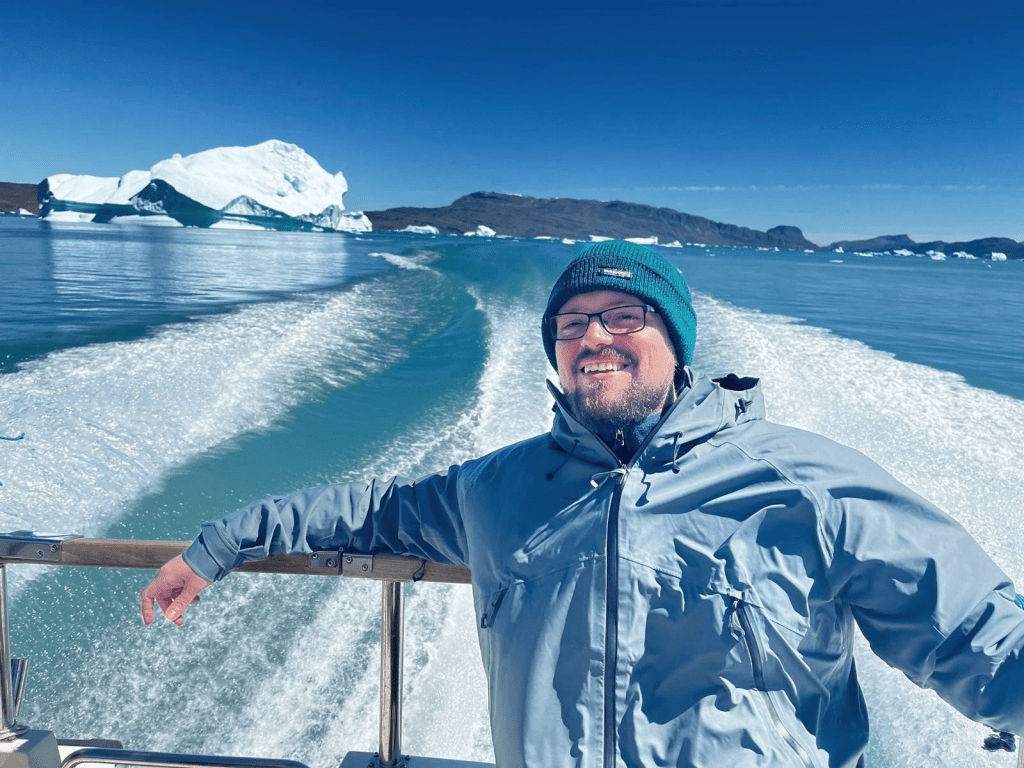
I am currently a postdoctoral researcher in Dr. Blake Matthew’s Evolutionary Ecology of Aquatic Ecosystems laboratory, in the Fish Ecology and Evolution department at The Swiss Federal Institute of Aquatic Science and Technology (Eawag). I’ll soon be starting my own research team as an Ambizione group leader in the Institute of Ecology and Evolution at the University of Bern.
Have you continued the research your paper is about?
Yes, I am now applying the CRN to study how ecological variation across a large lake system in southern Greenland has shaped the integration and evolution of behavior and morphology in three-spined stickleback (Gasterosteus aculeatus).
What one piece of advice would you give to someone in your field?
My advice would be to work toward carving out a well-defined and specialized niche for yourself, but to also approach that niche as broadly and integratively as you can. A mentor once told me to “be an interdisciplinary thinker but not an interdisciplinarian”, which I think is a nice way of putting it. Your success and recognition within a professional network will be affected by whether other members recognize you as one of their own; and when you apply for a position asking for a specialist in a particular subject matter, you want to be able to show that you are the right fit for the job. Yet, the deeper advancement of science and knowledge often comes through the influx of fresh ideas from outside a narrow intellectual space. If you only read other people working on the same topic, you’ll have a much harder time finding a novel perspective to push your field forward. So don’t forget to also think broadly, read widely, and stay curious about your little corner of the world from multiple perspectives.
 Methods Blog