Throughout March, we are featuring articles shortlisted for the 2025 Robert May Prize. The Robert May Prize is awarded by the British Ecological Society each year for the best paper in Methods in Ecology and Evolution written by an early career author. Xiaotian Zheng’s article ‘Spatial-statistical downscaling with uncertainty quantification in biodiversity modelling‘ is one of those shortlisted for the award.
About the paper
What is your shortlisted paper about, and what are you seeking to answer with your research?
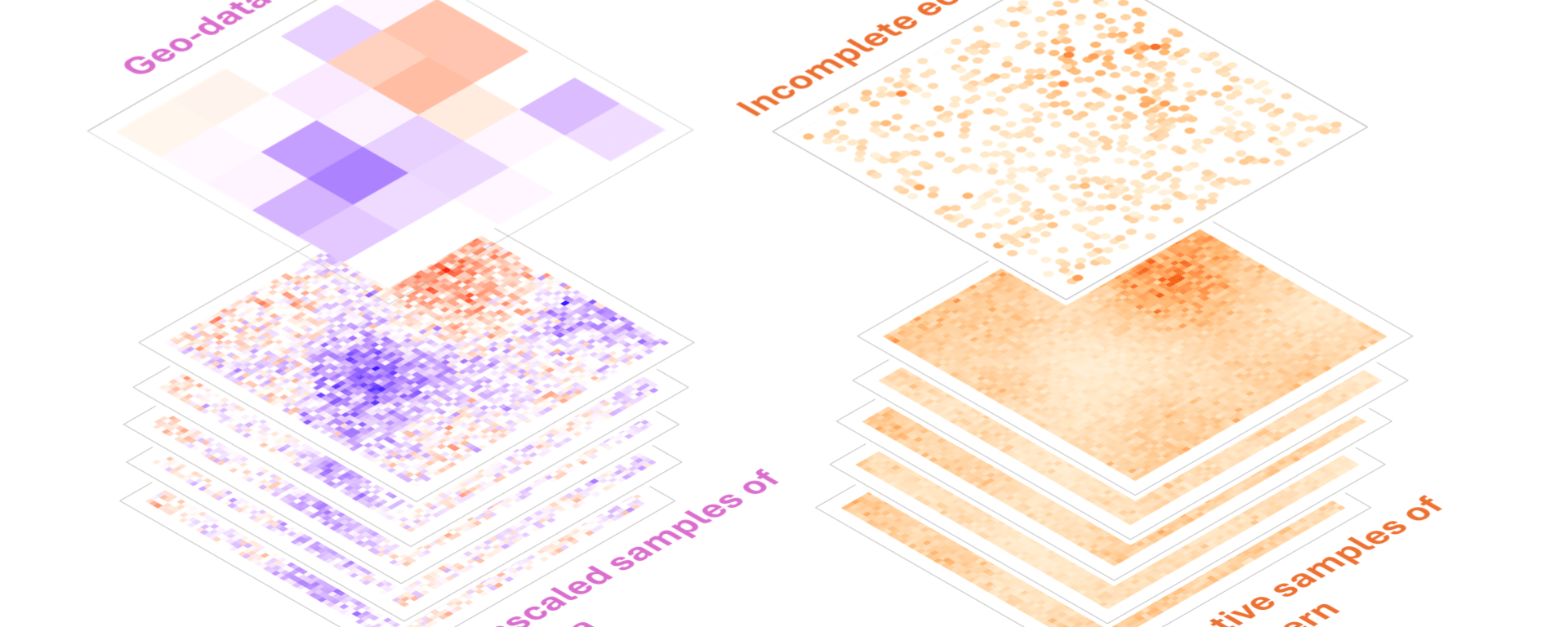
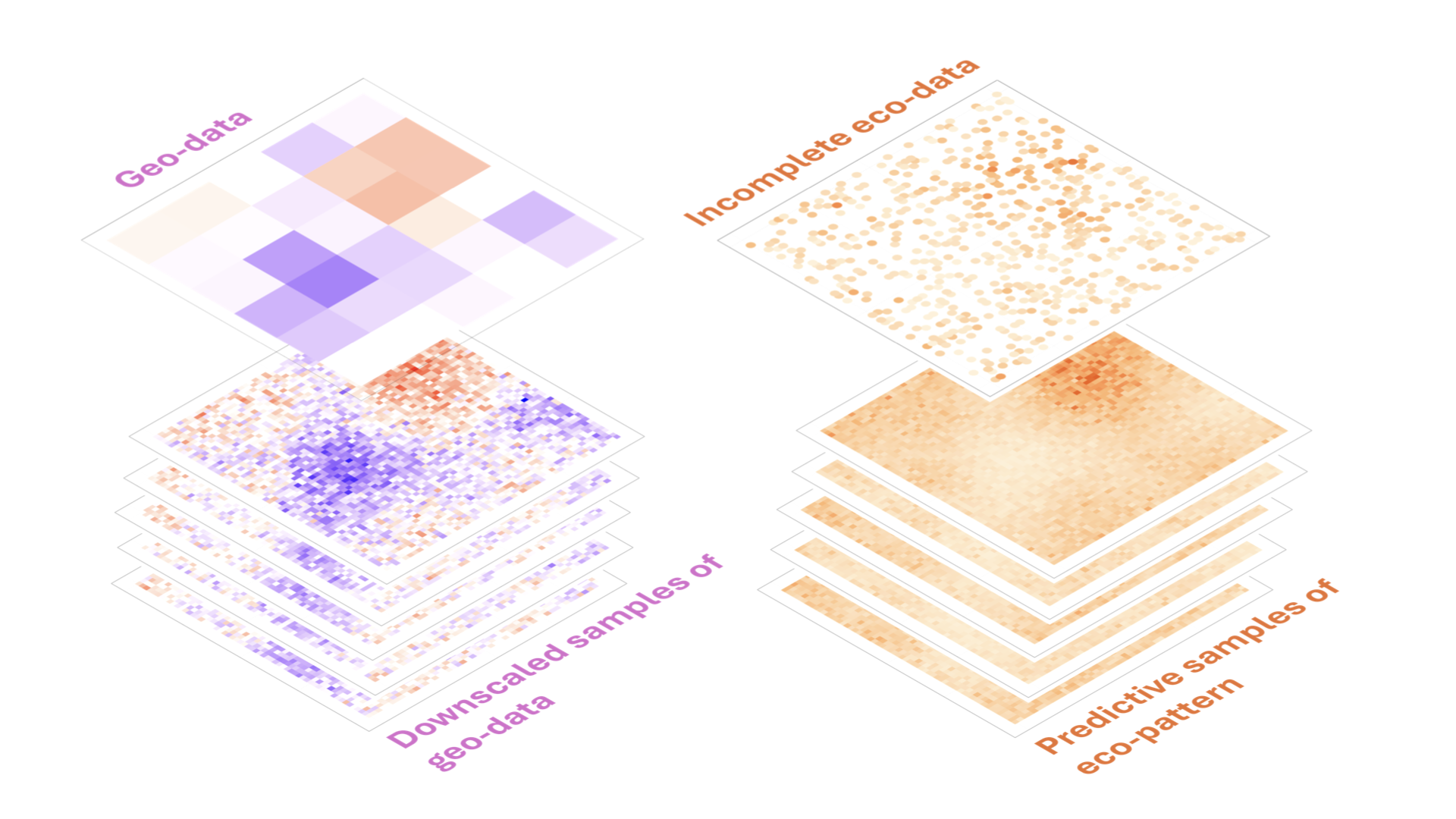
Understanding and predicting the unprecedented loss of biodiversity is one of the greatest challenges facing humanity. Addressing this challenge involves quantifying uncertainty in biodiversity inference, for example, for decision making related to conservation management and risk evaluation. Our paper addresses a key source of uncertainty that arises from downscaling of regional climate data from coarse to fine resolution. Downscaling reveals local details and spatial patterns that may not actually be present and hence comes with uncertainty. In the paper, we investigate the consequences of ignoring downscaling uncertainty for biodiversity inference using an analysis of variance. We propose a two-stage protocol in which the coarse-resolution data on climate explanatory variables are first downscaled with uncertainty quantification through Monte Carlo sampling. In the second stage, the downscaled samples are incorporated into a generalised linear model (GLM). We call this two-stage protocol CORGI (Change Of Resolution in GLM Inference).
Were you surprised by anything when working on it? Did you have any challenges to overcome?
It turned out that incorporating downscaling uncertainty into generalised linear models was non-trivial. As we show in the simulation study, a simple approach that directly includes downscaled samples can lead to biased and invalid inferences. To address this issue, we introduced a spatial Berkson-error decomposition for the downscaled samples. This decomposition allows downscaling uncertainty to be properly propagated into genearlised linear models.
What is the next step in this field going to be?
The next step is to develop downscaling approaches that push the limits of what can be achieved in terms of spatial resolution, while appropriately quantifying uncertainty. This is crucial for fine-scale biodiversity inference and assessment. There is also a need to develop protocols to properly include downscaling uncertainty in models other than genearlised linear models, to support a wide range of scientific applications.
What are the broader impacts or implications of your research for policy or practice?
There have been growing calls in the community to stop ignoring mapping uncertainty in biodiversity science. Our work contributes by providing a practical way to both quantify uncertainty and propagate it into subsequent analyses. We do this by generating Monte Carlo samples of biodiversity patterns (e.g., maps) using Monte Carlo samples of downscaled climate. This offers practical guidance for ongoing and future research in biodiversity inference, as well as for management and policy making, to consider not only best estimates or predictions, but also their associated uncertainty arising from climate downscaling.
About the author

How did you get involved in ecology?
I studied for my PhD at the University of California, Santa Cruz, a campus set on a forested hillside, surrounded by redwood trees and overlooking Monterey Bay. Living and studying in this environment rich in natural habitats gradually sparked my interest in ecology. Later, a postdoctoral opportunity in Australia to work on biodiversity and climate change to protect Antarctica turned the early inspiration into reality.
What is your current position?
This paper was completed during my time as a postdoctoral researcher at the University of Wollongong, where my position was supported by Australian Research Council SRIEAS Grant SR200100005 Securing Antarctica’s Environmental Future. I am now an Assistant Professor at the University of Georgia.
Have you continued the research your paper is about?
Yes! I am currently working on improving the computational aspects of the model to speed up the downscaling process. I am also developing software so that researchers can easily apply our downscaling method and propagate the associated uncertainty into analyses based on generalised linear models.
What one piece of advice would you give to someone in your field?
I would say that having a collaborative mindset can take our research much further than we might expect, and that we should always try to step out of our comfort zones and keep learning new things along the way.
 Methods Blog