Post provided by Karen Dyson and Kayla Aburida
When we first started using soil environmental DNA (eDNA) to understand how sustainable farming practices affect biodiversity, we thought the hard parts would be in the lab or the analysis. We were wrong. Instead, one of the biggest challenges came much earlier: in the field when collecting data.
Soil eDNA is patchy, shaped by microhabitats, plant cover, microtopology, soil conditions and the movements of organisms. That unevenness is a problem for a sampling design that assumes otherwise. Our pilot protocol asked field teams to collect from fixed, pre-defined 50m plots: a tidy idea that turned out to be slow and inflexible in practice, especially when we were already spending hours getting to remote sites. Every awkward plot adjustment felt like wasted time. So, we built something different.
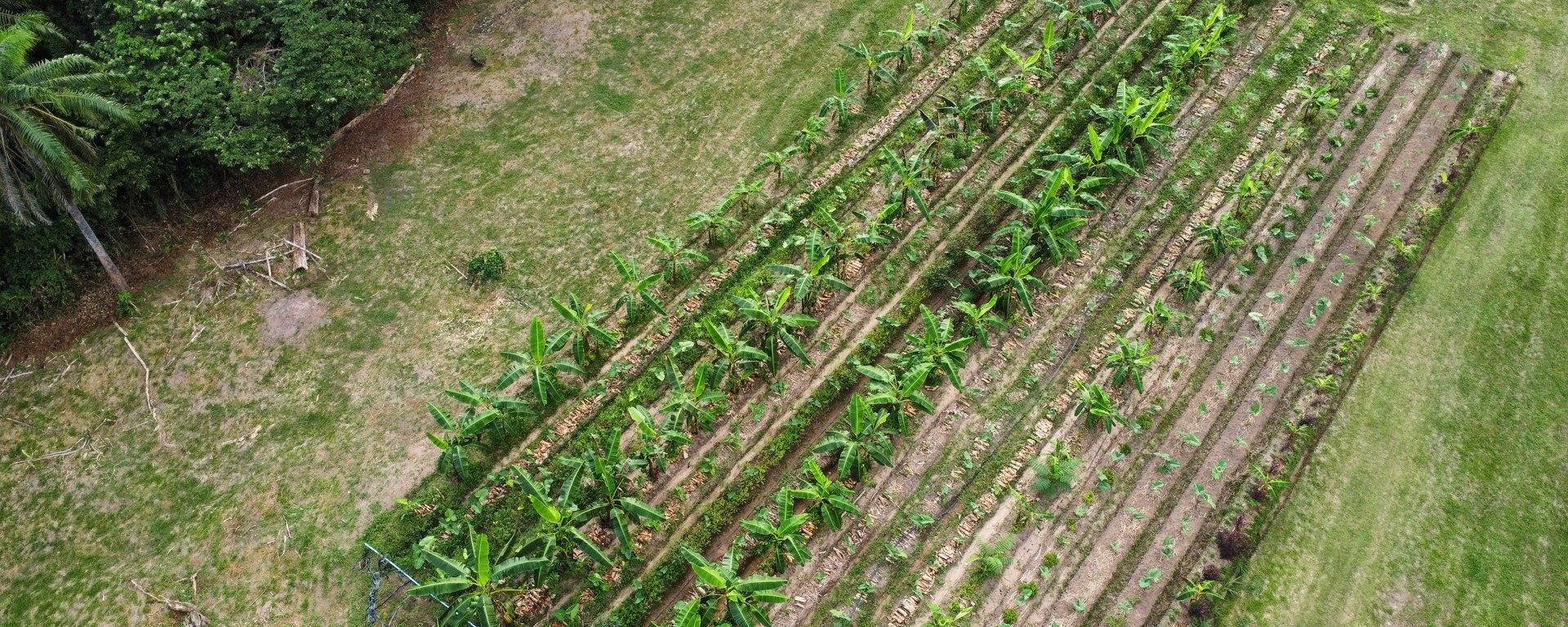
In our new publication, we describe an edge-to-edge, high-volume soil sampling approach that trades fixed plots for a full-site walk. A field technician moves across the entire site, taking small scoops of soil from each microhabitat they encounter, and pools everything into one large composite sample. We also developed a calibration step to determine how much total soil to collect in a given ecosystem. In our proof-of-concept work in Pará, Brazil, that came out to a recommended pooled volume of 2.4 litres, and the method successfully distinguished arthropod communities across syntropic agriculture, restoration, forest, and conventional agriculture.
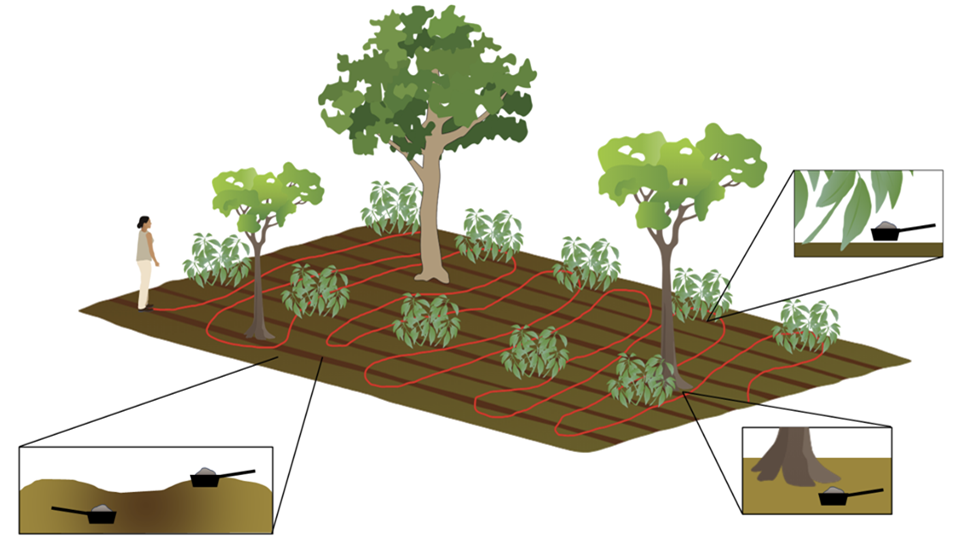
Two things drove us toward this design. One was needing a practical solution: we wanted a method that partner farmers and local collaborators could learn and use themselves, without depending on a specialist flying in from outside. The edge-to-edge approach can be taught in the morning and then carried out the same day. The other drive was scientific: a growing body of eDNA research (and our own pilot work) suggests that larger, more spatially distributed samples catch more of the biological variation that small fixed plots miss. If the signal is patchy, your sampling needs to match that.
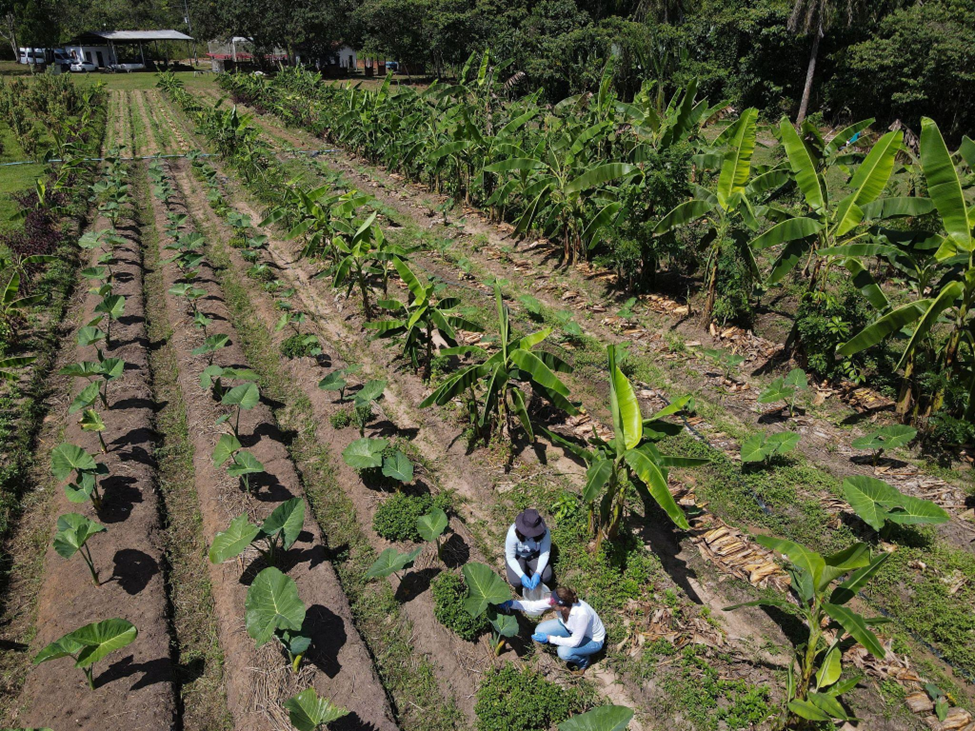
The method is also minimally invasive as there’s no plot setup, no digging holes, nothing that disrupts an active agricultural field more than necessary. And because the calibration step is built in, the approach can be adapted to ecosystems where soil eDNA protocols don’t yet exist.
We started this work because we wanted to understand what sustainable farming practices actually do to biodiversity at meaningful scales to advance sustainability and conservation goals. That requires rigorous and accessible monitoring tools that hold up under real field conditions. This is our attempt to build one.
If you want more background, the PLOS ONE paper that motivated this work is a good starting point. Our new publication builds directly on what we learned there.
Read the article here.

