How Can Understanding Animal Behaviour Help Support Wildlife Conservation?

Below is a press release about the Methods in Ecology and Evolution article ‘A novel biomechanical approach for animal behaviour recognition using accelerometers‘ taken from the EPFL.

©Arpat Ozgul, University of Zurich

Researchers from EPFL and the University of Zurich have developed a model that uses data from sensors worn by meerkats to gain a more detailed picture of how animals behave in the wild.

Advancement in sensor technologies has meant that field biologists are now collecting a growing mass of ever more precise data on animal behaviour. Yet there is currently no standardised method for determining exactly how to interpret these signals. Take meerkats, for instance. A signal that the animal is active could mean that it is moving; alternatively, it could indicate that it is digging in search of its favourite prey, scorpions. Likewise, an immobile meerkat could be resting – or keeping watch.

In an effort to answer these questions, researchers from EPFL’s School of Engineering Laboratory of Movement Analysis and Measurement (LMAM) teamed up with colleagues from the University of Zurich’s Population Ecology Research Group to develop a behavior recognition model. The research was conducted in affiliation with the Kalahari Research Centre. Continue reading “How Can Understanding Animal Behaviour Help Support Wildlife Conservation?”

Revisiting Past Biodiversity with the divDyn R Package

Post provided by ÁDÁM T. KOCSIS

The source of occurrence data: fossil collections (Early Jurassic ammonites in the collection of the University of Erlangen-Nuremberg, photo by Konstantin Frisch)
The source of occurrence data: fossil collections (photo by Konstantin Frisch).

To find out about changes in ancient ecosystems we need to analyse fossil databases that register the taxonomy and stratigraphic (temporal) positions of fossils. These data can be used to detect changes of taxonomic diversity and to draft time series of originations and extinctions.

The story would be so simple if it wasn’t the effects of heterogeneous and incomplete sampling: the white spots in our understanding of where and when species lived exactly. This phenomenon decreases the fidelity of face-value patterns extracted from the fossil record, making them less reliable. It must be considered if we want to get a glimpse into the biology or the distribution of life in space and time. Naturally, several metrics have been proposed to overcome this problem, each claiming to accurately depict the patterns of ancient life. Continue reading “Revisiting Past Biodiversity with the divDyn R Package”

Issue 10.4: Bayesian Models, Isoscapes, Camera Traps and More

The April issue of Methods is now online!

This month we’re thinking about hierarchical Bayesian models and Approximate Bayesian Computation, improving ecological niche models, and learning how to make our own Environmental Microcontroller Units (more on that below). We’ve got articles on Phylogenetics, Space (not outer space), Camera Traps and much more. Plus, there are six papers that are completely free to everybody, no subscription required!

Find out a little more about the new issue of Methods in Ecology and Evolution (including details about the bobcat on this month’s cover) below. Continue reading “Issue 10.4: Bayesian Models, Isoscapes, Camera Traps and More”

Using Experimental Methodology to Determine Grassland Response to Climate Change

Post provided by Heather Hager

©Hajnal Kovacs

In the second chapter of Grasslands and Climate ChangeMethodology I: Detecting and predicting grassland changeJonathan Newman and I take an in-depth look at the experimental methodology that has been used to determine how grassland ecosystems will respond to climate change. When we set out, we were interested in knowing, for example, the magnitudes and types of treatments applied, plot sizes, replication, study durations, and types of response variables that were measured and by how many studies. For simplicity(!), we focused on three treatment types: changes in atmospheric carbon dioxide levels, changes in temperature (mean, minimum, maximum), and changes in precipitation (increases, decreases, timing).

Using the methods of a formal systematic review, we identified 841 relevant studies, for which we extracted information on study location and experimental methodology. There were some surprises, both good and bad. For instance, mean and median plot sizes were actually larger than we had expected. On the other hand, numbers of true experimental replicates were low. Although many of the study methods were well reported, some areas lacked critical detail such as descriptions of (at least) the dominant plant species in the study area.

Continue reading “Using Experimental Methodology to Determine Grassland Response to Climate Change”

Phylogenetic Tip Rates: How Well Can We Estimate Diversification?

Post provided by Pascal Title and Dan Rabosky

Analyzing diversification rate heterogeneity across phylogenies allows us to explore all manner of questions, including why Australia has such an incredible diversity of lizards and snakes.

Within the tree of life there are differences in speciation and extinction rates over time and across lineages. Biologists have long been interested in how speciation rates change as a function of ecological opportunity or whether key innovations lead to increases in the rate of speciation. Exploring this rate variation and examining how clades differ in terms of their diversification dynamics can help us to understand why species diversity varies so dramatically in time and space. Learning more about the relationship between traits and diversification rates is especially important because it has the potential to reveal the causes of pervasive variation in species richness among clades and across geographic regions.

Several different classes of methods are available for studying the effects of species traits on lineage diversification rates. These include state-dependent diversification models (e.g., BiSSE, QuaSSE, HiSSE) and several non-model-based approaches. In our article – ‘Tip rates, phylogenies and diversification: What are we estimating, and how good are the estimates?’ – we assessed the accuracy of a number of model-free metrics (the DR statistic, node density metric, inverse of terminal branch lengths) and model-based approaches (Bayesian Analysis of Macroevolutionary Mixtures, BAMM) to determine how they perform under a variety of different types of rate heterogeneity. The “tip rates” using these approaches have become widely used for a few reasons, including ease of computation and how easy it is to pair them with other types of data. Continue reading “Phylogenetic Tip Rates: How Well Can We Estimate Diversification?”

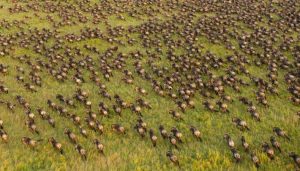
New Technologies Could Help Conservationists Keep Better Track of Serengeti Wildebeest Herds

Below is a press release about the Methods in Ecology and Evolution article ‘A comparison of deep learning and citizen science techniques for counting wildlife in aerial survey images‘ taken from the University of Glasgow.

A wildebeest herd in the Serengeti. ©Daniel Rosengren

Mathematicians and conservationists from the UK, Africa and the United States have used machine-learning and citizen science techniques to accurately count wildebeest in the Serengeti National Park in Tanzania more rapidly than is possible using traditional methods.

Evaluating wildebeest abundance is currently extremely costly and time-intensive, requiring manual counts of animals in thousands of aerial photographs of their habitats. From those counts, which can take months to complete, wildlife researchers use statistical estimates to determine the size of the population. Detecting changes in the population helps wildlife managers make more informed decisions about how best to keep herds healthy and sustainable. Continue reading “New Technologies Could Help Conservationists Keep Better Track of Serengeti Wildebeest Herds”

R-Ladies: For More Balance in the R Community!

The theme for this year’s International Women’s Day is #BalanceForBetter. So, we decided that we’d like to take this opportunity to promote an organisation that supports and empowers women and gender minorities in STEM fields that still suffer from underrepresentation. As a journal, we publish a lot of articles on software and code that are used in the study of different fields in ecology and evolutionary biology. We have a wide audience of R coders and R users who follow us on social media and read our blog. With that in mind, R-Ladies seemed like a fairly obvious group for us to promote…

Post provided by MAËLLE SALMON and HANNAH FRICK, two members of the R-LADIES GLOBAL TEAM.

What is R-Ladies?

R-Ladies is a global grassroots organisation whose aim is to promote gender diversity in the R community. The R community suffers from an underrepresentation of gender minorities (including but not limited to cis/trans women, trans men, non-binary, genderqueer, agender). This can be seen in every role and area of participation: leaders, package developers, conference speakers, conference participants, educators, users (see recent stats). What a waste of talent!

As a diversity initiative, the mission of R-Ladies is to achieve proportionate representation by encouraging, inspiring, and empowering people of genders currently underrepresented in the R community. So our primary focus is on supporting minority gender R enthusiasts to achieve their programming potential. We’re doing this by building a collaborative global network of R leaders, mentors, learners, and developers to help and encourage individual and collective progress worldwide. Continue reading “R-Ladies: For More Balance in the R Community!”

Quantifying Animal Movement from Videos

Quantifying animal movement is central to research spanning a variety of topics. It’s an important area of study for behavioural ecologists, evolutionary biologists, ecotoxicologists and many more. There are a lot of ways to track animals, but they’re often difficult, especially for people who don’t have a strong background in programming. Vivek Hari Sridhar, Dominique G. Roche and Simon Gingins have developed a new, simple software to … Continue reading Quantifying Animal Movement from Videos