Habitat destruction and degradation represent serious threats to biodiversity, and quantification of land-use change over time is important for understanding the consequences of these changes to organisms and ecosystem service provision. Historical land-use maps are important for documenting how habitat cover has changed over time, but digitizing these maps is a time consuming process. HistMapR is an R package designed to speed up the digitization … Continue reading Digitizing Historical Land-use Maps with HistMapR
To understand the factors shaping vocal communication, we need reliable information about the communicating individuals on different levels. First, vocal behaviour should be recorded from undisturbed animals in meaningful settings. Then we have to separate and assign the individuals’ vocalisations. Finally, the precise timing of vocal events needs to be stored. Microphone backpacks allow researchers to record the vocal behaviour of individual animals in naturalistic settings – even in acoustically challenging … Continue reading Microphone Backpacks for Individual-level Acoustic Recordings
Francesco de Bello describes the main elements of the method he has recently published in Methods in Ecology and Evolution. The method aims at decoupling and combining functional trait and phylogenetic dissimilarities between organisms. This allows for a more effective combination of non-overlapping information between phylogeny and functional traits. Decoupling trait and phylogenetic information can also uncover otherwise hidden signals underlying species coexistence and turnover, … Continue reading Decoupling Functional and Phylogenetic Dissimilarity between Organisms
In a new Methods in Ecology and Evolution podcast, Georgina Brennan (Bangor University) interviews Simon Creer (Bangor University) about his article ‘The ecologist’s field guide to sequence-based identification of biodiversity‘. They talk about about where the idea for the paper came from, what it’s aim are and who will benefit from it. We hear how new sequences can improve and enhance current biomonitoring programmes (and make them … Continue reading The Field Guide to Sequence-Based Identification of Biodiversity: An Interview with Simon Creer
In a new Methods in Ecology and Evolution podcast, the Senior Editors – Rob Freckleton, Bob O’Hara and Jana Vamosi – discuss the past, present and future of the journal. They talk about what sets it apart from other journals, their favourite articles and the kinds of papers that they would like to see more of. If you’re thinking about submitting to Methods in Ecology and … Continue reading What is Methods in Ecology and Evolution?
DNA dietary analysis is a non-invasive tool used to identify the food consumed by vertebrates. The method relies on identifying prey DNA in the target animals’ scats. It’s especially useful for marine animals such as seals and seabirds as it is difficult to watch their feeding events.
In the video below, Julie McInnes describes scat collection protocols that she (along with Rachael Alderman, Bruce Deagle, Mary-Anne Lea, Ben Raymond and Simon Jarman) developed to optimise the detection of food DNA in vertebrate scat samples. The authors use the shy albatross to demonstrate their new methods.
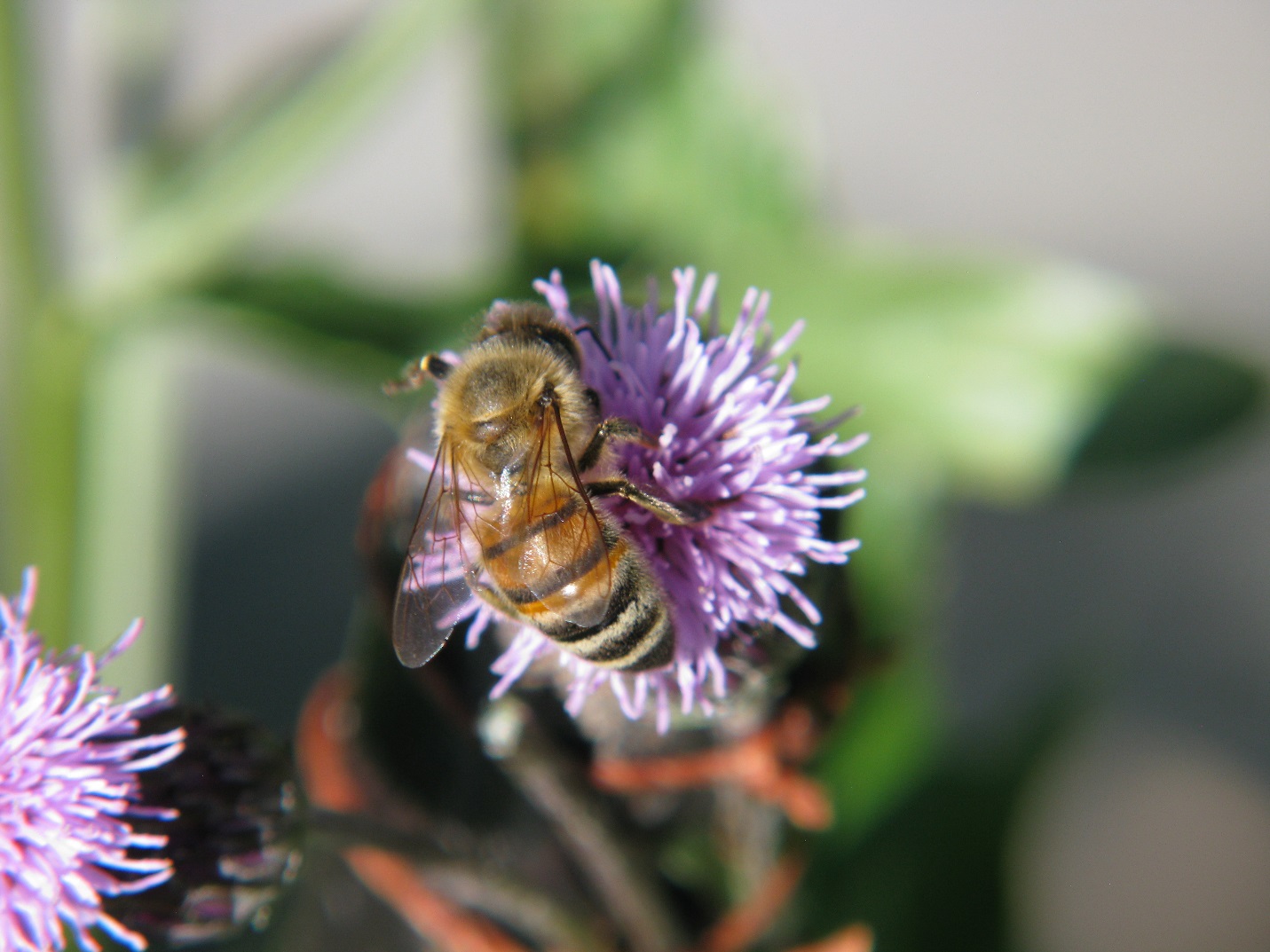
Image from the Canon PowerShot camera with CHDK script ‘Motion Detect Plus’. The thistle flower being visited by ♀ honeybee Apis mellifera L.
Pollinators have fascinated ecologists for decades, and they have traditionally been monitored by on-site human observations. This can be a time-consuming enterprise and – more importantly – species identification and recordings of behaviour have to be registered at the time of observation. This has two complications:
While writing notes, or recording them electronically, the observer cannot continue focusing on the animal or behaviour in question.
Such data then have to be transcribed, with the risk of making transcription errors.
Bringing Monitoring into the 21st Century
Although on-site human observations have predominated, today’s widespread availability of digital monitoring equipment has enabled unique data on flower visitors to be collected. In my research, I have used a time-efficient automated procedure for monitoring flower-visiting animals – namely foraging bumblebees visiting focal white clovers and honeybees visiting thistles.
David Warton (University of New South Wales) interviews interviews Ben Stevenson (University of St Andrews) about his 2015 Methods in Ecology and Evolution paper ‘A general framework for animal density estimation from acoustic detections across a fixed microphone array’. They also discuss what Ben is currently up to, including an interesting new method for dealing with uncertain identification in capture-recapture, published in Statistical Science as ‘Trace-Contrast Models for Capture–Recapture Without Capture Histories’.

 Methods Blog