Issue 7.1

Issue 7.1 is now online!

The January issue of Methods is now online!

As always, the first issue of the year is our sample issue. You can access all of the articles online free of charge. No subscription or membership is required!

We have two Open Access articles and two Applications papers in our January issue.

Recognizing False Positives: Environmental DNA (eDNA) is increasingly used for surveillance and detection of species of interest in aquatic and soil samples. A significant risk associated with eDNA methods is potential false-positive results due to laboratory contamination. To minimize and quantify this risk, Chris Wilson et al. designed and validated a set of synthetic oligonucleotides for use as species-specific positive PCR controls for several high-profile aquatic invasive species.

BiMat: An open-source MATLAB package for the study of the structure of bipartite ecological networks. BiMat enables both multiscale analysis of the structure of a bipartite ecological network – spanning global (i.e. entire network) to local (i.e. module-level) scales – and meta-analyses of many bipartite networks simultaneously. The authors have chosen to make this Applications article Open Access.

Gemma Murray et al. provide this month’s second Open Access article. In ‘The effect of genetic structure on molecular dating and tests for temporal signal‘ the authors use simulated data to investigate the performance of several tests of temporal signal, including some recently suggested modifications. The article shows that all of the standard tests of temporal signal are seriously misleading for data where temporal and genetic structures are confounded (i.e. where closely related sequences are more likely to have been sampled at similar times). This is not an artifact of genetic structure or tree shape per se, and can arise even when sequences have measurably evolved during the sampling period.

Our January issue also features articles on Monitoring, Population Ecology, Genetics, Evolution, Community Ecology, Diversity and more. Continue reading “Issue 7.1”

Methods in Ecology and Evolution 2015: The Year in Review

Happy New Year! We hope that you all had a wonderful Winter Break and that you’re ready to start 2016. We’re beginning the year with a look back at some of our highlights of 2015. Here’s how last year looked at Methods in Ecology and Evolution.

The Articles

We published some amazing articles in 2015, too many to mention them all here. However, we would like to say a massive thank you to all of the authors, reviewers and editors who contributed to the journal last year. Without your hard work, knowledge and generosity, the journal would not be where it is today. We really appreciate all of your time and effort. THANK YOU!

mee312268_CoverOpportunities at the Interface between Ecology and Statistics

There was only one Special Feature in the journal this year, but it was a great one. Arising from the 2013 Eco-Stats Symposium at the University of New South Wales and guest edited by Associate Editor David Warton, Opportunities at the Interface between Ecology and Statistics was one of the highlights of 2015 for us. It consists of seven articles written collaboratively by statisticians and ecologists and highlights the benefits of cross-disciplinary partnerships. Continue reading “Methods in Ecology and Evolution 2015: The Year in Review”

Issue 6.12

Issue 6.12 is now online!

The December issue of Methods is now online! 

Our final issue of 2015 contains one Applications article and two Open Access articles, all of which are freely available.

stagePOP: A tool for predicting the deterministic dynamics and interactions of stage-structured populations (i.e. where the life cycle consists of distinct stages, for example eggs, juveniles and reproductive adults). The continuous-time formulation enables stagePop to easily simulate time-varying stage durations, overlapping generations and density-dependent vital rates.

Julia Cherry et al. provide one of this month’s Open Access articles. In ‘Testing sea-level rise impacts in tidal wetlands: a novel in situ approach‘ the authors describe the use of experimental weirs that manipulate water levels to test sea-level rise impacts in situ and at larger spatial scales. This new method can provide more robust estimates of sea-level rise impacts on tidal wetland processes. This article was accompanied by a press release when it was published in Early View. You can read more about this article here.

Our September issue also features articles on Biodiversity, Demography, Predator-Prey Interactions, Animal Communication and much more. Continue reading “Issue 6.12”

New Associate Editor: Anne Chao

Today, we are pleased to be welcoming a new member of the Methods in Ecology and Evolution Associate Editor Board. Anne Chao joins us from the National Tsing Hua University in Taiwan and you can find out a little more about her below.

Anne Chao

Anne Chao

“I am 60% statistician, 30% mathematician and 10% ecologist. Mathematical and statistical problems in ecology and evolution fascinate me. My current research interests include statistical inferences of biodiversity measures (for example taxonomic, phylogenetic, and functional diversities along with related similarity/differentiation indices), and statistical analysis of ecological and environmental survey data (such as standardising biological samples and rarefaction/extrapolation techniques).”

Anne has been very engaged with the journal over the past few years as a regular reviewer and as an author. Her first article in Methods, Entropy and the species accumulation curve‘ (written with YT Wang and Lou Jost) was published in 2013 and is now freely available. Continue reading “New Associate Editor: Anne Chao”

Issue 6.11

Issue 6.11 is now online!

The November issue of Methods is now online!

This month’s issue contains two Applications articles and one Open Access article, all of which are freely available.

mvMORPH: A package of multivariate phylogenetic comparative methods for the R statistical environment which allows fitting a range of multivariate evolutionary models under a maximum-likelihood criterion. Its use can be extended to any biological data set with one or multiple covarying continuous traits.

Low-cost soil CO2 efflux and point concentration sensing systems: The authors use commercially available, low-cost and low-power non-dispersive infrared (NDIR) CO2 sensors to develop a soil CO2 efflux system and a point CO2 concentration system. Their methods enable terrestrial ecologists to substantially improve the characterization of CO2 fluxes and concentrations in heterogeneous environments.

This month’s Open Access article comes from Jolyon Troscianko and Martin Stevens. In ‘Image calibration and analysis toolbox – a free software suite for objectively measuring reflectance, colour and pattern‘ they introduce a toolbox that can convert images to correspond to the visual system (cone-catch values) of a wide range of animals, enabling human and non-human visual systems to be modelled. The toolbox is freely available as an addition to the open source ImageJ software and will considerably enhance the appropriate use of digital cameras across multiple areas of biology. In particular, researchers aiming to quantify animal and plant visual signals will find this useful. This article received some media attention upon Early View publication over the summer. You can read the Press Release about it here.

Our November issue also features articles on Population Genetics, Macroevolution, Modelling species turnover, Abundance modelling, Measuring stress and much more. Continue reading “Issue 6.11”

Issue 6.10

Issue 6.10 is now online!

The October issue of Methods is now online!

This month’s issue contains two Applications articles and one Open Access article, all of which are freely available.

letsR: A package for the R statistical computing environment, designed to handle and analyse macroecological data such as species’ geographic distributions and environmental variables. It also includes functions to obtain data on species’ habitat use, description year and current as well as temporal trends in conservation status.

Cleaning Oil from Seabirds: The authors assess the efficacy of sea water as an alternative to fresh water for cleaning oil from seabirds’ feathers. Results indicate that for oiled feathers, a sea water wash/rinse produced clean, low BAI/unclumped feathers with minimal particulate residue.

Stefano Canessa et al. provide this month’s only Open Access article. In ‘When do we need more data? A primer on calculating the value of information for applied ecologists‘ the authors guide readers through the calculation of Value of Information (VoI) using two case studies and illustrate the use of Bayesian updating to incorporate new information. Collecting information can require significant investments of resources; VoI analysis assists managers in deciding whether these investments are justified. The authors also wrote a blog post on VoI which you can find here.

Our October issue also features articles on Niche Modelling, Population Ecology, Spatial Ecology, Conservation, Monitoring and much more. Continue reading “Issue 6.10”

New Associate Editors

Over the next few weeks we will be welcoming three new Associate Editors to Methods in Ecology and Evolution. Susan Johnston (University of Edinburgh, UK) became a member of the Associate Editor Board on Monday 5 October. She will be joined on 19 October by Natalie Cooper (Natural History Museum, London, UK) and finally by Luísa Carvalheiro (University of Brasília, Brazil) on 2 November. You can find out … Continue reading New Associate Editors

Issue 6.9

Issue 6.9 is now online!

The September issue of Methods is now online!

This month’s issue contains one Applications article and two Open Access articles, all of which are freely available.

POPART: An integrated software package that provides a comprehensive implementation of haplotype network methods, phylogeographic visualisation tools and standard statistical tests, together with publication-ready figure production. The package also provides a platform for the implementation and distribution of new network-based methods.

Michalis Vardakis et al. provide this month’s first Open Access article. In ‘Discrete choice modelling of natal dispersal: ‘Choosing’ where to breed from a finite set of available areas‘ the authors show how the dispersal discrete choice model can be used for analysing natal dispersal data in patchy environments given that the natal and the breeding area of the disperser are observed. This model can be used for any species or system that uses some form of discrete breeding location or a certain degree of discretization can be applied.

Our September issue also features articles on Animal Movement, Population Dynamics, Statistical Ecology, Biodiversity, Conservation Biology and much more. Continue reading “Issue 6.9”

A new tool based on microbial interactions to analyze bipartite networks

Below is a press release about the Methods paper ‘BiMat: a MATLAB package to facilitate the analysis of bipartite networks‘ taken from the Pompeu Fabra University.

The Georgia Institute of Technology has created, together with the Pompeu Fabra University and the University of Canterbury, a new open-access and open-source tool for the study of bipartite networks

The team led by Joshua S. Weitz, Associate Professor at the School of Biology from the Georgia Institute of Technology, has developed BiMat: an open source MATLAB® package for the study of the structure of bipartite ecological networks inspired by real problems in microbiology and with broader applications. Cesar O. Flores, researcher at the School of Physics of the same institute, describes this new tool in an article published in the journal Methods in Ecology and Evolution. Sergi Valverde, Visiting Professor at the Complex Systems Lab from the Pompeu Fabra University, and Timothée Poisot, from the School of Biological Sciences of the University of Canterbury, are involved in the project. Continue reading “A new tool based on microbial interactions to analyze bipartite networks”

Mainz scientists develop new soil moisture sensor

Below is a press release about the Methods paper ‘Development and calibration of a novel sensor to quantify the water content of surface soils and biological soil crusts‘ taken from the Max Planck Institute.

Innovative measuring device enables the water content of biological soil crusts to be measured for the first time.

Biological soil crusts comprising lichens, algae and mosses play an important role in the earth’s ecosystems. They fix carbon dioxide and nitrogen while giving off significant amounts of the greenhouse gas nitrous oxide. Information on soil moisture is of vital importance to investigate their fixation and release processes and to understand them in detail. Previously, no sensor existed that could measure the water content in the top millimeters of the soil with sufficient accuracy. This gap has now been closed by a new development of Bettina Weber and her colleagues at the Max Planck Institute for Chemistry in Mainz, as can be read online in the ‘Early View’ section of the Methods in Ecology and Evolution Wiley Online Library. They have managed to construct an appropriate soil moisture sensor, which delivers reliable data, as well as being cost-effective and flexible to use.

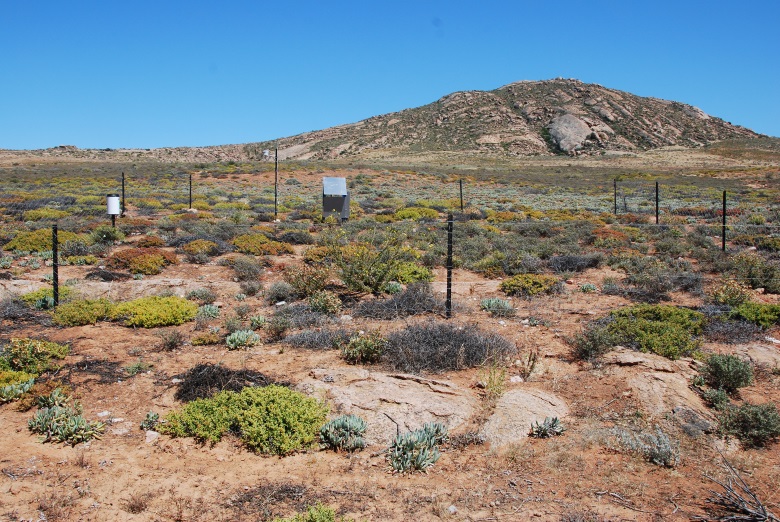
The site, where the soil moisture sensors are installed as a compound of climate stations, is protected from grazing animals by means of a fence. ©Bettina Weber

Biological soil crusts consist of a community of cyanobacteria, lichens, algae and bryophytes, together with fungi, bacteria, and archaea, which grow in the upper three to five millimeters of the soil, forming a hardened layer. They exist in dry regions throughout the world and occupy approximately 20 million square meters, which is almost as large as the surface of South America. All the organisms in biological soil crusts are poikilohydric, which means that they are only active when the soil is sufficiently moist, but survive in an inactive state under dry conditions. Continue reading “Mainz scientists develop new soil moisture sensor”