2014 Robert May Prize Winner: Laure Gallien

The Robert May Prize is awarded annually for the best paper published in Methods by a young author at the start of their research career. We’re delighted to announce that the 2014 winner is Laure Gallien, for her article ‘Identifying the signal of environmental filtering and competition in invasion patterns – a contest of approaches from community ecology.

Today, biological invasions are of major concern for maintaining biodiversity. However, understanding what drives the success of invasive species at the scale of the community remains a challenge. Two processes have been described as main drivers of the coexistence between invasive and native species: environmental filtering and competitive interactions. However, recent reviews have shown that competitive interactions are rarely detected, and thus their importance as drivers of invasion success placed under question. But can this be due to pure methodological issues? Using a simulation model of community assembly, Laure and co-authors (Marta Carboni and Tamara Münkemüller) show that the infrequent detection of competition can arise from three important methodological shortcomings, and provide guidelines for future studies of invasion drivers at the scale of the community.

Continue reading “2014 Robert May Prize Winner: Laure Gallien”

Associate Editor Profile: LOUISE JOHNSON

Dr Louise Johnson, a population geneticist working on the evolution of genetic systems, has been an Associate Editor for Methods in Ecology and Evolution since October 2013. In that time she has handled a range of manuscripts falling within her areas of expertise (primarily molecular evolution, population genetics and genomes).

Louise Johnson
Dr Louise Johnson

Louise began her academic career with a degree in Genetics at the University of Edinburgh. She then moved south to complete her PhD on the evolution of mating systems in yeast at Imperial College London under the supervision of Professor Austin Burt. Following her successful time in London, she took up post-doctorate positions at the University of Nottingham (working on transposable elements with Professor John Brookfield) and across the Atlantic at the University of Virginia (looking at genome defences with Professor Janis Antonovics and Professor Michael Hood). Louise returned to the UK in 2006 to take up an RCUK Fellowship at the University of Reading and has been there ever since.

As part of our series of Editor Profiles, we asked Louise to tell us about some of her current research:

There are three projects which I am currently working on that I would like to outline. I’ll be discussing the cancer project – or at least the story so far – at the Methods in Ecology and Evolution 5th Anniversary Symposium later this month. Do check out the programme, and I hope to see you there! The whole point of a methods journal is to help each other do our research as well and easily as possible, so there’s a built-in community spirit about MEE, which bodes well for a fun and useful meeting. Before I start I should also say that I’m lucky to have amazing collaborators at Reading and beyond: for the projects below, credit is particularly due to my colleagues Rob Jackson and Tiffany Taylor, who had a huge input, and to Mike Brockhurst at York. Continue reading “Associate Editor Profile: LOUISE JOHNSON”

Issue 6.3

Issue 6.3 is now online!

The March issue of Methods is now online!

We have three freely available Applications articles in this issue. Anyone can access these with no subscription required and no charge to download.

TR8: This R package was built to provide plant scientists with a simple tool for retrieving plant functional traits from freely accessible online traitbases.

StereoMorph: A new R package for the rapid and accurate collection of 3D landmarks and curves using two standard digital cameras.

MotionMeerkat: A new standalone program that identifies motion events from a video stream. This tool reduces the time needed to review videos and accommodates a variety of inputs.

This month we have a total of FIVE Open Access articles. That makes eight articles in this issue of Methods in Ecology and Evolution that you can read for free!

Continue reading “Issue 6.3”

Our 5th Anniversary Symposium

Charles Darwin House, London, UK: 10:00 – 18:00 (GMT) Alberta Room, Dining Centre, University of Calgary, Canada: 08:30 – 17:00 (MST) 22 April 2015 Methods in Ecology and Evolution, the British Ecological Society’s youngest journal, turns five this year. To celebrate we will be holding a joint Symposium – beginning in the UK and concluding in Canada. We will be hearing what’s in store for … Continue reading Our 5th Anniversary Symposium

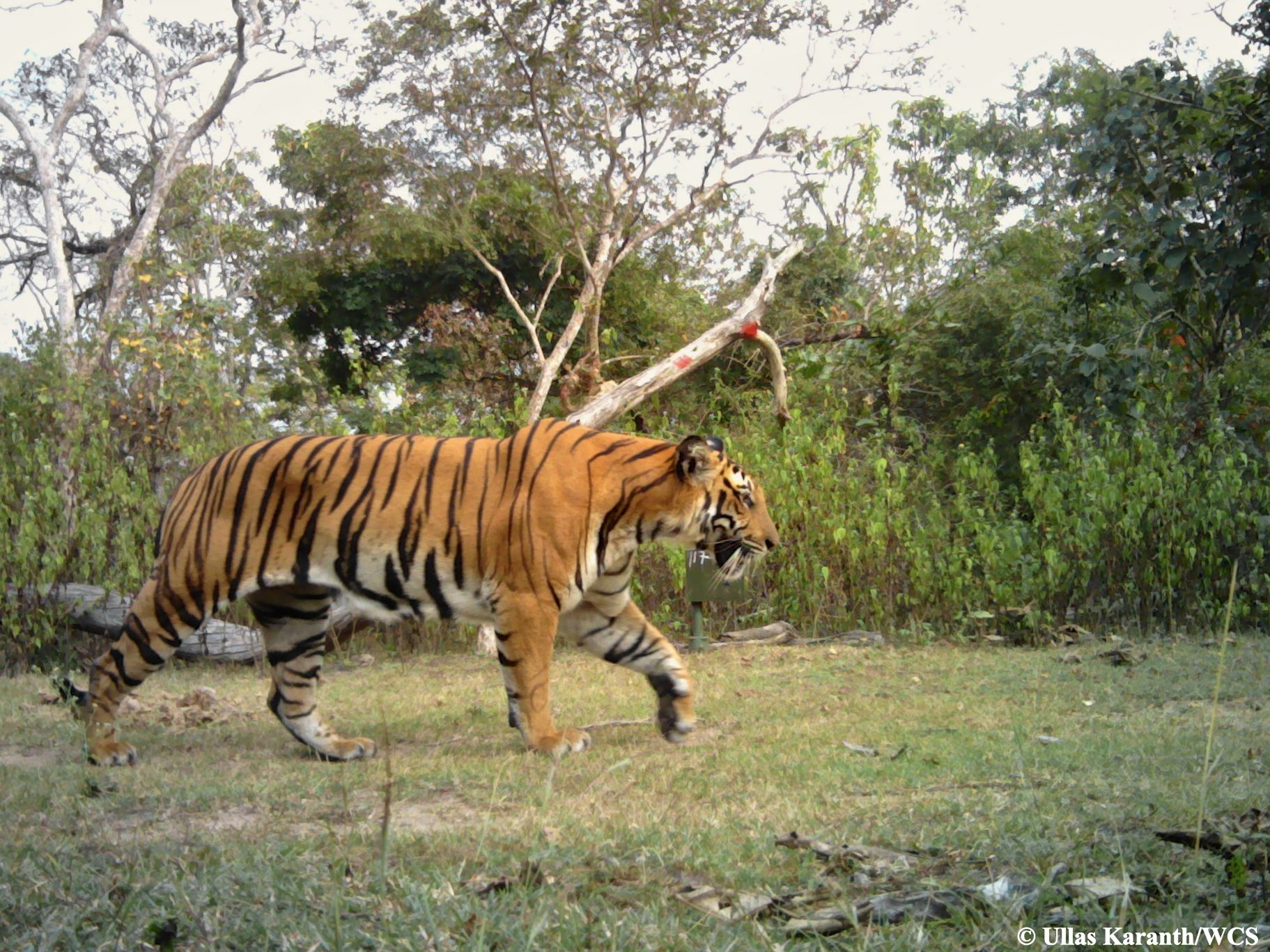
Flawed Method puts Tiger Rise in Doubt

The following is a press release about the Methods paper ‘An examination of index-calibration experiments: counting tigers at macroecological scales‘ taken from the University of Oxford News and Events page:

Flaws in a method commonly used in censuses of tigers and other rare wildlife put the accuracy of such surveys in doubt, a new study suggests.

A team of scientists from theNH_QT_K2934024 University of Oxford, Indian Statistical Institute, and Wildlife Conservation Society exposes, for the first time, inherent shortcomings in the ‘index-calibration’ method that means it can produce inaccurate results. Amongst recent studies thought to be based on this method is India’s national tiger survey (January 2015) which claimed a surprising but welcome 30 percent rise in tiger numbers in just four years.

The team urges conservation practitioners to guard against these sources of error, which could mislead even the best conservation efforts, and suggests a constructive way forward using alternative methods of counting rare animals that avoid the pitfalls of the index-calibration approach.

A report of the research is published this week in the journal Methods in Ecology and Evolution.

Continue reading “Flawed Method puts Tiger Rise in Doubt”

Issue 6.2

Issue 6.2 is now online! The February issue of Methods is now online! This month we have two applications articles. Both are free to access, no subscription required. – NLMpy: A PYTHON software package for the creation of neutral landscape models (there are also two videos associated to this paper on our Youtube channel) – BAT – an R package for the measurement and estimation of … Continue reading Issue 6.2

Thank you to our 2014 Reviewers

2014 was a wonderful year for Methods in Ecology and Evolution. We had a record number of submissions and we published some fantastic articles (if we do say so ourselves). None of this would have been possible though without the work of the people who generously provide reviews for the journal. Whether you reviewed one paper or twenty, we really appreciate your time and effort. … Continue reading Thank you to our 2014 Reviewers

Issue 6.1

Issue 6.1 is now online! Our first issue of 2015 is now online! This month we include one freely available Applications article: – A biochemical approach for identifying plastics exposure in live wildlife We also have two wonderful Open Access papers, ‘Evaluation and management implications of uncertainty in a multispecies size-structured model of population and community responses to fishing‘ by Robert B. Thorpe, Will J. … Continue reading Issue 6.1

NLMpy: a python software package for the creation of neutral landscape models

In this video Thomas Etherington shows how to use the NLMpy Python package to create neutral landscape models.  The video demonstrates how the paper’s Supporting Information documentation, Python scripts, and GIS data can be used to create a the example neutral landscape models that are shown in the paper. Recognising that some ecologists may not be very familiar with Python, the authors have also created … Continue reading NLMpy: a python software package for the creation of neutral landscape models

Issue 5.11

Issue 5.11 is now online! This month we include 2 freely available application articles: – ENMeval: An R package for conducting spatially independent evaluations and estimating optimal model complexity for Maxent ecological niche models – enaR: An r package for Ecosystem Network Analysis We also have 4 interesting open access papers, ‘The accuracy of Fastloc-GPS locations and implications for animal tracking‘ by Antoine Dujon et … Continue reading Issue 5.11